

THE
MYSTERY
Why does the Torah call
tefillin totafot and what does
the word mean?
T
THE
MYSTERY
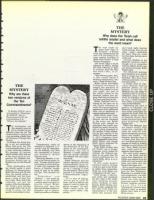
Why are there
two versions of
the Ten
Commandments?
211111111111111111
1 ---:,:
- -
4,.. -- --
. . , ....,. -
.
.,........== . . . . . „ . . - ,. _ .........
7-
... ■ --......
• ,,. -4.... '''
Itt
..:
- —
----...
• vv., •
- .„
7
• -
. Z. :: - ...-. • - - '
T
_
--
:' -
':,.. , -. -
-- -"'
'
-:: ---..- •::--'.- ■ --- . - - • -': - -•:7:2
•
"Z..
- '
- ....- --..
.....
- -- z------.
*N;;--
• ---7 :
. .. :. ■
,,
-
3:.
•
4
4,„
•
-
he investigation into
this mystery must be-
gin by considering the
different times the two Ten
Commandment versions are
cited, according to Rabbi Dan-
nel Schwartz of Temple Shir
Shalom.
In Exodus, the Jewish peo-
ple is not yet established.
When God gives the Ten
Commandments here, it is to
a more universal audience.
His message: All persons
should imitate God, and one
of the ways to do so is to re-
member the Sabbath day.
Everyone should rest on
Shabbat just as God Himself
did.
God's relationship with
the Jewish people is quite
different in Deuteronomy,
Rabbi Schwartz said. By this
time, the Jewish nation is
established and has been
given a series of rules they
are to obey. Here, God is the
redeemer, not just the
creator, of the Jewish people.
The Torah's focus becomes
not simply God's role in the
world at large, but His
specific relationship to Jews.
.
•--._ -.' ,- --. :-:---„,. : --- .:_-'7_,--,.. -i,.
--- ...,‹
z-
. . :- ....--
„ - ,. , . __ -.. .
.
In Exodus, 20:2-14, one is
commanded to "Remember
the Sabbath." But in
Deuteronomy 5:6-18, the
commandment is to
"Observe the Sabbath."
,. . - _ . :. „'- . . . :
. .- -
- : - - .- ,- -_- :-,- -- :- -z --• -.- - . . . -_-:
........ ..."....„....
....
ft..
..„
• "
.
•
..
-
---.
-
--
.,
. . , - - - . . --....
._ .-: . . , - .
,' „_: 0 Z -- . . --I'z-,..
_ --.7- ----
■
.--
,...r
...
i.r
.... - :-
..:---
."^-...- - .-
■ :;.--- * -.?"-----
. ..101- -
- -----
—..:-
-:
4.E.,......._ t
-4..,-::_:,::-.--;.--*:
;
,--,.
.-..
- .. 4.. ---,,,, •
-- ---
- ..-
-
...,.,,:
----'1"" ■
- ---___
....,
:-
II' "‘" „le: i ,_.
...I
. :. 1
• :".- " -
N.rS: .-'ices ,_-...._ .- .:.",1/4•....:.
...._:-.7'...z-.
--
. - lit -7'7-:•-
•. .I. wqs,
....r........
.?-,,..;.1
-
.
ir,
..
.
7:74...
.,
,,,,„A:...
.........
twassaiswart, i-........,.._
-.
Ar.
- -
.
--N.'. - ---...-...-..._:- - af- ::-..... -...-...
..---:„.. •
4 _, I Nez. . .4.
_ I • _, ''.`-. - . _ ',..... - _
-' - `S"...L. .. '1•*. . - 1 :-. '7%, 5
-N•-•
: --...._ .1' - -., Plb-s•:- '.2 ,....i
•
-N.„......, -V.--
--
,---:
.
,
. • .7,. J _-- --,,i „,,• • 1
,....,.... ,
..... e
N---.4 /
1 " --
1-
z .
.;41.:-
_
,i 7.1-- ■ ;-:" 1P . . "•.-,.....7*-N
-- „..--7 .1,1401'."-:-: ...
..
1- : --. .
-'
-.N.7
4.
•
-
.
'
.
.1
.
-.N.1,:'
4 .- •:"2.' ' " . 7
, .: • - ---
s 4
7 ---. • "v ■ -• ' ' - ' ---'' - 4,
•
-7-1".',.:%'s•s-....‘4
..$1 .- Z:l :-
.... - .
.1 ...1 * ;..7*.
e. ■
. ' . - . '''''' • - . . . _ . ' ' ' . ` ..• 1...
- " % - .k.: - . 1'4 - I :i! ' 11.....
Z. --.1.
Consequently, while all
mankind is obligated to re-
member God by remember-
ing the Sabbath, only Jews
are commanded to observe
the Sabbath, Rabbi
Schwartz said.
Observing Shabbat is cen-
tral to the Jewish people, he
said. "It keeps memory alive
and creates a certain feeling.
A child will remember the
beauty of Shabbat candles
being lit and, as an adult,
will feel, 'This shouldn't be
lost.' "
"Remember" and
"observe" — two words ap-
plicable to the Sabbath
—surface again and again in
Jewish ritual, Rabbi
Schwartz said. Jews also
light two Shabbat candles, to
remember and to observe.
Lighting candles on Shabbat
serves as the beginning of
the observance of the day,
while on its counterpart,
Havdalah, the end of
Shabbat, a candle signifies
that one should remember
the Sabbath will come again
next week.
Rabbi Schwartz said the
Torah's repetition of the Ten
Commandments serves an-
other purpose, in addition to
giving a message to both
Jew and gentile. This second
purpose is to emphasize the
Commandments' impor-
tance.
"It's a way of saying,
`You've got to really do
these,' just as in Hebrew one
repeats a word to make the
phrase stronger," he said.
"Maher means 'quick,' but
maher, maher means, 'very
quickly.' "
he word totafot ap
pears three times in
the Torah — in Exodus
13:16 and Deuteronomy 6:8
and 11:18, and always in the
same context according to
Rabbi Eliot Pachter of Adat
Shalom Synagogue.
The Torah makes a fourth
reference to tefillin, though
this time referring to them
as zicharon, from the Heb-
rew word l'zkor, to re-
member.
"One obvious guess, then,
is that totafot means a
memory-stimulating ele-
ment," Rabbi Pachter said.
Rabbi Akiva and Rabbi
Yishmael discussed at
length the question of
totafot. They wanted to know
why totafot, the part of
the tefillin placed on the
forehead, contain four sec-
tions while the yad, bound to
the hand, contains just one.
Rabbi Yishmael was in-
trigued by the extra vav in
one Torah reference to
totafot. He was convinced the
appearance of the additional
letter was of importance in
understanding the totafot.
Rabbi Akiva, while usual-
ly impressed by such
theories, was not interested
in the extra vav, Rabbi
Pachter said. Instead, he
postulated that totafot com-
prised two words, tot and fot,
each of which translated to
the number 2 (thus explain-
ing the four sections of the
totafot). No one knows exact-
ly what languages these
words supposedly come from,
Rabbi Pachter said, though
Rabbi Akiva indicated fot
was an African word.
While Rabbi Pachter says
the Torah's use of foreign
language would indeed be
strange, the Talmud sug-
gests at one point that the
word tot could mean two, "so
maybe Rabbi Akiva is on to
something."
In fact, some modern
scholars believe foreign
words are used in the Torah,
he added. Some researchers
think the name Moses was
an Egyptian word for "son."
Yosef Lange, a Detroit-
area scribe, also considered
the four sides of the totafot
when speaking recently
before students at Adat
Shalom, Rabbi Pachter said.
Rabbi Lange suggested the
four sides of the totafot are
representative of the four
senses that emanate from
one's head: sight, hearing,
smell and taste. But only one
sense — touch — comes from
the hand. Thus the totafot
has four sides, but just one is
on the yad.
Tractate Shabbat in the
Mishnah mentions totafot,
though not in connection
with the tefillin Jewish men
use during davening, Rabbi
Pachter said.
The MiShnah passage
gives direction as to exactly
what a woman may wear on
Shabbat. She may wear
clothing and jewelry, but not
just any jewelry.
A woman must be espe-
cially cautious wearing
precious jewelry on the
Sabbath. If this fell, the
Mishnah says, she might be
tempted to pick it up and ac-
cidentally carry it (which
would be forbidden without
an eruv, a ritual boundary
that makes it permissible to
carry on the Sabbath).
Addressing the issue of
jewelry on Shabbat, the
Mishnah specifically men-
tions totefet, presumably the
singular for totafot. That the
Mishnah advises women to
so securely fasten their
totefet must have meant they
were precious, Rabbi
Pachter said.
While the Mishnah does
not explain exactly what
totefet are —probably be-
cause the word was well-
known enough that no trans-
lation was needed — the
Gemarah describes them as
a charm worn from ear to
ear. And Rashi described the
purpose of totefet as holding
medicine to ward off the evil
eye. Thus, Rabbi Pachter
said, totefet could be con-
sidered a kind of amulet.
The word totafot appears
only in the Torah and the
prayer book. Separately, the
tefillin are referred to as the
tefilla shel cosh, bound to the
head, and tefilla shel yad,
bound to the upper arm.
But in secular texts, totafot
is translated as phylacteries,
from the New Testament.
Phylactery is related to the
word prophylactic, and both
ultimately stem from the
Greek root work phulax,
meaning guard. Rabbi
Pachter suggests gentiles
used the term
"phylacteries" because they
regarded totafot as magical
charms Jews used to ward
off the evil eye.
THE DETROIT JEWISH NEWS
23