

MONNI MUST
Special to The Jewish News
THEN
NOW
Former camper
Monni Must
returns to Camp
Tamakwa for a
nostalgic visit.
W
ho says that you can
never go back in
time? I spent a
week at Camp Tamakwa
this summer — a dream
come true. I spent 12
summers there, 20 years
ago. Twenty years ago camp
had deteriorated, and Unca
Lou died. Since then,
Tamakwa has been purchas-
ed and revived by Vic
Norris, Dave Bale and
Howard Perlmutter.
I made plans to come to
camp with Vic last
February. From February
until the day I left, a day
didn't pass that a thought of
camp didn't flash through my
mind. Before I arrived, Vic
gave me a whole shpiel
about how camp is not how I
remember it and not to go
back to relive my childhood.
I must admit I had fleeting
thoughts of "What if I'm
disappointed?" "What if it's
too dirty for me?" "What if,
what if, what if . . .?" I was
relieved when the guest
cabin had heat, was clean
and had a bathroom.
There is just the right mix-
ture of fresh, new ideas with
the comfort of tradition to
make Tamakwa the ex-
emplary camp that it once
was.
My first night there I
didn't miss a beat singing
"Taps." I crossed my arms
and swayed next to my
daughter who had just
learned the evening closing
song. Each day of my stay I
remembered more and more
songs and experiences I had
had. Funny how that works
— I can't remember where I
left my keys or wallet at
home or a movie I saw the
week before. But here, I re-
membered it all! The ex-
citement soared with each
memory.
One of my memories was of
the kitchen with Bill Cox,
the cook, and Wolfgang, the
baker. They have been
replaced by a whole staff and
a whole new kitchen, one
that is an efficient factory
which feeds 350 people at
each meal. However, by
outward appearances, the
buildings look the same.
That is the essence of what
the new Tamakwa is all
about. The guts of the
buildings have been rebuilt
while the flavor of rustic re-
mains.
The bell is still there to
signal an activity change.
But now, the bell is secured
by steel beams and no longer
swerves as you pull the rope,
leaving the person wonder-
ing if this would be the time
it would fall on him.
The arts and crafts pro-
gram? In 12 summers, I
don't recall a time I chose to
go to arts and crafts. The
camp was directed toward
water sports: Now, however,
they make and create ter-
rific projects and have real
materials! Tess Simon has
built a clay program that is
filled every activity period.
The ropes course is
awesome! And, naturally,
the tetherball courts, in
abundance, are in constant
use.
Two of the more im-
pressive things about Camp
Tamakwa of the 90s are that
everything works and the
boats don't leak. I remember
many a swim to Treasure by
a rowboat one-third filled
with green, slimy water.
Fitness has hit Tamakwa,
too! Treasure swims are
now part of the morning
workouts. Or, for those who
choose to run, a trip to the
baseball field and all
through camp is more in
order. I tried one of Vic's
killer workouts, and it was
exactly that!
Other pleasant surprises
were the spirit and warmth
of the campers and
counselors. I got to know
many of the children and
staff in my brief stay. They
embraced me and my family.
I used to think, "How
could camp be camp without
Unca Lou, Esta, Kal and
Ada?" I do miss them, but
there is new Tamakwa blood
and it's doing a fine job.
Besides, Marilyn is still
there to keep everything and
everyone in order.
I felt those heart-
wrenching throbs I used to
get at the end of each
summer. The tears flowed
when I had to leave.
Tamakwa gave me many
things: my love of lakes and
nature and the strength of
the lasting bonds one makes
with people. There was the
warm feeling I got when I
met all the kids this summer
whose parents I knew. These
kids understood the mean-
ing and intensity of being a
Tamakwan. Unca Lou would
be proud; Tamakwa is alive
and thriving — "How-How,
How-How, How-How, How-
How!" El
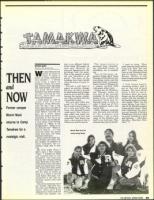
Monni Must and her
camp loving family.
THE DETROIT JEWISH NEWS
49