

CLOSE-UP
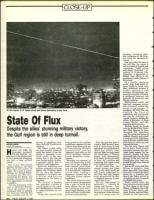
Tel Aviv skyline: A U.S. Patriot missile sails toward intercepting an Iraqi Scud.
State Of Flux
Despite the allies' stunning military victory,
the Gulf region is still in deep turmoil.
HELEN DAVIS
Foreign Correspondent
H
istory will judge the
stunningly successful
U.S.-led military en-
gagement in the Persian Gulf
to have produced something
less than a clear political
victory.
For Iraqi President
Saddam Hussein, the Gulf
War does not count as
defeat. He is still in power,
defying the United States,
taunting the Shi'ites,
tormenting the Kurds, and
perhaps preparing for his
next opportunity to menace
a neighbor.
Nor has democracy taken
root in liberated Kuwait,
where the success of the
reinstated emir in dousing
his burning oilfields has
been matched only by his
24
FRIDAY, JANUARY 17, 1992
success in expelling more
than 200,000 Palestinian
residents.
The lesson is that while
the most powerful nation on
earth has shown it has the
muscle to intervene in the
Arab world, it has also
shown that it has only the
most limited ability to affect
a political reality that is
rooted in tribal despotism.
Political analysts and
military strategists will long
debate why President Bush
did not carry the military
campaign to its logical con-
clusions and pursue
vengeance to the gates of
Baghdad.
The survival of Saddam
has unleashed a torrent of
mixed signals on the world,
but Washington's reticence
is understandable on two
levels:
Firstly, the removal of the
Iraqi tyrant by the coalition
would have appeared to the
volatile Arab street as an act
of over-arching Western
imperialism, casting
America's Arab allies in the
role of "quislings," with pro-
found domestic conse-
quences.
Secondly, his removal in
such circumstances would
have led to the collapse of
Iraq's internal power struc-
ture and the disintegration
of a strategically important
oil-rich state, creating a
dangerous vacuum and in-
viting even greater regional
instability.
The Bush administration
must be sorely disappointed
that a cadre of senior Iraqi
army officers did not seize
the initiative and them-
selves topple Saddam, an act
that would have settled both
problems simultaneously.
Even the post-war plan to
create a Gulf security struc-
ture of Arab forces to keep
aggressors out and bullies in
check has quietly been
shelved. Much as they resent
the intervention of Western
powers, Arab governments,
even allies, are not yet ready
to bury old rivalries and
suspicions that stand in the
way of effective action.
At the same time, the
seismic changes now under
way in the Arab world are
only barely understood by
the West and only tangen-
tially influenced by its wide-
ly despised message of dem-
ocratic liberalism.
The few experiments in
democracy — notably by
Jordan and Algeria — have
served only to expose the
forces of antipathetic fun-
damentalism whose declared
goal is to sweep away the
decadent, corrupting, athe-
istic influences of the West,
not least its democratic
values.
One year after the start of
the Gulf War, the region is
still in a state of turmoil and
uncertainty, "highly strung
and deeply disturbed," ac-
cording to Professor Elie
Kedourie, a specialist in
Middle East affairs at the
prestigious London School of
Economics.
In a rapidly changing
world, most Arab states re-
main unable to break with
their traditions] systems of
feudal autocracy and K
military dictatorship, ap-
parently incapable of finding
a synthesis between the
demands of modernity and
Islamic tradition.
Sophisticated armies and
high-tech weaponry remain
the principal means for
preserving power. If
anything, the Gulf War has
fuelled the fires of
radicalism and accelerated
the race for ever-more ad-
vanced weapons, despite the
efforts of Secretary of State
James Baker and the
emergent peace process.
Having wrung its hands
over the plight of the Kurds,
the West appears to have
shrugged its shoulders
over the continued tenure of
Saddam Hussein and turned
a blind eye to the determina-
tion of Kuwait and the other
Gulf states to resist any real
internal refol
For the rest, Egypt and
Syria have been richly
rewarded (because they pro-
vided token support for the
alliance), Jordan has been
welcomed back into the fold
(though it did not) and the
Palestinians have been em-
braced (though they cheered
for Saddam).
But not all of the Gulf War
fallout is negative. Just
three days after Iraq uncon-
ditionally accepted the allied
terms for a ceasefire last
March, Mr. Baker arrived in
Jerusalem to start his search
for Middle East peace.
Eight months later, his
long, tortuous journey ended
its first phase at the Royal
Palace in Madrid where offi-
cials of Israel, Syria, Leb-
anon, Jordan and the Pales-
tinians at last faced each