

Mr. Kranchik, who im-
migrated to Israel in 1990,
attended the State College of
Arts and the State Institute
of Theatre, Music and
Cinematography in Len-
ingrad.
Three panels of jurors
helped Mrs. Levin select
work for exhibition in the
United States. The artwork
was shipped overseas with
the financial help of El Al
Israel Airlines and Rosette
Pascal of Great Neck, N.Y.
"These are works of living
artists who have had the
best education and the worst
exposure," said Mrs. Pascal,
who is also arranging to
promote Soviet Jewish ar-
tists and their work in the
United States.
Mrs. Levin said she wasn't
prepared for the gap bet-
ween the two cultures. "For
Russians, life in a democrat-
ic society poses a cultural
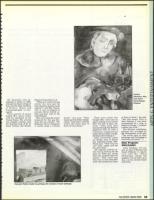
Svetlana
Ostrovsky's early
work shows
strong Russian
influence.
shock," she said. "They
cannot get rid of their deeply
rooted, mistrustful attitude
within the short time of
their arrival in Israel."
There were artists who
thought Mrs. Levin was an
agent, making a lot of money
from the sale of their art-
work. "Only after they
learned through the Russian
grapevine that we were a
volunteer organization
which did not make a profit,
did they start trusting us."
After perestroika, many
art dealers went to Russia
and exploited artists, Mrs.
Pascal said. "They'd buy for
very little, export and sell
for a great deal."
The majority of Soviet ar-
tists end up working for the
state for $200 per month
after they complete their ed-
ucation. "They would hear
from time to time that their
work was exhibited in Tokyo
or Paris or Rome," she said.
"But this meant little to
them because it was never
accompanied by a raise in
salary or a bonus — in short,
a better way of life."
The 60-piece exhibition,
selected and arranged by
Ms. Zimmerman, is for sale.
"The artists sent us their
paintings, and I'm hoping to
send back a fat check." ❑
Kids' Program
With Exhibit
Celia Goodman will pre-
sent an hour of Russian and
Israeli folktales in conjunc-
tion with the "After
Perestroika" exhibit. The
program will be held 2 p.m.
Jan. 2 at the Jewish Center
and is free.
•
Alexander Rodkov breaks his paintings with windows of Israeli landscape.
THE DETROIT JEWISH NEWS
55
ENTERTAI N MENT
O