

FINE ARTS
Clor
Theo
Of Chan e
Russian Immigrant Artists in Israel
AMY J. MEHLER
Staff Writer
T
he morning after
Yochi Levin advertis-
ed for Russian artists
on Kol Israel's Russian radio
program, she found a large
group of people lined up out-
side her office.
"They came with port-
folios, photographs, pain-
tings and a lot of hopes,"
said Mrs. Levin, an artist
and art historian from
Rehovot, Israel.
Mrs. Levin, a member of
the Israeli Artists Society,
helps immigrant artists ex-
hibit their work through the
Israeli Painters and
Sculptors Association, a not-
for-profit group in Tel Aviv.
"Israel faces a tremendous
undertaking in absorbing so
many people in such a short
time, providing housing,
jobs, education and health
care," Mrs. Levin said. "You
can imagine that the caring
for artists is not one of the
highest priorities."
In advance of a trip to the
United States to visit family,
Mrs. Levin set about arrang-
ing exhibitions.
"After Perestroika: Rus-
sian Immigrant Artists in
Israel," opened Dec. 22 and
runs through Jan. 16 at the
Janice Charach Epstein Mu-
seum Gallery at the Jewish
Community Center in West
Bloomfield. The show, which
travels from Detroit to
Boston, Pittsburgh and New
York, features paintings,
drawings and etchings of 10
Russian artists, all of whom
immigrated to Israel in the
last two years.
Mark Tochilkin, 33, from
Dniepropetrovsk in
Ukraine, immigrated to
Israel in 1990. For the ex-
hibit, he sent four oil-on-
canvas paintings of abstract
street scenes in Tel Aviv.
"Mark is a perfect example
of someone who's really ex-
cited to be free," said Sharon
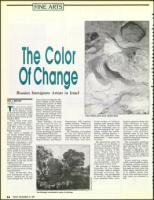
Anton Staikov paints loose, abstract birds.
broad strokes in brilliant
purples, reds, browns, blues
and yellows. English and
Hebrew billboards, such as
an advertisement for ciga-
rettes, wander the canvas.
Swirly, curling figures —
more like spacemen than
pedestrians — roam canvas
to canvas.
Ms. Zimmerman said a lot
of modern art in Russia is
easily identifiable by the
abundance of green and gen-
eral poor quality of the
paint. "That's why I was
particularly fascinated by
this exhibit," she said. "You
can see the kinds of change
— not only materially, but
also thematically — that have
taken place in their work."
The portraits of Svetlana
Ostrovsky, 28, from Odessa
in Ukraine, reflect a marked
personal evolution. Ms.
Ostrovsky, who immigrated
to Israel in 1990, departs
from painting hefty, jowly
Zimmerman, JCC museum
gallery director. "There's no
way he could've painted
scenes like this in the Soviet
Union."
Mr. Tochilkin, who studied
at the Art Institute in
Dniepropetrovsk and at the
Arts Academy in the Rus-
sian Far East, uses firm,
_c>
O
O
Ilya Steingart contributed a series of etchings.
54
FRIDAY, DECEMBER 27, 1991
Russian peasant women who
clean chickens, to light,
iridescent faces of young
girls. These images, painted
in profile, are happier,
cleaner, with straight,
abstract lines. In her later
work, almost no attention is
spent forming facial features
and costume detail.
The surrealistic paintings
of Alexandr Kanchik are the
most daring of the exhibit.
Mr. Kanchik, 32, from
Kishinev in Moldavia, uses
overblown, slothful fish as a
metaphor for the depraved
state of politics in the Soviet
Union.
Nasty-looking wasps,
snails, and armadillos gnaw
at peeling, rotting scales of
one fish. Human, boneless
feet peek out from under the
fish's angry, red-yellow bel-
ly. In another canvas, bull-
horns, tails and other animal
body parts are attached to
fish.