

UP FRONT
Vigilantes
Continued from preceding page
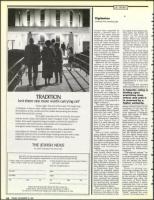
TRADITION.
Isn't there one more worth carrying on?
Friday night. The end of the week. The beginning
of Shabbat. A time to relax, reflect and renew. And as much a part of
this tradition as the candles and the challah was knowing the weekly
Jewish News had also arrived.
It brought news about the community, the nation
and the world. Today, that tradition hasn't changed. In fact, it's gotten
better. Each week award-winning journalists combine the warmth of
community with world issues using candor and compassion to
strengthen Jewish identity and...tradition.
Keep the tradition alive. Give a Jewish News
subscription to a friend, a relative, as a special gift. If you don't
subscribe, (and you find yourself always reading someone else's copy)
maybe it's time to start your own tradition. The Jewish News. It's a
tradition worth keeping.
THE JEWISH NEWS
No Other Publication Has More Faith
r
1
Save 40% over the newsstand price. Receive 52 award winning weekly issues plus
five separate Style magazine supplements for only $31.00 (out-of-state $41.00).
❑ Yes! I want to be a faithful reader of the Jewish
❑ Why should I be the only one to enjoy? I'd like to
News, I'd like to order my own subscription.
send a gift subscription.
Send my thoughtful gift to:
My Name
Name
My Address
Address
City
State
Zip
City
State
Gift card to read
Please send all payments along with this coupon to:
Jewish News, 27676 Franklin Road, Southfield, MI 48034
Or call (313) 354-6060 and charge your order to Mastercard or Visa.
L
12
FRIDAY, DECEMBER 27, 1991
Zip
always been regarded as
strictly a security issue. In
light of the recent terrorist
attacks and the increased
danger on the roads in the
territories, over the past few
weeks 35 rabbis serving the
Jewish settlements have
organized into a new body
and issued halachic (rab-
binical) rulings defining the
new situation as pikuach
nefesh, or life and death.
Without going into details,
the gist of the ruling is that
radical steps are in order.
Moreover, for the religious
settlers in the territories
(who make up some 40 per-
cent of the Jewish popula-
tion there), a halachic ruling
is more than a recommended
suggestion. It carries the
force of an obligation, giving
the rabbis considerably more
clout than the settlers' es-
tablished political leader-
ship. If the Judea, Samaria,
and Gaza Council (or set-
tlers' lobby) adopts a certain
policy, any resident in the
territories can embrace or
ignore it as he sees fit. But a
halachic ruling is binding
upon practicing Jews unless
and until it is reversed by a
higher authority.
The result has been quite
predictable. "The law is fin-
ished around here," settler
Ephraim Meir told an Israeli
journalist last week. "From
now on the law will be
perceived here according to
our ideological approach,
and that means that if
there's a clash between the
laws of the state and the
laws of the Torah, we'll give
preference to the laws of the
Torah."
Alert to such undercur-
rents, defense analyst Ze'ev
Schiff of the prestigious dai-
ly Ha' aretz has intimated
that taken to extremes, this
turnabout could generate an
Israeli version of the Hez-
bollah, and everything it
implies.
Until now, the rabbis have
been careful about issuing
rulings that require a
specific course of action. The
most prominent exception
has been the license, by
Rabbi Eliyakim Levanon of
the Samarian settlement of
Alon Moreh, to uproot trees
on Palestinian land. That
caused an extended uproar
after a group of settlers first
butchered the ancient olive
trees near their settlement,
then uprooted the saplings
planted to replace them and,
as a parting shot, arrogated
the young trees for the beau-
tification of Alon Moreh.
The upshot of this latest
ferment is a slew of new
strains on the fabric of rela-
tions between Israelis on the
two sides of the Green Line.
Once again the settlers are
openly at odds with the
army, and an oft-quoted
senior officer has already
complained about having to
allocate forces to restrain
the errant settlers, at the
expense of the security of all
the rest.
Since Chief of Staff Ehud
Barak has made it clear that
the army will not be able to
ensure absolute security in
the territories (or anywhere
else in Israel, for that
matter), some observers fear
the emergence of local
militias to fill the vacuum —
what the pols call the
"Lebanonization of Israel."
The rise of the rabbis has
also upset members of the
settlers' present leadership,
who rightly fear they may be
undermined by a more com-
pelling force.
Yet beyond the manifest
shifts and clashes, there is a
A halachic ruling is
binding upon
practicing Jews
unless and until it
is reversed by a
higher authority.
deeper political import to the
turnabout of the past few
weeks. Ostensibly, the ac-
tivist approach is designed,
plain and simple, to deter
Palestinian violence.
"The political aim of the
latest actions is to cause the
Palestinians to fear the set-
tlers more than they fear
Hamas," explains settler
Yonit Avihazar of Hebron.
But sophisticated observers
like Mr. Schiff believe that
the real signal being being
broadcast by the settlers is
not just to the local the Pa-
lestinians but to the Israeli
government, and the real
issue at hand is less security
for Israelis today than
autonomy for Palestinians
tomorrow.
"The settlers' actions," he
writes, "are designed to say
to the government, the IDF,
and the public at large: We
will not permit the estab-
lishment of Palestinian
autonomy in the ter-
ritories."
There is strong cor-
roborating evidence for this
view. While Eliyakim
Rubinstein was negotiating
in the corridor of the State
Department last week, the
new body of West Bank
rabbis published a letter
imploring him "not to lend
your hand to the dangerous
autonomy program," and
forces signing themselves as
"Kach" sprayed the word
"traitor" on his front door. ❑