

NTE TAI NM EN
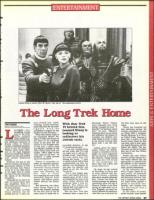
Leonard Nimoy as science officer Mr. Spock in Star Trek VI: The Undiscovered Country.
The Long Trek Home
TOM TUGEND
Special to The Jewish News
os Angeles — As a
struggling young
actor in the early
1950s, Leonard
Nimoy, inspired by
the rebirth of the Jewish state
and childhood memories of
Zionist rallies in Boston
Garden, considered moving to
Israel to join the Habimah
Theater. Upon cooler reflec-
tion on the huge language
barrier he would face, Nimoy
dropped the idea and headed
west toward Hollywood
instead.
Whatever the loss to the
Hebrew theater, the decision
guaranteed millions of Star
Trek devotees that Nimoy
would be at the right place
at the right time to create
the role of the semi-immortal
Mr. Spock of the Starship
Enterprise.
Although he can never es-
cape his pointy-eared alter
ego completely, there is a
great deal more to Nimoy as
an actor and man.
An old friend, novelist
Diane Johnson, has de-
scribed him as "a nice, ear-
L
nest Jewish boy, hard-
working, family-oriented,
under-educated for his intel-
ligence, with the
autodidact's respect for the
intellect and for literature."
What does Nimoy think of
the thumbnail sketch? Sit-
ting in T-shirt and shorts on
the patio of his rambling
house in the posh Bel Air
section of Los Angeles earli-
er this year, a scuba mask
and Matkot paddles on the
table, Nimoy leans back and
laughs. "She's right on the
nose, right on the nose," he
exclaims. "I really screwed
up on my education."
Nimoy is unusually re-
laxed. As executive produc-
er of Star Trek VI: The Un-
discovered Country, released
two weeks ago7 he has spent
much time promoting the
film. And, of course,
he is reprising his role as the
eminently logical, half-
human, half-Vulcan science
officer aboard the Enter-
prise.
But otherwise, the relent-
lessly driven Nimoy is at
peace with himself, perhaps
for the first time in the 43
years since he made the ir-
With Star Trek
VI behind him,
Leonard Nimoy is
looking to
rediscover his
Jewish roots.
revocable decision, at age
17, to become an actor.
"I am now turning down
all new work, and I've told
my agent not to call me for
at least a year," says Nimoy,
his lean, grave face val-
idating his words. "I want
to spend a great deal of time
re-examining my life, my
identity, my Jewishness. In
the past, my identity was
based on my job, but now
I'm secure.
"I'm a very happy guy,
with a new family and no fi-
nancial cares. At 60, I have
accomplished far more as an
actor, writer, director and
producer than I ever ex-
pected. The tables are
cleared and I am open to in-
spiration and choice."
Has the Star Trek phe-
nomenon been a curse or a
blessing? "Both," Nimoy
says jokingly but then
quickly changes his tone. "I
shouldn't be facetious about
this," he says. "[Spock's
fame] has given me an entree
and influence, the chance to
translate my abilities into
other kinds of work, to play
in the theater because they
know that I can sell tick-
ets."
Indeed, given the oppor-
tunity, Nimoy has demon-
strated a versatility even he
might not have suspected.
He has become a respected
film director, listing among
his credits Star Trek III and
/V, the blockbuster hit
Three Men and a Baby and
Funny About Love.
On stage, he has starred
on Broadway in Equus and
as actor, director and pro-
ducer of Vincent, a one-man
play about another alienated
hero, Vincent Van Gogh. He
derived perhaps his greatest
satisfaction from the role of
Thvye in Fiddler on the Roof
during an eight-week run in
New England, not least be-
cause it allowed his parents to
view their son as an actor for
the first time since he left
home.
Nimoy has branched out
into television movies. He
warmly remembers his part
as Golda Meir's husband,
Morris Myerson, in A Wom-
an Called Golda, because it
gave him a chance to both
revisit Israel, where the film
was shot, and to play oppo-
site Ingrid Bergman, shortly
before her death. The per-
formance as Morris brought
him one of his four Emmy
nominations.
Earlier this year, Nimoy
scored a critical success in a
role which offered him the
opportunity to express both
his affinity to the stubborn
loner in a hostile environ-
ment, and his Jewishness.
In the television movie
Never Forget, based on ac-
tual events, he portrayed
Mel Mermelstein, a 64-year
old Holocaust survivor, who
won a dramatic and drawn-
out legal battle against a
group of neo-Nazi revi-
sionists, who claimed that
the Holocaust was a
"Jewish hoax."
In the midst of profes-
sional success, some painful
THE DETROIT JEWISH NEWS
67