

7.1010764
SOUTHFIELD:
AT RISK?
Just northwest of downtown Philadelphia
rests a quaint urban neighborhood
that is integrated -- by choke.
MT AIRY, PENNSYLVANIA
P
KIMBERLY LIFTON
Staff Writer
Jewish
Philadelphia
Mt. Airy, with a population
of about 34,000, is located
within Philadelphia proper
at the northwest fringes. Its
housing stock is diverse,
ranging from large Penn-
sylvania stone houses to
apartments to dilapidated
row houses.
Philadelphia's Jewish
population is estimated at
250,000, with half living
within city limits, but not in
any of the original Jewish
neighborhoods.
hiladelphia — Gisha and Dr.
Raymond Berkowitz lived in
the Mt. Airy, Philadelphia'
neighborhood for 10 years
when they decided to move
to suburbia in the early
1960s.
Once a place boasting of a
vibrant Jewish community
with six temples and syn-
agogues and a bustling Jew-
ish community center, Mt.
Airy, like other sections of
Philadelphia, was losing
Jews and institutions to
suburban exodus.
The new suburbanites
came from all over
Philadelphia, and they
echoed a common concern
about the old Jewish neigh-
borhood. It was becoming
more integrated with black
families and other
minorities. They feared
crime was on the rise and
urban schools were on the
brink of disaster.
The suburbs seemed like a
nice, safe place to raise their
three sons, and the
Berkowitzes put down a de-
posit on a house in Mon-
tgomery County. But one
day, on a drive through the
area, they changed their
minds.
"We just couldn't do it,"
Gisha Berkowitz said. "It
felt sterile in the suburbs."
Today, the Berkowitzes
remain in Mt. Airy, about an
8-square-mile eclectic com-
munity of 34,000 residents.
Their large Pennsylvania
stone colonial, built in 1937,
is filled with Jewish draw-
ings and African oil pain-
tings — symbolic of the
community's charm.
Mt. Airy is a neighborhood
almost totally integrated,
about half black and half
white. About one-fourth are
Je-wish. Walking their dogs
on the street are people of all
colors and religions. They
live side by side, their chil-
dren play together, and they
work together on community
boards.
"It has an ethos of its
own," said longtime resi-
dent Miriam Gafni, an at-
torney active in the organiz-
ed Jewish community and
former president of Mt.
Airy's only remaining syn-
agogue, the Germantown
Jewish Centre. "The Jewish
community has stabilized.
Whites sell to blacks. Blacks
sell to whites. People move
in and out. Mt. Airy is on the
cutting edge. It is pro-
gressive."
Many Jews fled the area in
the 1960s, as did all but the
one synagogue, German-
town. Yet during the flight,
affordable housing and
grass-roots campaigning
helped stabilize Mt. Airy —
today a national model of in-
tegration.
Along the way, Mt. Airy
has attracted a new genera-
tion of Jews, who have made
conscious decisions to live in
an integrated area and at
the same time, guide it
through a Jewish rebirth.
Some Tension,
But Interaction
"We have drugs, we have
crime and the economics of
the society affect us, too,"
said Ernie Covington, 35, a
mortgage banker who grew
up in Mt. Airy. "The differ-
ence is that we talk about it.
We try to change things."
Mr. Covington is president
of the East Mt. Airy
Neighbors, one of many
community groups. His
family members were the
first blacks on the block
when they moved to Mt.
Airy in 1961. He wouldn't
live anywhere else.
"We have some racial ten-
sion here and I'd be lying if I
said there was none," he
said. "But other people don't
talk about it. We interrelate
with each other on a regular
basis, and we are always
working on improving it."
On any given weeknight,
community meetings are
under way in Mt. Airy.
Among the groups are East
and West Mt. Airy
Neighbors associations, the
Northwest Interfaith
Movement, the Jewish
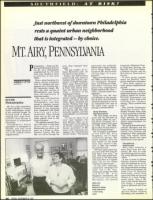
Gisha and
Raymond
Berkowitz display
multi-cultural art
in their living
room.
Community Relations Coun-
cil Northwest Division, the
West Mt. Airy Town Watch,
a feminist minyan, and the
Northwest Interschool
Council.
In each group, agenda
issues are plentiful. Some
groups need more volunteers
— more block captains to
make certain neighborhoods
are safe.
Parent-teacher organiza-
tion meetings are so well at-
tended that people can't find
parking spaces for blocks.
Political statements run
rampant. Even some local
churches don stickers
stating, "This a nuclear free
zone."
The Jewish Community
Relations Council Nor-
thwest Division drew close
to 20 at a meeting in October
at the Berkowitz home.
Their speaker: Dr. James
Lytle, the northwest district
school superintendent for
Philadelphia.
The group discussed multi-
cultural education and the
teaching of Afro-American
history, race relations and
integration. How could they
help, they asked? White
children . should also learn
black history, they agreed.
Ultraliberal .
And Jewish
With their seminary a
short drive from the com-
munity, Mt. Airy is a pop-
ular dwelling place for aspir-
ing young Reconstructionist
rabbis.
It also is home to Zalmon
Schacter, formerly of Boston,
who was ordained as an Or-
thodox rabbi, and is one of
the self-proclaimed founders
of the Chavura movement. He
leads P'nai Or Religious
Fellowship, which rents
space and holds services and
classes at a local Presby-
terian church. Also in Mt.
Airy is the Jewish Renewal
Life Center, a progressive
yeshiva affiliated with P'nai
Or.
Art Green, founder of
Havurot Shalom religious
fellowship and president of