

FINE ARTS
Art in the Computer Age
Ilene Schuster controls millions of colors
with an electronic palette.
AMY J. MEHLER
Staff Writer
W
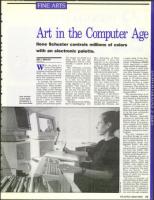
Ilene Schuster
creates digital
photography in
her home studio.
ith the press of a
button, Ilene Schus-
ter is the captain of
hundreds of millions of colors.
With the whirling, zig-
zagging motion of her stylus,
she is the conductor of hun-
dreds of artists' tools.
In seconds, she activates
palettes of brilliant and
muted colors. When needed,
she designs a paintbrush's
width, shape or size. Various
computer modes attach diff-
erent characteristics to her
stylus, a pen that simulates
the function of an airbrush,
pencil, a piece of sculpting
equipment, even trans-
parent, wet and smear paints.
The images are stored on a
floppy disc and shot onto
photographic film by a film
recorder, a special kind of
camera.
Mrs. Schuster controls
paint transparency and
brush density with her
stylus and a flat, desk-top
digitizing tablet. The stylus
is connected to her computer
by a cord. As her stylus
whizzes across the tablet, an
image appears on a color
graphics video monitor. If
set for wet paint, for exam-
ple, the pen will smear the
colors on the monitor. Mrs.
Schuster can custom design
brushes, stretch and shrink
areas, blend, stipple, even
watercolor.
"My options are so endless,
they're mindboggling," said
Mrs. Schuster, of West
Bloomfield. "I have the
capacity to do everything
with the computer that other
artists do with their tools.
The difference is I can work
with a multitude of colors
and tools at the same time."
An instructor at the
Center for Creative Studies
College of Art and Design in
Detroit, Mrs. Schuster first
saw how state-of-the-art
computer technology
transformed art when she
was a graduate student at
the Massachusetts Institute
of Technology in Boston.
" 'Welcome to the future!'
read the entrance sign to a
series of rooms in 1978
which astounded the eye and
sparked the imagination,"
recalled Mrs. Schuster, also
a guest artist of the Envi-
ronmental Research In-
stitute of Michigan (ERIM),
which specializes in outer
space satellite photography.
One among a small cadre
of advanced, avant-garde ar-
tists, Mrs. Schuster witness-
ed robots painting 10x15
inch canvases, arrays of
paint in 12 million colors,
realistic images instantly
transferred into a super
computer for further en-
hancement. This was the na-
- ture of the Architecture
Machine Group at M.I.T. in
the late 1970s.
"The characteristics of ad-
vanced imaging technology
had reached a high level of
maturity," Mrs. Schuster
said. "This sophistication,
combined with the vast in-
fluence of computers on
society, convinced- me that
these tools had the potential
to be the most artistically
significant of our time."
Mrs. Schuster, classically
trained in painting and
drawing from her years at
Wayne State University,
never thought she'd forsake
the paintbrush and pencil
for the sterile touch of the
computer keyboard and stee-
ly stylus.
"The term 'computer art'
too often brings to mind
plotted mathematical curves
and transformations of a
photographic image into
digitized blocks," she said.
"This was actually
characteristic of computer
art from the 1960s. The
computer today is a genuine-
ly lovely and profound tool."
The computer, she says, is
the Leica or Rolls Royce of
artists' tools. "They are
complex, rich in variety and
subtlety, more organic, and
far more flexible than
earlier computers,"she said.
They are fertile, "with
creative potential the boun-
daries of which are beyond
our comprehension."
Having developed an
understanding of these tools
- and their potential societal
ramifications, Mrs. Schuster
iu CD said she was able to predict a
computer war. "I understood
that the public would receive
• war news through computer
THE DETROIT JEWISH NEWS
71