
GIFT GUIDE ❑ GIFT GUIDE ❑ GIFT GUIDE ❑ GIFT GUIDE ❑ GIFT GUIDE ❑ GIFT GUIDE ❑ GIFT GUIDE ❑ GIFT GUIDE ❑ GIFT GUIDE ❑ GIFT GUIDE
O
Q
—
=
.44.:3Sli.lpfrt. /.***.4S1riiii
........44.4444
- WatlA
a■ JO
„
1-• ■ •••
A
r t .■
N/M11111111111111111111Minua
N
...\\\\
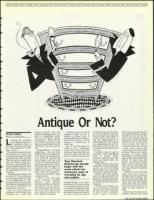
Antique Or Not?
DENNIS O'BRIEN
Special to The Jewish News
L
ooking for antiques
from America's past can
be anything from a
pleasant afternoon browsing
at a flea market to a full-
blown mania.
Buying an antique can also
be hazardous to both your
wallet and your ego if you find
yourself stuck with a phony.
Whether you are wondering if
that old family chest is a
valuable or are seriously look-
ing for a specific piece for your
early American kitchen, a lit-
tle knowledge can save a lot
of money.
Although some dealers will
consider a 5-75-year-old piece
as an antique, most don't app-
ly the designation to any-
thing less than 100 years old.
Some dealers also specify that
the piece be handmade, not
produced in a factory.
Lest you have visions of
picking up something really
valuable at a local flea
market, dealers say the
chance of finding a really rare
piece in magnificent condi-
tion is, to be polite, almost
nonexistent. "Most of the
very finest pieces have long
ago been squirreled away by
museums," one dealer points
out.
Distinguishing — or at least
suspecting — the real from
the fake will involve detective
work. In the case of furniture,
your Sherlock Holmes-ing
should begin with the wood
which has numerous ways of
revealing its age and origins.
Wood shrinks with age; it is
relatively soft; it holds tool
marks and scars; it wears
away with use; it discolors.
Here are the telltale signs
of authenticity:
• Years of use will make
wood surfaces smooth.
Because wood absorbs
moisture and then releases it,
the surface will be uneven,
but still smooth. Round sur-
faces, like chair legs, turned
on a lathe have usually lost
their perfect roundness.
• Almost as soon as wood is
exposed to light and air, it
begins to change color. A
marked difference in shade —
say on drawer fronts — would
indicate a replacement of
some sort.
One of the first places to
check is the "secondary
wood." This is the wood that
has been protected from ex-
posure to light, like the bot-
tom of a drawer. Compare an
Your Sherlock
Holmes-ing should
begin with the
wood which has
numerous ways of
revealing its age
and origins.
exposed section to an unex-
posed part of the same piece
— for example, bottom or back
of a drawer compared to the
exposed back of the chest. The
protected drawer back should
be lighter than the back of
the chest. If it is not, the piece
is not old. Where wood has
been shielded from light by
another part of the piece —
say, the underportion of a
folded table leg — the color of
the exposed portion will be
noticeably darker. If the col-
or is the same, the piece is not
very old.
• Another sign of age is
assembly with hand-forged
nails or screws. Their
presence indicates that the
piece was made before the
machine age.
• Older furniture was hand-
made; thus, corners and edges
usually are not razor sharp.
Sharp edges are a sign that
the piece is machine-made.
• Solid wood was usually
used to make genuinely old
furniture. Veneers came later.
Obviously, plywood and parti-
cle board are never found in
antiques.
• Swing out movable por-
tions of furniture and pull
open drawers. You should not
be able to find a manufac-
turer's plate anywhere.
Drawers are opened and clos-
ed hundreds of times, so there
should be wear on the bot-
toms of the runners and on
the guides. Chairs and stools
will show wear on the stret-
chers where the feet of
countless sitters have rested.
Look at the wood on the
lower portion of a chest, table
or chair. Floors were water-
mopped to clean them
thoroughly 100 to 200 years
ago, and the mop often hit the
bottom of chair legs and
tables, discoloring them.
There will be wear near the
feet, and the stain from the
wet mop will have darkened
the wood.
• If there are "worm" holes,
make sure they don't go
straight into the wood. If they
do, they were probably put
there with a drill to make the
wood look older. The insects
which bore real holes enter
the wood and then turn at an
angle as they continue to
bore.
Restoration of antiques is a
delicate balance. Too much
THE DETROIT JEWISH NEWS
Scanned image of the page. Keyboard directions: use + to zoom in, - to zoom out, arrow keys to pan inside the viewer.
November 29, 1991 - Image 115
- Resource type:
- Text
- Publication:
- The Detroit Jewish News, 1991-11-29
Disclaimer: Computer generated plain text may have errors. Read more about this.