

OPINION
A Rabbi Is Targeted
By Religious McCarthyism
GARY ROSENBLATT
Editor
Rabbi Shlomo
Riskin does not
look like a
heretic. He is a
short, cherubic-
faced man in his
early 50s who
wears a large,
knitted kippah and a smile
that makes Magic Johnson
look downright glum.
But the appearance of
Rabbi Riskin for a lecture
last week stirred a con-
troversy that is but a
microcosm of a much larger
ideological battle taking
place daily, in Israel and
America. It speaks of a
triumphalism among the
right-wing, or fundamenta-
list, Orthodox camp that
seeks to discredit those who
do not share their views —
and the method employed
too often is not intellectual
debate but threats and scare
tactics.
One of the best known Or-
thodox rabbis in the world,
Shlomo Riskin is a graduate
of Yeshiva University,
where he received ordina-
tion, and made his name by
transforming a tiny, Con-
servative congregation on
Manhattan's Upper West
Side into one of the largest
and most vibrant of Or-
thodox synagogues.
Lincoln Square Synagogue
now boasts 3,000 members,
many of them singles and
many of them ba'alei
teshuva, or non-observant
Jews who have become Or-
thodox. Much of the syn-
agogue's success is due to
Rabbi Riskin's blend of per-
sonal warmth and his in-
sights into helping modern,
secularly educated Jews find
meaning and fulfillment
through Torah study and
observance.
During his tenure, he cre-
ated an adult studies in-
stitute at the synagogue
which continues to attract
hundreds of people to classes
and lectures six nights a
week, and founded several
yeshivot in New York.
Eight years ago, the rabbi
left Lincoln Square to help
found the city of Efrat, on
Israel's West Bank, and he
now serves as its chief rabbi,
in addition to operating
separate yeshivot for young
men and women, from Israel
and the Diaspora.
Why, then, has he been la-
beled a heretic by several of
Israel's Torah sages?
It's a critical question, and
not easy to answer. Osten-
sibly, Rabbi Riskin was
branded a kofer, or heretic,
several years ago for in-
viting Nechama Leibowitz,
an Israeli Torah scholar now
about 85, to lecture at his
yeshiva in Israel.
The problem is that
Nechama Leibowitz is a
woman, and the fundamen-
talist camp of Orthodoxy
bans the mixing of the sexes
for Torah study.
In addition, some of the
Parshat Hashavuah, or
Torah portion of the week,
columns that he writes for
this and several other Jew-
ish newspapers have been
It's time for our
religious leaders to
stop shrugging
their shoulders and
speak out.
considered offensive in their
descriptions of the Patriar-
chs and Matriarchs.
But the real issue is that
Rabbi Riskin represents a
brand of Orthodoxy that
seeks to blend Torah and
modernity, not only
tolerating secular education
but valuing it, and this ap-
proach is considered highly
dangerous to those on the
right who view Western cul-
ture as seductive and im-
moral.
He is an unabashed
Zionist, teaches Torah and
Talmud to women, advocates
tolerance and believes in
moderation, not out of lack
of commitment but as a
sacred principle, in the spirit
of Maimonides.
These views are in opposi-
tion to the fundamentalists
who point to the lack of
values and morality in our
culture and sincerely believe
that the only way to protect
Orthodox Jewry is to build a
protective wall between the
Jewish community and the
outside world.
Rabbi Riskin would argue
that American culture is too
pervasive to be ignored. At-
tempts to ban televisions,
eschew the workplace and
prohibit university atten-
dance are doomed, he be-
lieves, because they are im-
practical — and because it is
better to confront a
challenge than avoid it.
His approach is embodied
by Yeshiva University,
whose motto is Torah
U'Madah, "Torah and
secular knowledge," asser-
ting that the study of world-
ly wisdom enhances Torah.
Each of the two views has
merit and deserves discus-
sion. What is disturbing is
the lack of tolerance by the
fundamentalist camp for the
centrist view.
The night before his
scheduled appearance in
Baltimore, Rabbi Riskin
shared a platform in New
York with Dr. Ruth
Westheimer, discussing
Jewish approaches to sex-
uality.
Telegrams poured in all
day from fundamentalist
rabbis and yeshivot denoun-
cing Lincoln Square Syn-
agogue for sponsoring the
program. In the end, the
program was moved across
the street to a public school
auditorium, in part to ac-
commodate the overflow
crowd of 1,300 and in part to
remove the onus from the
synagogue.
Rabbi Riskin said that
while he was uncomfortable
with some of Dr. Ruth's ex-
plicit language, he felt the
evening was valuable be-
cause it attracted a large
segment of young Jews,
many not observant, and ex-
posed them to a Jewish point
of view in which he em-
phasized the importance of
"sacred sex" rather than
"safe sex."
In Baltimore, when it
became known that Rabbi
Riskin was invited to lecture
at an Orthodox synagogue
on the topic of Arabs and
Jews, there was an immedi-
ate rumbling in the funda-
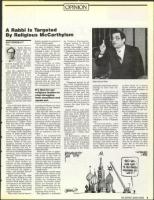
Rabbi Shlomo Riskin
mentalist community and an
attempt to have him dis-
invited.
(In the interest of
disclosure, I should note that
I was on the synagogue
committee extending the in-
vitation to Rabbi Riskin.)
An anonymous flyer was
circulated in some Orthodox
shuls noting that Rabbi
Riskin had been labeled a
heretic by several Torah
sages and urging the spon-
soring congregation to res-
cind its invitation. The
notice was signed,
"Members of the Congrega-
tion."
Unfortunately, this
episode is not atypical and is
not confined to either
Baltimore or Rabbi Riskin.
Rabbi Adin Steinsaltz, the
brilliant translator of the
Talmud into Hebrew and
English, has also been bann-
ed as a heretic for some of his
writings. And those who do
the branding are not on the
fringe. They include rabbis
like Eliezer Schach, the yen-
erable head of a major
Israeli yeshiva and one of
the most revered leaders of
the Torah world.
It's time for our religious
leaders to stop shrugging
their shoulders and speak
out against this brand of re-
ligious McCarthyism — an
effort to label anyone with a
different hashkafa, or ap-
proach, as non-Orthodox or
heretical, and thus not wor-
thy of a response.
Such behavior flaunts our
tradition, which has not only
tolerated but celebrated dif-
ferences of opinion among
rabbis and scholars whose
common goal is to bring
Jews closer to Torah. The
pages of the Talmud are fill-
ed with the give-and-take of
such disputes.
Indeed, there has always
been more than one path to
the Torah. Those who seek to
cut off each path but their
own do no service to their
cause. For in the end they
will only be speaking to
themselves.
❑
illes CLOD...
(1"
AWAY! '
ME NEW igit4Li
MEMS4DOR val.
LOVE iT!
'
(
r---
THE DETROIT JEWISH NEWS
7