

"Our focus is on creating a
connected, interacting com-
munity where everyone par-
ticipates. We could not survive
if our members only showed
up three days a year."
For the most part, services
at T'chiyah are much like ser-
vices at a Reform or Conser-
vative congregation, depen-
ding on who leads the service
and how it is structured.
At the beginning of the
Torah service, rather than
march with the Ibrah in a pro-
cessional, congregants hand
the Torah from person to per-
son, from row to row, until it
makes a complete circuit of
the room. On the High
Holidays, all congregants who
have a shofar are invited to
come forward and play
together.
The quintessential T'chiyah
event is the bar or bat mitz-
vah. Unlike b'nai mitzvah in
many congregations, who read
a small part of the Torah
reading or the haftorah, b'nai
mitzvah at T'chiyah usually
lead all or most of the entire
Saturday morning service.
"Todd Schenk was our first
bar mitzvah, and he set a
standard that other people
have tried to follow," Ms. Har-
ris says. "Todd designed and
led the entire service, the en-
tire Torah portion, and the
haftorah — he did everything.
"We don't have a lot of
policies, but we do have a bar
and bat mitzvah policy that,
in typical T'chiyah and
Reconstructionist fashion, we
developed after a long period
of study and discussion," she
adds. "Once someone came to
us and said, 'I want my son to
have a bar mitzvah but I'm
not interested in joining. I just
want your hechshir (stamp of
approval)! We debated long
and hard over it, and finally
said no!'
"My bar mitzvah was very
moving," says Todd Schenk's
brother, Matthew, a student at
the University of Michigan.
"All my life I had been part of
this congregation where par-
ticipation was so highly stress-
ed, and now it was time for me
to come and accept my respon-
sibilities. We were all in tears
by the end!"
In many ways, Congregation
T'chiyah comes closer to the
Reconstructionist ideals of
diversity and community
transcending denomination-
alism than any other Recon-
structionist congregation in
the country — in part because
many of its members do not
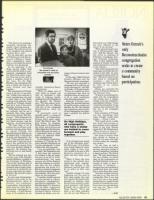
The Schenks:
"We wanted to create an
atmosphere that was family
oriented."
consider themselves Recon-
structionists.
"When we began, part of
what made us unique was
that we welcomed a wide
range of religious beliefs,
ranging from the Orthodox to
the agnostic," Mr. Hansell
says. "For that reason, we in-
tentionally did not affiliate
with any of the recognized
denominations when we
began.
"I personally tend to
describe myself — in terms of
observance — as Conservative,
because that's easily under-
stood," Ms. Harris says. "We
keep kosher, my daughter,
Molly, goes to a Conservative
day school, and so did my son
Adam before her. But the prin-
ciples of Reconstructionism, as
I understand them at least,
explain my approach better
than anything else!'
Al and Harriet Saperstein,
members of T'chiyah for 12
years, describe themselves as
"secular and agnostic" in their
background and approach.
"I am not profoundly God-
oriented," Mr. Saperstein says.
"I don't deny the existence,
but neither is She an impor-
tant part of my life. If, by Re-
constructionist, you mean
someone who follows Kaplan's
idea that Judaism is a civiliza-
tion, then yes, I'm a Recon-
structionist and proud of it.
But if you choose to emphasize
the religious aspects of Recon-
structionism, then I'm some-
where on the periphery!"
"I consider myself a secular
Jew who belongs to a Recon-
structionist congregation,"
says Harriet Saperstein. "On
the other hand, I've learned to
love our fellow congregants,
and to respect our differences.
As long as they're willing to
tolerate our doubt, we're cer-
tainly willing to tolerate their
faith!'
In the early 1980s T'chiyah
formally affiliated with the
Reconstructionist movement.
"We were not interested in
changing to fit in with any na-
tional organization," says Bet-
ty Schenk, a T'chiyah founder.
"But as we studied the issue,
we discovered that what we
had been doing all along real-
ly fit in quite comfortably
with Reconstructionism."
Although T'chiyah's mem-
bership has hovered between
35 and 50 singles, couples and
families for the last decade,
the composition and character
of the congregation has under-
gone a gradual but definite
change.
On High Holidays,
all congregants
who have a shofar
are invited to come
forward and play
together.
"A lot of people have moved
out of the downtown area,"
Ms. Harris says. "A lot of them
were young couples in transi-
tional stages in their lives,
who wanted to be part of this
downtown community for a
while and have since moved
on.
"Many of those who have
moved to the suburbs have
maintained their member-
ships; but because of the
distances involved they can't
be as active as they once
were!"
"Another change I've seen
happening over the years is
that many people who may
have joined with limited back-
grounds in Judaism have
become more attuned to tradi-
tional practices," adds Raina
Ernstoff, who is married to
Sandy Hansell. "We've had
quite a few adult members
who did not read Hebrew at
first and do now. That change
has been reflected in the
nature of our services!'
"We're going through a pro-
cess of self-evaluation right
now," adds Mr. Hansell, who
also serves as chairman of
T'chiyah's Long-Range Stra-
tegic Planning Committee.
"Part of that addresses the
question of whether we should
remain downtown or move out
to the suburbs.
"One of the things that the
long-range committee has con-
cluded is that after 14 years
our group has gotten tired," he
says. "We have to attract some
new blood to reinvigorate
ourselves — and I'm not
altogether sure we'll be able to
do that if we remain
downtown."
Others are convinced the
future of T'chiyah belongs in
the downtown area.
"It says in our guiding prin-
ciples that the congregation
will always have a respon-
sibility to the city of Detroit,"
says Matthew Schenk. "I have
a hard time seeing how we can
continue that connection with
the city if the synagogue
moves out."
Some members of T'chiyah
are also considering what
many thought would never
happen — hiring a rabbi.
"This would not be a rabbi
who would lead services, or
give sermons, or be a spiritual
leader of any kind. Nobody
wants that," Mr. Hansell says.
"What we have in mind is a
part-time resource person."
One thing is certain: those
who choose to belong to
T'chiyah will never lose sight
of what makes the congrega-
tion unique.
"At one time we had a
member, who has since pass-
ed away, who had a number of
physical disabilities, including
a speech problem," Ms. Harris
says. "We were discussing at
the time whether we should
open up the congregation on
the High Holidays to the corn-
munity at large, or keep it
restricted to members —
because there are hundreds of
unaffiliated Jews who would
like to come three days a year.
"And this member stood up
and said to us, 'But here I'm
comfortable. Here I can sing
out.' If you have a few people
performing at a pulpit for the
benefit of hundreds they don't
know, then you can't stand up
and sing out. That's what
we're all about." ❑
Metro Detroit's
only
Reconstructionist
congregation
seeks to create
a community
based on
participation.
M.W.
THE DETROIT JEWISH NEWS
31