

Today's fireplaces are
surrounded by an astonishing
array of materials.
pre-engineered fireplaces offer fac-
ings as options.
There is a slight leaning toward the
traditional looks like Mount Vernon
and Williamsburg designs, but peo-
ple are interested in Victorian, coun-
try French, even Art Deco.
which to "face" or surround their
fireplaces. Today, a fireplace can be
attired to blend with any type of
room decor.
Indeed, with all the new options on
the market, older fireplaces are get-
ting facelifts to blend with remodeled
or redecorated interiors. Peter Stuart,
of Federal Fireplace, notes that his
store offers more than 100 types of
glass enclosures.
Brick is the most traditional and ver-
satile material, but marble, granite,
slate, fieldstone, even concrete, quarry
tiles and adobe, are also used, de-
pending on the interior design.
Stone can be left natural or pol-
ished. It can make a fireplace look
rustic, or be highly stylized or carved
for a contemporary effect. For the
look of stone without its weight or
cost, stone veneers in a variety of
realistic finishes are attracting interest.
Smooth and sophisticated, marble
is equally at home setting off a sleek
contemporary fireplace or compli-
menting a traditional design. Marble
is often used to butt-up to and sur-
round the firebox, Mainly, Italian mar-
ble is used, and it comes in white, al-
mond, gray, green, brown, black and
a number of other variations.
Some people like the traditional
look of custom woodworking, parti-
cularly in Williamsburg or colonial-
style homes. There has been renewed
interest in custom fireplace work over
the last two years. Prices range from
$200 for a simple mantel shelf to
$5,000 for complete wall surrounds
in oak, cherry or mahogany.
Pre-built options are getting lots of
attention from homeowners and
builders, too. Companies offer a
myriad of completed mantels, from
French Regency and American colo-
nial to Danish modern, in woods like
mahogany, pine, oak, poplar, or un-
finished for painting. Prices range
from about $300 -to $2,000.
Complete ready-made wall systems
with bookshelves, cabinets and stor-
age for television and stereos are also
available. Some companies that make
Accessories
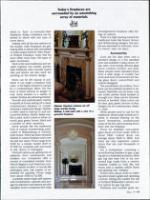
Above: Classical columns set off
beige marble facing.
Below: A hall ends with a view of a
graceful fireplace.
Gone are the days when only a
standard design in a few standard
sizes was available in glass doors. To-
day, safer, more energy efficient glass
doors combine function and style.
Many people select standard doors
from a wide range of models, but
more and more homeowners are hav-
ing glass doors custom-fitted and
custom-designed.
The possibilities are endless. Door
trims can be polished, brushed or an-
tiqued. Materials can be brass, cop-
per, nickel, pewter, black lacquer or
wrought iron. Glass can be mirrored,
etched or beveled. Glass colors can
be clear, gray, green, bronze or blue.
Designs can be contemporary, classic
or rustic.
While people tend to opt for the
traditional, trends today include an in-
terest in minimal framing on the
doors themselves, unobstructed
views of the fire, and mounting doors
flush with the fireplace.
Prices for standard, non-custom
glass doors run from under $100 to
about $400. Custom doors can
average about $600 to $800. And
there are very expensive custom
doors that can cost thousands of
dollars.
For a homeowner converting a
wood-burning fireplace to gas, a gas
log set is a must-have accessory. Most
gas log sets have five or six con-
nected logs made from a ceramic
material crafted to look like real
wood, plus a realistic yellow flame
and glowing red "embers."
Priced from about $320 to $400,
log sets include a grate and operating
controls. Hitting the market this fall
is Portland Willamette's remote con-
trol option for gas log sets.
Firebacks and modular grate sys-
FALL '91 53