

DETROIT
AMY J. MEHLER
Staff Writer
L
eonid Tikh didn't see
much of the art he
studied at the univer-
sity until he left Moscow.
The Sistine Chapel, the Vat-
ican, Notre Dame,
Michelangelo's David —
each was a fuzzy reproduc-
tion seen from slides and art
books.
"It's impossible to see
great art of the world when
you have no freedom to
travel," said Mr. Tikh, 27, a
painter who left the Soviet
Union 1 1/2 years ago.
Today, Mr. Tikh lives in
Oak Park. Not only has he
freedom to travel, he has
freedom to exhibit and sell
his work. He'll do so next
month at the 19th annual
Birmingham Temple Art
Show.
Mr. Tikh joins 128 artists
as well as Anna Kocherov-
sky, Rudolf Nay and Irina
Baranovskaya, three new
Americans, in a multi-media
show Nov. 2-3. It is the
temple's first show to
feature the work of new
Americans.
Mr. Nay, a photographer,
and Mrs. Baranovskaya, a
puppet designer, have had
international exposure. Mr.
Nay, 2 7 , has had
photographs displayed in
Leningrad and published in
Russian photo magazines.
Before leaving the Soviet
Union, he received his
Bachelor of Fine Arts degree
in photography from the
Leningrad Art College.
Mrs. Baranovskaya
designs life-size puppets and
makes all their clothes. Her
puppets, drawings, sets • and
costumes are part of the col-
lections of Russian puppet
theaters in Chelyabinsk,
Tyumen, Nab and Chelny.
Her puppets are among the
principal players in the Rus-
sian American Puppet
Theater, established about a
year ago in Detroit.
"We're excited about the
art they've contributed,"
said Sharon Klein, who
helped jury the show in
August. "We have
photographs of Russian life,
paintings, weavings and
puppets that give us clear
impressions of what life is or
was like there. We think it's
special because the artists
share with us a piece of the
life they left behind."
Mr. Tikh, who uses oils
and tempera or watercoloi-
techniques, paints bucolic
scenes — peasants in fields,
simple portraits and land-
scapes and lonely, abandon-
ed stone houses — all
reminiscent of home. Some
of Mr. Tikh's paintings have
Religion
Continued from Page 1
"The challenge of Jewish-
Christian dialogue is not
interpreting what the other
one believes but understan-
ding what the other one be-
lieves," he said.
Bishop Stendahl, who was
dean of the Harvard Divini-
ty, School for 11 years,
echoed Rabbi Hartman's
remarks.
Maintaining that people,
not religions, have dia-
logues, he stressed the prin-
ciple of diversity of beliefs.
"Diversity inspires the one
who is hungry to learn more
about-God," he said. "Let us
not try to defend God. Let us
aspire to faithful interpreta-
tion."
Audience members reacted
warmly to both speakers.
"We don't have to accept
everything about another
person," said Arthur Green-
berg, a Muskegon dentist.
"But we should try to under-
stand."
14
FRIDAY, OCTOBER 18, 1991
For some audience mem-
bers, the conference repre-
sented a means towards
building bridges. Many
Christians expressed guilt
over the Holocaust. Jews
spoke about the need to pre-
vent religious misunder-
standing as a means of
survival.
"A dialogue like this is ex-
tremely important," said
Barbara Bloomfield, also
from Muskegon. Ms. Bloom-
field recently traveled to
Eastern Europe, where, she
said, the events of the Holo-
caust are being played out
once again against immi-
grants.
"None of us has the whole
picture," said James Gar-
rison, a Lutheran pastor
from Kalamazoo. In a group
discussion, Mr. Garrison
cited Israel's policies in the
West Bank and Gaza as one
of the things that perplexes
him about Jews.
❑
Photo by Gle nn Triest
Temple To Show
New American Art
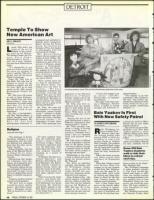
Irina Baranovskaya, Leonid Tikh and Anna Kocherovsky hold some of their work.
appeared in the National
Exhibition of Moscow
Folklore Artists and at the
annual exhibitions of the
Moscow Art Club.
Mr. Tikh also drew in-
spiration from the months
spent in Italy before he was
able to come to the United
States. While there, he did
some traveling and a lot of
sketching. •
"Seeing the art of the
great Renaissance is quite a
different experience than
reading about it," he said.
Mr. Tikh recently com-
pleted a trilogy of favorite
scenes from Florence. "I
wanted to remember every-
thing I saw, so I sketched
them and painted them
later."
Mr. Tikh said it is difficult
but not impossible to exhibit
work in the Soviet Union.
"One way is official, through
a national - union of artists.
The other, which is easier, is
through local art clubs."
Membership . in the union
is hard to obtain and can be
harder for Jewish artists,
Mr. Tikh said.
Mrs. Klein, an education
counselor and teacher, said
the Birmingham Temple
show, which earned the
temple $15,000 last year,
gives new American artists
important local exposure.
Anna Kocherovsky, who
weaves tapestry, is thankful
she has a place to show her
work. She and her husband
and son left Moldavia in
1989. She says she is fas-
cinated by the variety of
people she has seen and met
since coming to America.
"I weave the images I see
on canvas," said Mrs.
Kocherovsky, an engineer
by profession.
Her major work since com-
ing to Michigan, Simchat
Torah, is based on Jewish
heritage and Amerkan re-
ligious freedom.
"The tapestry is my best
expression," Mrs. Kocherov-
sky said. "The holiday rep-
resents the celebration of the
Torah, which is to me, a uni-
versal symbol, symbolizing
Judaism." ❑
Bais Yaakov Is First
With New Safety Patrol
ELIZABETH APPLEBAUM
Assistant Editor
R
uth Waldman be-
lieves in Safety First.
Several years _ago,
she learned parents were
paying $250 a child for
students to ride a bus
several blocks to Yeshiva
Beth Yehudah. The problem
was Greenfield Road, where
the city had posted no traffic
guards. Students could not
cross the busy intersection
alone.
Today, the busses are gone
and safety guards work
regularly at Greenfield
Road. .
When Bais Yaakov moved
from Beverly Hills this
summer to its new location
in Oak Park, Mrs. Waldman
again saw the need for in-
creased safety. Girls would
be walking and riding their
bikes to school for the first
time. Crossing guards, she
realized, were a necessity.
Now, 11 Bais Yaakov girls
serve on the school's safety
patrol, working in conjunc-
tion with guards provided by
the cities of Southfield and
Oak Park. For the first time,
a Jewish day school in Metro
Detroit has its own safety
guards and patrol.
The service has given Mrs.
Waldman and other Bais
Yaa.kov parents a whole
different feeling about send-
ing their daughters to
school.
"It's nice knowing that
when your children walk out
the door, somebody will be
Some 300 Bais
Yaakov students
walk or ride their
bikes to school
each day.
there to look out for theni,"
Mrs. Waldman said.
Mrs. Waldman's campaign
to make students' journeys
to Oak Park Jewish day
schools safe began in 1987,
when she learned parents
were bussing students so the
boys wouldn't have to cross
Greenfield. Doing her own
survey, she found that more
than 150 boys needed to
cross Greenfield on their
way to school.
Mrs. Waldman approached
the Oakland County Road