

Spread Too Thin?
With a fine arts
background, Lurie
married the traditional
oil-painting technique
with his caricature art.
Jimmy Margulies, an intern with Mr.
Lurie in 1975-1976 and now the editorial car-
toonist for The Record newspaper in
Hackensack, N.J., admires the artistic,
analytical and business skills of his former
boss.
"His cartoon is an analysis of each issue
as he sees it," Mr. Margulies said. "Others
are just gag writers. His cartoon could be
expanded into an editorial or a written
analysis. And he's been very good as an
entrepreneur."
"He's got a tremendous amount of charis-
ma and personal presence and knows how
to use it," added Kevin Kallaugher, who
signs his name KAL as editorial cartoonist
for The Baltimore Sun and The Economist
news weekly of Great Britain. "When he
spends a lot of time on the art work and car-
toons, he can put out some first class stuff."
But others who draw editorial cartoons
say Mr. Lurie's schedule of close to ten car-
toons a week, interviews, fine art and
"Nightline" work have spread him too thin,
causing him to rely heavily on his large
stable of caricatures and return to some of
the same cliches over and over again.
Some in the editorial cartooning busi-
ness don't quite know
what to make of Mr. Lurie.
"He seems so much of a
sideshow," said a syndicated
colleague, who asked not to be
identified. "I don't see him do-
ing the same thing the rest of us
are doing."
Often, however, that's just
what newspaper editors are look-
ing for. They'll often use Mr.
Lurie's drawings as an eye-catch-
ing illustration, rather than as a
piece of political or economic com-
mentary.
"His caricatures are certainly
among the best available," said
Lee Salem, vice president and edi-
torial director of Universal Press
Syndicate, which sold Mr. Lurie's
work in the early 1980s. "But his car-
toons are more a symbolization of an
event, rather than a comment on
an event. You can't tell where he
stands. That may help him
abroad, but not here."
Added another syndicated
cartoonist, who also asked not
be identified: "Lurie is very
safe for an editor trying to
avoid controversy?'
Mr. Lurie said some cartoonists and
others in the news business seem disturbed
over his wealth and fame, which recently
enabled him to purchase his second Rolls
Royce.
"All I have I got with my three fingers it
takes to draw, and a few ideas," he said as
he walked around his property, which sits at
the end of a long driveway in an exclusive
section of Greenwich. "But cartoonists are
not supposed to be successful"
However evidence of Mr. Lurie's success
is all over his house.
Behind his specially made mahogany desk
is a wall-sized world map, holding scores of
red flags — each representing a client
publication. Down a hallway is a wall
covered with newspapers that publish his
work.
Near a movie screen that rolls down from
the ceiling is the specially made drafting
table where Mr. Lurie creates his familiar
figures and cartoons on economic and poli-
tical subjects. Next to it is a small television
set with two screens. The second will freeze
an image for "about a half hour — long
C LOSE U P
real message. "Drawing is the least impor-
tant thing in political cartooning."
The only difference between a political car-
toonist and commentators like William
Safire and A.M. Rosenthal is "they don't
know how to draw," Mr. Lurie said.
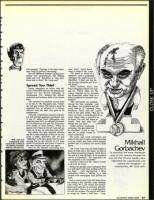
Mikhail
Gorbachev
"is probably the most important
man of the century because he
was the first [Soviet leader] who
identified the catastrophe and
started the slaughter" of
communism, Mr. Lurie said.
THE DETROIT JEWISH NEWS 27