

.1 1111111101111-401
DETROIT
Interfaith Community Effort
Aimed At Helping Area Teens
the film's executive producer,
Robert Larson.
AMY J. MEHLER
Staff Writer
The Second Chance Gang,
M
eet the "Second
Chance Gang"
—four inner-city
teen-agers who got second
chances through Detroit Job
Corps, a federally funded job
training program.
There's Scott, a white,
former suburban high school
truant, and there's Robert,
who left the gangs because
he realized that even with
all his weapons, he "couldn't
kill them all."
There's Lyvett, a baby
having babies. She's a
mother to her sisters and
brothers as well as to her
own child. She swears she'll
do better than her mother.
And finally, there's Helena
who grew up in a crack
house. She used to make
$300 to $400 a day selling
drugs in the "hood." One
night, while inside a crack
house, she witnessed her
favorite uncle Mark beaten
to death.
Now meet Harvey Ovshin-
sky, an independent writer
and producer, who poked his
video recorder into their
world of crack cocaine and
gang violence— a world in
which gold chains and ex-
pensive pairs of sneakers
sometimes cost young people
their lives.
Mr. Ovshinsky, a nine-
time local Emmy winner
from Grosse Pointe, spent
3 1/2 months documenting
their stories for the City For
Youth Project, a coalition of
250 religious and secular
agencies committed to de-
veloping and supporting
youth programs.
Other documentaries pro-
duced include Psalm for the
City by Steve Palackdharry
and A Time to Build by Bob
Rossbach, each confronting
the challenges of youth in a
troubled, racially divided
city.
"I want to motivate the
suburban audience as well
as the urban audience to
care about these kids," Mr.
Ovshinsky said. "Most peo-
ple have no clue about what
makes these kids into what
they are. They get most of
their ideas from TV and bad
press. This way, it's in your
face —like a challenge, a
dare. If it gets people saying,
`What can I do,' I'll have
done something. If no one
reacts, then I'll know I'll
have my first big failure."
People are reacting, said
a 27-minute video produced
in association with Channel
56, aired Oct. 6,7,8 and 9 and
was simulcast October 7 on
WKBD Fox 50.
"People don't want to
believe it, but these prob-
lems are not peculiar to the
city," Mr. Larson said. "We
all have to accept the
premise that each child
belongs to everyone. If a
child hurts in the city, then
we ought to hurt too —
beyond the boundaries of
Eight Mile Road."
Mr. Larson, president and
general manager of WTVS-
Channel 56, said the concept
of a City For Youth began
two years ago "in the minds
and hearts of six ministers."
"The question was
elegantly simple," he said.
"How can believing com-
munity leaders address the
welfare of young people in
our city? The only way, they
decided, was to develop a
grass roots campaign —
Brent Triest:
Channel 56 host.
.
14
FRIDAY, OCTOBER 11, 1991
interfaith in nature — to
come up with the solutions."
One idea was to form
panels of spiritual leaders,
business professionals,
government representatives
and members of the media
who will address the con-
cerns of youth.
Subjects discussed in
documentaries and in each
of the four televised panels
will be made accessible to
the general public in more
than 100 talk and view sites,
including Temple Israel in
West Bloomfield, Temple
Beth El in Bloomfield
Township and Temple
Emanu-El in Oak Park.
The first forum, which in-
vited spiritual leaders, aired
Oct. 3 and asked the au-
dience if the clergy was do-
ing everything it could for
the city's youth. The "town
meeting" was broadcast live
on WTVS and was
moderated by Channel 56
host Brent Triest. Three
more forums, to run Oct. 10,
17 and 24, will ask each of
the panels to address the
problems facing youth.
Rabbi Lane Steinger of
Temple Emanu-El was one
of nine clergymen on a panel
including Christian and
Moslem faiths facing an au-
dience of more than 50 civic
and community activists and
youth ministers as well as
other pastors from across
Metro Detroit.
"Clergy is not doing
enough to address the con-
cerns of young people,"
Rabbi Steinger said. "The
Jewish community is also
part of the metro area and
should be more involved in
issues facing the city. I'm
not sure we face the same
problems, but we've been
around. We've learned
valuable lessons we can
share with others."
Rabbi Steinger suggested
the Jewish community could
become more active in men-
toring youth, both in and out
of the city.
But Rabbi David Nelson of
Congregation Beth Shalom,
in the studio audience, said
clergy is doing enough.
"I've had enough of this
self-flagellation," Rabbi
Nelson said. "I just went
through 25 hours of prayer
and contrition (during Yom
Kippur). I'm not prepared to
take all the blame.
"That doesn't mean
there's not a lot of work to be
done," he said. "We face
alcohol and substance abuse
in our community as well.
We see ourselves intrinsical-
ly connected to Detroit. We
must allow the development
of values to live in a climate
of morality. We need to show
young people role models.
This is my commitment as a
rabbi."
Other suggestions from
the panel and audience in-
cluded spending more time
with teens where they hang
out and helping them apply
religious meaning to their
lives.
At one point, a young
member of the audience who
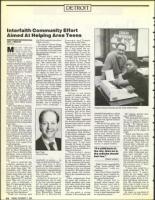
Producer Harvey Ovshinsky and Job Corps member Robert.
identified himself as a black
brother from New York,
accused clerics of ignoring
the race war against African
Americans.
"We are at war, man," the
young man said. The discus-
sion became heated when he
turned to Rabbi Nelson and
and told him history has
shown that Jewish beliefs
are false. Another person in
the audience criticized the
Moslem faith because it did
not allow women to become
imams, or prayer leaders.
"If a child hurts in
the city, then we in
the suburbs should
hurt too."
Robert Larson
Rabbi Nelson responded by
saying "name calling" and
"unkindness" were un-
necessary.
Host Brent Triest said the
discussion grew heated be-
cause of the importance of
the issues being raised.
"When people feel so
strongly about issues, they
often become loud and a
little angry," he said.
"These issues frustrate
many people, but I thought
it was a good beginning and
an important process."
Mr. Larson, general man-
ager of WTVS, agreed.
"We developed this just so
we could bring together
clerics of different faiths,"
he said. "We figured every
Jew, Moslem and Christian
can reach some kind of
agreement on the subject of
youth.
"Brent and Harvey, both
Jewish, have taken much
upon themselves in the area
of youth programming and
mentoring. They both go
beyond their cultural con-
texts to tell the stories that
need to be heard."
Mr. Ovshinsky, an urban
story teller whose past pro-
jects have included "City
Nights," a stylized, award-
winning look at the city of
Detroit, said the youth of the
city and the suburbs require
intervention now if their
lives are to be saved.
"I knew this would be a
tough assignment," Mr. Ov-
shinsky said. "I mean,
where do you begin when
tackling such a problem? It
always comes down to fin-
ding individual communica-
tion. My challenge was to
find a way to turn it on, to
scratch the surface beyond
the degradation, beyond the
detachment."
As many as one-third of
Detroit's 167,000 public