
LIFE IN ISRAEL
LEAH ABRAMOVITZ
Special to The Jewish News
T
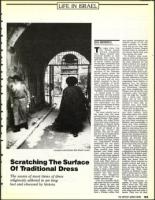
Jerusalem's ultra-Orthodox Mea Shearim quarter.
Scratching The Surface
Of Traditional Dress
The source of most items of dress
religiously adhered to are long
lost and obscured by history.
he sages claim that
the Jewish people
merited redemption
from Egypt because they
remained faithful to their
language, their names and
their dress even under duress
of slavery. Indeed, through-
out the ages, assimilation was
avoided due mainly to this
clannish cleavage to tradition.
Even today, the most con-
servative of the Orthodox
Jewish groups retain the
dress patterns of their ances-
tors, even if they go back 300
to 400 years and are com-
pletely unsuited to the cli-
matic conditions of Israel.
This is especially true of var-
ious Chasidic sects and what
is popularly referred to as
"haredim" (ultra-Orthodox).
A partial guide to who
wears what can only scratch
the surface of a fascinating
subject. The basis for certain
customs are rooted in a spe-
cific philosophy, but the
source of most items of dress
religiously adhered to are
long lost and obscured by
history.
The most colorful and at
the same time the most
secluded sect of haredim are
the anti-Zionist "Reb Areleh"
Chasidim, also called Toldot
Aaron (the name of their con-
gregation) or Neturei Karta
(their political affiliation). If
the rule of thumb is the
blacker the "frumer" (the
stricter), this sect of Chasi-
dim live up to expectations,
at least during the week.
The women of 'Ibldot Aaron
wear black stockings, simply
cut, long-sleeved dresses,
sometimes but not exclu-
sively black, and black
scarves over shaved heads.
Their menfolk wear black
knickers over black socks,
black wide-rimmed velvet
hats and silk robes (caftans)
of white or blue with black or
white sbripes, tied with a
broad sash. Their shoes are
laceless and their shirts have
no buttons, but are pulled on
over the head, the reason
being to keep a distinction
between their world and the
modern one. One source
claims that Hungarian
clergymen dressed this way
several centuries ago.
Only the yarmulke (skull-
cap) under the hat is a knitted
white beanie, for men and
boys alike. On Shabbat, the
men wear golden caftans with
black stripes, which stems
from a Persian caftan that
was popular throughout the
Turkish empire in the last
three centuries. In winter,
when they go out, they wear
an abayah (a brown, longish
Oriental robe), in contrast to
the shorter black cloth coat
worn during the week.
On Shabbat, their stock-
ings are white and their most
distinctive item of clothing is
the wide, elaborate fur hat
called a streimel. It is made of
24 fur tails of sable, mink or
fox which are still sometimes
imported from Russia. Al-
most all Chasidic sects main-
tain the custom of a streimel
on Shabbat but there are
distinct differences between
this kind, also worn by Jews
originating from Galicia or
Romania (e.g., the Satmar,
Erloy, Sanz, Belz, Vishnitz
and Klozenberg Chasidim,
and those originating from
Poland, such as the Gur and
Amshenov sects. The latter
wear the high fur "spodik"
with a plush base which
makes use of the whole
animal, not just the tails. The
streimel is worn only by
married men, and bride-
grooms invest between $500
and $1,500 on this item.
The boys of rIbldot Aaron,
like their fathers, wear
buttonless shirts over which
their tzizzit is sometimes
worn. They, too, wear knickers
but with black stockings on
Shabbat and occasionally a
velvet vest. Their skullcaps
are white. It is an impressive
sight to look down from the
women's section of their syna-
gogue on Shabbat or holidays
and see the rotating circles of
dancers; the little boys on the
inside, all dressed alike;
around them a circle of the
post-Bar Mitzvah boys; and
in the outer circle, the married
men, all wearing their
streimel and golden kapote.
Upstairs, the women of the
congregation are also dressed
in distinctive Shabbat garb.
They, too, sport white stock-
ings and their dress is some-
what less severe than on
weekdays. Many maintain an
ancient custom and wear a
white lace apron over their
dress, an item which has no
practical use. Their head
covering on Shabbat is gen-
erally a white scarf or shawl.
The girls all seem to have
long braids and are modestly
dressed.
The Karlin Chasidim re-
semble, in some ways, the
ibldot Aaron sect. The men
wear long pants and black
skullcaps but their streimel is
wide, disarrayed and made of
beaver. They, too, tie their
THE DETROIT JEWISH NEWS
103
Scanned image of the page. Keyboard directions: use + to zoom in, - to zoom out, arrow keys to pan inside the viewer.
October 11, 1991 - Image 111
- Resource type:
- Text
- Publication:
- The Detroit Jewish News, 1991-10-11
Disclaimer: Computer generated plain text may have errors. Read more about this.