
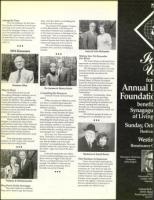

Among the Trees
From his childhood, the Baal Shem
Tov, founder of Chassidism, loved to pray
and study in the woods. Here among the
trees of the Synagogue Campus, as you
see in the photographs, our honorees are
reliving that experience and realizing
the Baal Shem Tov's dream: a place close
to nature where Jews could commune
with G-d.
•• •
1991 Honorees
Norman Allan
dirty. And they believe in building the
body as well as the spirit.
The projected Synagogue Campus
in West Bloomfield, with 40 acres of
untouched wetlands and woodlands, is
at 'the heart of nature, in the heart of the
community.' This is a natural setting
which they intend to preserve and
enhance because they know that love of
nature can bring one to love of G-d.
The Lubavitchers are keeping
Judaism alive, and they're helping it
breathe.
•• •
.
Dr. Jerome & Sherry Kasle
They're Doers
Their Mitzvah bus travels
throughout Michigan, teaching men to
put on tefillin and women to light
candles for Shabbos. The religious day
school phenomenon of today is a credit
to Chabad and to the previous Rebbe's
conviction that American Jewish
children must be educated if the Jewish
people are to survive.
The Lubavitchers are teaching
people to remember that they are Jews.
When I met the Rebbe in Crown
Heights, I understood where these
Lubavitchers come from. Only someone
like that, someone with endless energy
and endless belief can inspire others to
forsake comfort and go to places
throughout the world where Jews need
help.
They help people experience
Judaism, in their camps, their schools
and in those traveling buses.
•• •
Committing the Resources
General Norman Schwartzkopf
said it.
When you plan an offensive action
you have to commit three times the
resources as you would to maintain a
defensive posture.
He was talking about the Gulf
War, but his words describe the Syna-
gogue Campus of Living Judaism!
Lubavitch is never satisfied with
defending the Jewish status quo. They
want to keep on the attack (with kind-
ness, tolerance and love, of course),
always seeking to extend the perimeters
of their influence, to bring more and
more people into "yiddishkeit."
As in any war, there are frustra-
tions. Yesterday's newly-conquered
territory is tomorrow's defense perim-
eter. But the Rebbe will not accept
yesterday's accomplishments. He is not
satisfied unless his Lubavitchers "go on
the attack" again and extend the lines
further.
Lubavitch emissaries and rabbis
dot the southeast Michigan area, each of
them a beacon of light in his suburb.
This is a wonderful picture, but it's not
enough. The Rebbe's vision encom-
passes an entire community that is
Jewishly moved by Chabad.
•• •
William & Shirley Jacobs
They Don't Fit the Stereotype
They don't believe in isolation.
They aren't afraid to get their hands
Larry & Lois Nichamin
Making Sure We Remember
Our Roots
The Lubavitchers understand how
important our family histories are. They
know that our roots lie in the past.
The Synagogue Campus of Living
Judaism will house an Archive Center,
containing family records of the
Founders.
When my grandfather came to the
United States, to Detroit, he helped
found the Nusach H'Ari shul, because
that particular kind of shul reflected
his Lubavitch heritage. My father
continued that tradition; he too was a
Lubavitcher.
Somehow, mysteriously, those
roots going back to our past kept
drawing life-giving moisture from
underground springs of tradition and
history, sending that vital sap up
through our veins and maintaining
Jewish values and traditions within our
families.
The Chabad people of today are
making sure we remember our roots.
•• •
Bentzion & Soroh Rosen
Their Kindness Is Impressive
I have always been impressed by
the kindness of these people. I traveled
to Israel and saw first hand some of
what they do. I saw the love and care
that they give to abandoned, homeless
children in their orphanage and school
at Kfar Chabad. I saw Lubavitch soup
kitchens where people sit down to be
served with dignity. I learned of stores
that are subsidized by Lubavitch so
poor people can afford to buy.
Honorary Chairman
Governor
John Engler