

DETROIT
Neglected Orphans Of Romania
Get Help From A Detroit Doctor
ALAN HITSKY
Associate Editor
T
he conditions are
horrible —hundreds of
naked, malnourished
Romanian orphans living in
their own filth.
Since the execution of
Romanian dictator Nicolai
Ceausescu in December
1989, "60 Minutes" and
"20/20" have brought tele-
vised pictures of the dev-
astating conditions for
40,000 Romanian children
sentenced to "orphanages."
Their crime: having crossed
eyes, minor deformities or
being unwanted.
Detroiter David Rosenberg
saw first-hand the human
deprivation. A fourth-year
fellow in child neuro-
psychiatry at the University
of Pittsburgh, Dr. Rosenberg
just returned from a month
of volunteer work in a
Romanian chiTdren's in-
stitution.
Most devastating for Dr.
Rosenberg was the quick
realization that many of
these children are not
"irrecuperable" as diag-
nosed. They are affected by
inhumane conditions impos-
ed by a dictator and the
unsettled economy of one of
the poorest countries in
Europe.
"I met an 18-year-old boy
— Mitica — who had been
institutionalized all his life
because he had limb defor-
mities," Dr. Rosenberg said.
"But he was very bright and
taught himself to play chess
by watching other children.
He beat me in 10 minutes
and I fancy myself a chess
player."
Dr. Rosenberg asked
Mitica to do a drawing. With
deformed and weak hands,
the teen made a picture of a
young man. "I looked hard
for some kind of psycho-
pathology in the drawing,"
said Dr. Rosenberg, "and I
couldn't find it.
"He was not bitter. He said
he could not waste time on
bitterness. The figure he
drew had large eyes, scann-
ing the world. There was no
hint of anger and no
psychiatric diagnosis."
Mitica was one of 450
Romanian children living in
three orphanages in the
rural farming community of
Babeni, 300 miles from
Bucharest. The 150 children
in Mitica's orphanage were
cared for by four untrained
.
14
FRIDAY, OCTOBER 4, 1991
nurses and a director who
did not speak to his staff.
Working 16-hour days
with an interpreter hired in
the village, Dr. Rosenberg
initiated daily staff
meetings, taught the chil-
dren their names and posted
individual signs with their
name, birthdate and a bright
picture. He also started a
regular bathing schedule
with the able-bodied chil-
dren helping the staff.
His translator helped him
convert scales, assessment
tools, medication labels and
instructions into Romanian.
The Romanian staff "were
concerned at first that
maybe we were inspecting
them. Once we rolled.up our
sleeves, they were very ap-
preciative."
He also distributed paper
and markers to the children.
Within days, several had
graduated from drawing
stick figures to detailed pic-
tures of flowers and people.
"I would walk in," he said,
"and they would call out
Skree, skree! — 'Write,
write!' in Romanian."
Dr. Rosenberg, a graduate
of Hillel Day School, Berkley
High School and the Univer-
sity of Michigan medical
school's Inteflex program,
was the first volunteer to
visit Babeni. He said the
medical situation in
Romania has changed for
the better since Ceausescu's
downfall, but conditions are
still woeful.
"There were no nurses
during Ceausescu's time,"
he said. "In many ways
Ceausescu was a peasant.
He blamed contraception for
the country's problems and
ordered all women to have
five children. There was
even a gynecologic squad of
the police to enforce his
rules."
Medical specialists were
banned and there are still no
half-way houses or foster
parent programs in
Romania, he said.
Dr. Rosenberg believes the
shortage of modern medical
procedures and specialists is
compounded by the attitude
of the Romanian public.
They believe their small
population will be swallowed
up by neighboring east Eu-
ropean ethnic groups.
He said Romania will need
volunteer help for some time
to correct its medical defi-
ciencies, public attitude and
the institutionalized neglect
of its children.
"Fully 20-25 percent of the
children in this institution
were normal —both
psychologically and
physically — and most were
not orphans," he said. But
Romania has no provisions
to release the children into
society. Once institu-
tionalized, they stay there
for life.
While records were scarce,
Dr. Rosenberg did find birth
and religious information for
each patient. He found no
Jews among the children, a
fact he credits to Romanian
Chief Rabbi Moshe Rosen
who has dedicated his life to
helping the Jews of Romania
immigrate to Israel. Few
young Jews remain in the
country.
After leaving Babeni, Dr.
Rosenberg visited Rabbi
Rosen's synagogue in
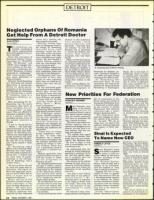
Dr. Rosenberg looks at Mitica's drawing.
Bucharest for Shabbat ser-
vices, introduced himself to
the rabbi and spent Friday
evening at the rabbi's home.
Dr. Rosenberg left
Romania Sept. 24 and
returned to the home of his
parents, Dr. Jerry and Corlis
Rosenberg in Huntington
Woods. He is now back in
Pittsburgh, where he hopes
to organize more volunteers
through Project Concern
International. He would also
like to return to Romania
next year, possibly for a
three-month visit, to help
the orphans of Ceausescu. I=1
.
New Priorities For Federation
NOAM M.M. NEUSNER
Staff Writer
M
ark Schlussel, pres-
ident of the Jewish
Federation of
Metropolitan Detroit, said at
last week's annual meeting
that the Jewish community
will have to scrutinize the
way it spends its money.
This was a year where con-
stituent agencies were re-
quired to cut budgets by five
percent, the first time in re-
cent memory that any cut-
back was required.
"The outlook with regard
to the (Allied Jewish) Cam-
paign has to be very conser-
vative," Mr. Schlussel said.
"We have to begin to look
with a scrutinizing eye at
everything we do."
He emphasized that the
process by which Federation
spending is analyzed will be
fair and that specific agen-
cies or programs have not
b _ een targeted for cuts.
His remarks at the annual
meeting, he said, were in re-
sponse to world and national
events that have forced the
Federation to set spending
priorities.
"Our help is more critical
today than at any point in
recent history," Mr.
Schlussel said, in reference
to the influx of Soviet Jews
into Israel. "This alone will
test the strength of our
commitment to world
Jewry."
He referred to other emer-
ging problems, including the
fall of communism in the
Soviet Union, the arrival of
thousands of Ethiopian Jews
to Israel and a recent report
by the Council of Jewish
Federations that declared
intermarriage a major
threat to American Jews.
"The Federation must
seek new linkages to insure
the viability of the commun-
ity," he said. "We can no
longer bury our head in the
sand over intermarriage and
the progeny of those mar-
riages."
The annual meeting, held
at Adat Shalom Synagogue
on Sept. 26, also saw. the
nomination and election of
new Federation board mem-
bers and officers. Mr.
Schlussel will be returning
as president for his third
year:
Jack Robinson, vice presi-
dent of United Jewish
Charities and past vice pres-
ident of the Federation, was
given the Fred M. Butzel
Memorial Award For Com-
munity Service.
Sinai Is Expected
To Name New CEO
KIMBERLY LIFTON
Staff Writer
S
inai Hospital's board
of trustees is expected
to name a chief ex-
ecutive officer by the end of
October, according to the
search committee.
Dr. Norman Bolton,
Sinai's chief of staff and a
member of the committee,
said the hospital is "very
close to making a selection."
Topping the list of can-
didates, he said, is a Jewish
male who serves as CEO for
a Jewish-sponsored hospital
in the Midwest. Dr. Bolton
said the committee is finaliz-
ing details with the leading
candidate before recommen-
ding him to the board for
confirmation.
Former administrator
Robert Steinberg left his
position last February.
Meanwhile, Howard Watts,
a managing director of the
Hunter Group, a Chicago-
based health care consulting
firm, was hired as interim
CEO.
Sinai hired Hunter Group
in April to help the hospital
get out of financial
difficulties. Hunter Group
administrators are con-
tracted through January,
and Dr. Bolton said it is like-
ly a new administrator will
be in place before then.
In addition, plans are
underway to restructure
Sinai's 66-member board of
directors, condensing the
large body and setting up a
foundation that will oversee
the hospital's philanthropic
efforts.
The future board is ex-
pected to be downsized to a
maximum of 15 members.