

I UP FRONT
.. r I IN
A F.E
DAKF?
4 AF, CHIN .
E
• ,-
B
t pop
z'
TV- • '*`
1
.
''
c)
L4.4
B
v.
`* e . A — C •
'44
Al4sE R
rq
i:EA C.
-
,
t.g
-
E
P . rd.,
br (-PEA C.
A
A C.
91..-1
Otorac. I. Rawl saostra Do.Dx.
0.113 r06an5ia COVIGIENCAIDDEASK.
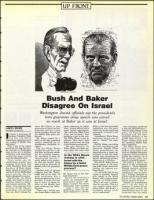
Bush And Baker
Disagree On Israel
Washington Jewish officials say the president's
loan guarantee delay speech was aimed
as much at Baker as it was at Israel.
JAMES D. BESSER
Washington Correspondent
I
s there a growing rift
between President Bush
and his top State
Department appointees over
the conduct of Middle East
diplomacy?
That is one of the urgent
questions that has kept Jew-
ish activists in Washington
busy as they try to decipher
confusing and sometimes
conflicting signs coming
from the administration.
Three weeks ago, ad-
ministration sources were
dropping broad hints that
while President Bush and
Secretary of State James
Baker agreed on broad U.S.
objectives in the Middle East
peace process, the two
leaders disagreed on tactics.
Specifically, the White
House was ready to take a
hard-line stand on Israel's
settlements policies. Mr.
Baker, while opposing those
policies of the Shamir
government, was convinced
that any direct linkage bet-
ween $10 billion in loan
guarantees to Israel and set-
tlements policies could
throw a monkey wrench into
the Middle East peace con-
ference.
Mr. Baker pushed for a
delay in the loan guarantee
process, something the ad-
ministration ultimately ac-
cepted.
But the White House
bungled the push for a 120-
day delay by directly attack-
ing the pro-Israel commun-
ity, according to some ad-
ministration sources —
which added to the possibil-
ity that the October peace
talks would be adversely af-
fected by the loan guarantee
issue.
Another body of opinion
suggests that Mr. Bush's
tough talk at his Sept. 12
news conference was a
deliberate effort to box in his
secretary of state, who was
due to arrive in Israel for
talks on the Middle East
peace conference the follow-
ing week.
"There was a feeling here
that James Baker wants this
peace conference no matter
what," said an official with a
major Jewish organization.
"He wants his Nobel Peace
Prize, and he doesn't want
anything to get in the way.
The White House is less op-
timistic. They don't want
Baker to give away the shop
to the Shamir government."
The gap between the
White House and State sur-
faced again last week when
Is the White House
looking to stick
Israel with the
blame for a failed
Middle East peace
process?
Mr. Baker was on his way
back from Israel.
Aboard the secretary's
plane, an anonymous ad-
ministration source —Mr.
Baker himself, the State
Department later admitted
— made it clear that the
underlying reason for Mr.
Bush's demand for a 120-day
delay in the loan guarantee
legislation was the presi-
dent's fury at the continuing
expansion of Israel's set-
tlements.
Immediately, White House
machinery swung into ac-
tion to "clarify" the state-
ment.
But Mr. Baker was telling
the truth, according to most
observers. Despite White
House protestations, the
administration is clearly de-
termined to link the badly
needed loan guarantees to
Israel's settlements policies,
either now or in 120 days.
Why did Mr. Baker give an
honest answer to the ques-
tion of Mr. Bush's motives in
lashing out against pro-
Israel forces?
"It's obviously that he was
trying to position himself
with respect to the White
House," said a top pro-Israel
activist in Washington.
"What's not clear is exactly
what he was after. This is a
very complex game that's
taking place, and there's a
tremendous amount we do
not yet understand."
One emerging possibility
is that the administration —
with its high ratings in the
polls, its Persian Gulf
triumph and the fast-
changing situation on the
global chess board — no
longer expects much from
the upcoming Middle East
peace conference.
The White House, accor-
ding to this scenario, is
ready to cut its losses in the
drive for a Middle East peace
conference. If Israel could be
goaded into backing out of
the upcoming peace con-
ference, so much the better.
By putting a heavy em-
phasis on the settlements
question — Prime Minister
Yitzhak Shamir's political
Achilles heel — the ad-
ministration may be pursu-
ing a strategy designed to
put the onus for the expected
failure of the peace con-
ference squarely on Israel.
Despite its protestations
that a 120 day delay is
necessary to protect the up-
coming peace process, the
administration may be less
concerned with the peace
THE DETROIT JEWISH NEWS
11