

RELIGION
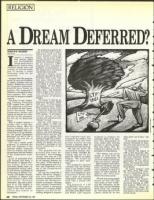
A DREAM DEFERRED?
Staff Writer
I
magine a program
that gathers gifted
- and knowledgeable
Jewish youth twice a
month, teaches them
advanced Jewish texts and
concepts, all with the simple
goal of creating a future
leadership class for the
community.
Imagine that the program
works: It turns out hundreds
of rabbis, scholars and lay
leaders. Federations recruit
the program's graduates.
Schools hire them as
teachers. The community's
lifeblood is enriched by their
mere presence. Now, imag-
ine that the program stopped
running.
The story is true. Leader-
ship Training Fellowship
(LTE4') existed from 1946 to
1981, producing a rich boun-
ty of leaders for the Conser-
vative movement. Some
Conservative leaders still
regard its demise as a blow
not only for the movement,
but for all of American
Jewry.
Why it ended remains a
mystery that, to this day,
troubles many. Was its
demise knotted into its
elitist philosophy? Was it in-
stead done in by its benefac-
tor, the Jewish Theological
Seminary? Or did it live a
fruitful life and die of
natural causes?
LTF was a model youth
program. It collected the
best and brightest of the
teenage ranks, nurtured
them on Judaica, and later
turned them into the leaders
of the Conservative move-
ment.
A list of graduates from
LTF include Joel Roth, a
JTS scholar in Talmud; Ger-
son Cohen, JTS's late
chancellor; Robert Alter, an
accomplished biblical schol-
ar; Lee Levine, a professor of
archaeology at Hebrew Uni-
versity; and Robert Chazan,
a professor of Hebrew and
Judaic Studies at New York
University. Barbara
Goldsmith, who was a presi-
dent of an LTF chapter in
Detroit, was the first prin-
cipal of the first Conser-
vative day school in
Jerusalem:
42
FRIDAY, SEPTEMBER 20, 1991
Its graduates populate the
rolls of Conservative rabbis,
federation staff and day
school teachers across the
nation. At one point, LTF's
national director was Chaim
Potok, the esteemed author.
By all measures, LTF's
graduates have ascended to
positions of preeminence in
the Conservative movement
and Jewish community.
Detroit's chapter alone
produced a panoply of talent.
Professor Roth came from
this area, where he par-
ticipated in an LTF chapter
and edited a national LTF
newspaper. So did Rabbi
Leon Waldman, now in Fair-
field, Conn., and Professor
Jeffrey Tigay of the Univer-
sity of Pennsylvania's
Department of Oriental
Studies.
"Of course it had an in-
fluence on my career," Rabbi
Roth said. "To what .extent,
one will never know." Rabbi
Roth made his career choice
at about the same time that
he entered a Detroit-wide
LTF chapter. "It provided a
chevrah (group) of like-
minded and committed indi-
viduals," he said.
And. yet, with dollars in
scarce supply in 1981, the
program was abandoned.
The program had been
sliding before its national
closure, and some Seminary
administrators say that LTF
had no more energy. But
people still call JTS, wonder-
ing when LTF will be resus-
citated. Its demise has even
provoked a challenge to the
entire leadership of the
movement.
"The program was ne-
glected and then de-
teriorated," said Jonathan
Levine, who was an LTF
participant and later served
as its national director for
four years. "LTF's demise is
part of the general lack of vi-
sion and leadership at the
top of the (Conservative)
movement."
LTF was the brainchild of
Rabbi Mordecai Kaplan,
who then headed JTS's
Teacher's Institute and later
founded the Reconstruc-
tionist movement. Sensing
that talented Conservative
youth needed a nurturing
experience in Judaica, Rabbi
Kaplan and Sylvia Et-
tenberg designed a program
-4
•
I llustration by N ip Rogers
NOAM M.M. NEUSNER
that required local par-
ticipation by rabbis and
teachers, with the local
groups loosely strung
around a national ideal of
advanced teen-age learning.
"We did not stress ad-
ministrative duties, elec-
tions, so forth," said Mrs. Et-
tenberg, who ran the pro-
gram for JTS for its entire
lifespan. "We wanted the
teen-agers to grow spiri-
tually."
The program's genesis
coincided with the develop-
ment of the Ramah camps,
another Seminary project.
Both were supposed to give
Conservative Jewish chil-
dren a sense of year-round
collegialism while infusing
them with a Jewish edu-
cation.
The demands of LTF
membership were great.
Unlike social organizations
like USY, B'nai Brith Youth
and NCSY, LTF required
students to prepare for
meetings. Most of its mem-
bers were hand-picked by
local rabbis after showing
promise in Jewish studies.
The sum effect, Mrs. Et-
tenberg now admits, was the
perception of cliquishness.
"The elitism was not by
design. It came from the
realm of committment. If
you were ready to live by the
rules, you were in," she said.
Some chapters were led by
rabbinical students and the
teens, meeting biweekly,
were obligated to deliver a
report on some element of
Judaica, like Pirke Avot.
Others were more social.
"We felt that young people
should not feel like they
were alone in this world,"
said Mrs. Ettenberg. At the
same time, serious thinking
about Torah was encourag-
ed. "The whole idea of Torah
L'Shma (Torah for its own
sake) grew out of this," she
said.
At its height, the program
claimed thousands of mem-
bers, but since dues were not
a requirement, no exact
count is available.
In Detroit, the legacy of
LTF is still being felt. Sha-
rona Shapiro, the director of
the local American Jewish
Committee chapter, was a
participant. So was Calvin
Weiss, who heads. the ritual
committee at Congregation
B'nai Moshe.
"It wasn't classes," said
Mr. Weiss of his LTF years.
"It was maintaining an in-
terest in Judaism, getting
our backgrounds to gel."
Recently, some Conser-
vative rabbis in Michigan
discussed starting an LTF-
like program. While still in
the exploratory stage, the
discussions underscore the
local desire to develop young
Jewish minds.
4
-4
4