

"When I saw
that picture it
was like two
broken chains
that snapped
back together."
— Nathan Roth
coincidence, his daughter
was married on erev rosh
chodesh Tammuz, his father's
yahrtzeit.
of amazing string
of coincidences led
to Nathan Roth's
first sight in more than 40
years of his father's grave.
Several months ago, Mr.
Roth decided to attend a
reunion of former residents
of Berezhany, Hungary (to-
day the Ukraine), where he
was born and raised. The
reunion was held in New
York. By chance, Mr. Roth
began speaking with one
man there who, also by
chance, had with him a
number of photographs from
Berezhany. The photos
happened to include pictures
of Berezhany cemeteries.
"I started to look at them
and I came to one picture,"
Mr. Roth says. "Sure
enough, it was my father's
grave. I couldn't believe it. I
kept saying, 'Look at it!
Look! Look!' "
Though no Jewish com-
munity exists today in
Berezhnay, the small town
was once home to a large
Jewish population. Unlike
most of his fellow Jews in
the city, Nathan Roth's
father, Tzvi Avigdor, pre-
ferred to wear his beard
short and well-trimmed. He
held a minyan at his home
every Shabbat and on holi-
days so his sickly father
could attend. Each day, Tzvi
Avigdor set out for work at a
law office.
"I can still see his desk and
the two windows, right next
to the district courthouse,"
Mr. Roth says. .
When Tzvi Roth became
ill, his two sons approached
a renowned rabbi who lived
nearby. The rabbi came to
the home and wished Tzvi a
"refuah shelema", (complete
recovery). Nathan's father
was soon healthy again.
The second time Tzvi got
sick, in 1937, the boys also
went for the rabbi. But this
time the man said nothing of
recovery. Instead, he emerg-
ed from Tzvi's room, rubbing
his chin and telling the fami-
ly to "go with God."
The next morning, Tzvi
died. Nathan was 12.
The day of the funeral "the
street was filled with men in
black. My father was laid
out in the living room,
candles all around him. He
26
FRIDAY, SEPTEMBER 13, 1991
was placed in a coffin with
no nails; it was wood only
(according to Jewish law),
with slits on the side so the
body would disintegrate.
"We walked a long way to
the cemetery, about 200
people following us," he
says. "My brother kept pass-
ing out tzedakah. We carried
my father the whole way."
Tzvi Roth's widow sup-
ported her eight children by
running a small store that
sold fruit, canned goods and
sandwiches. She saw that
her son, Nathan, had his bar
mitzvah then continued his
studies in 1939 at a
Budapest yeshiva. To help
pay for his upkeep, Nathan
worked during the day and
learned at night.
Rumors began circulating
throughout Budapest about
trouble back home,-Mr. Roth
says. The Nazis were taking
over. Nathan decided to
return to his family. He
boarded a train for
Berezhany, but it was over-
taken by Nazis. Nathan was
deported to Auschwitz.
Nathan Roth was held
prisoner in Auschwitz until
1945. As the Soviet army
approached he managed to
escape by digging under the
gates with the back of a
spoon. Then he returned
home to Berezhany.
In 1950, Mr. Roth came to
the United States. He has
not been back to Berezhany
since. "I don't want to see
that place again," he says.
"There's no point. It would
be heart-rending."
But he always wondered
about his father's burial site.
And when his son recently
visited Berezhany, Mr. Roth
made one request: look for
Tzvi Avigdor's grave. His
son found nothing.
Then came the Berezhany
reunion in New York, and
the chance encounter that
put a photograph of Tzvi
Roth's grave in Nathan's
hands.
"What was amazing is
that my father's grave is one
of the only ones (in the
cemetery) standing straight
up, and still in good condi-
tion," he says. "When I saw
that picture it was like two
broken chains that snapped
back together."
ouis Golden calls
himself "the rein-
carnation of Tom
Sawyer." His life started on
the river and has included as
many adventures as any ac-
tion film.
Among these adventures
was a reception where Mr.
Golden's unplanned speech
led to his discovery of infor-
mation about his long-lost
grandfather — a discovery
that had a profound in-
fluence on his life.
Louis Golden was raised in
Ypsilanti, where he spent
his afternoons along the
Huron River. "I loved the
flow of the river," he says. "I
would lie in the tall reeds
and watch and watch and
watch life in the water."
Louis' grandfather,
Herschel, had come. from
Russia to Bay City, where he
traded horses, worked in
iron and sold furs. He also
raised eight children, cared
for numerous grandchildren
and helped resettle friends
from the Old Country.
"As I've gone through life,
I've met many people who
somehow felt the touch of my
grandfather's hand," Mr.
Golden says. As an example,
he tells this story:
Louis found a job at Sam's
Cut-Rate drugs. "There was
a night watchman there —
he was in his 60s — and one
time I saw these three guys
picking on him. Finally,
they made him spill his
chicken soup. I said, 'These
guys are mine.' "
After taking care of the
troublemakers, Louis sat
down with the watchman.
"You're a nice guy," the
guard said. "What's your
name?" Hearing Louis' last
name, he continued, "Are
you related to Herschel?"
Louis told him Herschel
was his grandfather.
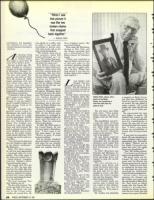
Nathan Roth, above, with a
photo of his father.
Below: the tombstone it
took him more than 40
years to find.
The old man's eyes filled
with tears. "Your grand-
father brought me and my
brother from the Old Coun-
try."
His grandfather was 6'4,"
a man who spoke "of Torah
and Russia, and always told
me, 'Never forget who you
are,' " Mr. Golden says. An
ardent Zionist, Herschel
ended all his prayers, "Next
year in Jerusalem."
He also dearly loved his
wife, Yehudis. Mr. Golden
remembers the two playing
checkers each night (his
grandmother always won)
and listening to Enrico
Caruso.
In 1937, Herschel and
Yehudis left Michigan for
Palestine. They'd heard of
Arab uprisings there and
wanted to help the Jewish
residents.
The two settled on a
moshav near Afula and
wrote the family back home
about their new lives. But
the mail took two to three
months to arrive, and after
awhile the letters became
less and less frequent. Then
they stopped altogether.
Louis Golden made nu-
merous trips to Israel, but
was unable to find informa-
tion about the rest of
Herschel's life. Then came a
1974 visit.
Mr. Golden was attending
a reception at Haifa Univer-
sity that year. Suddenly, he
heard he would be receiving
an award. He was asked to
make a speech. "All I could
think was, what the hell am
I going to say to these peo-
ple?"
He approached the dais
and began to speak. He
decided that instant to tell
the story of his grandfather
and his commitment to
Israel. He also told of how
the families had lost contact,
how "I didn't even know
where my grandfather is
buried, what remnants there
are."
A year later he returned to
Israel. He was attending an-
other reception when a man
approached him. Excitedly,
he asked, "Weren't you at
the Haifa University pro-
gram last year? You spoke
about your grandfather?"
"Yes," Mr. Golden replied.
"I've found everything out
about your grandparents."
The man's name was Dr.
Carmel. He was a former
agent with the Mossad, the
Israeli secret service, and he
told Dr. Golden he had been
so touched by his story that
he had spent the past year
searching for information
about the lost grandparents.
After their chance
meeting, Dr. Carmel and
Mr. Golden went looking for
the lost threads of Herschel's
life. They found an elderly
couple who had known Mr.
Golden's grandfather.
Among the stories the man
told was how when food and
money were scarce, Herschel