

BACKGROUND
HELEN DAVIS
Foreign Correspondent
A
s Israel prepares to
embark on a new
year, the reverbera-
tions of the trauma from the
Persian Gulf War are still
being felt and their conse-
quences continue to
dominate the regional agen-
da.
The defeat of Iraq, the
demise of the Soviet Union
and the emergence of the
United States as a super-
power manifestly prepared
to exert its muscle have
combined to radically
change the political map of
the Middle East.
Syria, the most obdurate of
Israel's enemies, is ready to
talk; the Gulf states are
prepared to abandon their
economic boycott; the
Palestine Liberation Organ-
ization has suffered a polit-
ical calamity equivalent in
size and scope to the military
defeat inflicted on its Iraqi
ally.
Within hours of the end of
the Gulf War, Secretary of
State James Baker had leapt
through the window of op-
portunity, moving swiftly to
capitalize on the changed
perceptions and the emer-
ging new realities.
During six diplomatic
shuttles, he relentlessly ma-
neuvered the various pieces
around the board, skilfully
juggled their sensitivities,
inexorably drew them closer
to his intended goal.
Next week, he is scheduled
to return to the region for a
triumphal seventh visit —
not to negotiate, this time,
but to present his Middle
East interlocutors with the
fruits of his labor: Invita-
tions to a peace conference,
probably in Geneva in late
October or early November.
For the first time since the
Jewish state was established
in 1948, all of its Arab
neighbors have signaled
their willingness to respond
positively to the call for
direct, bilateral negotia-
tions, a formula that Israel's
leaders have been enun-
ciating for 43 years.
So when Israelis welcome
the New Year on Sunday
night they will not, as they
did last year and on so many
previous years, face the
imminent threat of war, but
rather the realistic prospect
of peace.
4 • "
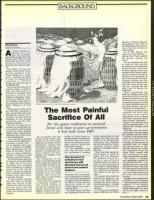
Artwork by D. B. Johnson. Copyright. 1991. D. B. Johnson. Distributed by Los Angeles Ttrnes Syndicate.
The Most Painful
Sacrifice Of All
For the peace conference to succeed,
Israel will have to give up territories
it has held since 1967.
No one doubts that this
process will be without pain
or peril. It will involve tough
negotiations, strains with its
adversaries, tensions with
its friends. It will also pro-
voke bitter internal debates,
personal recriminations, po-
litical schisms and even,
perhaps, the collapse of the
government.
But ultimately, if real
peace is to be attained, Israel
will be required to make the
most painful sacrifice of all.
It will have to relinquish
precious territory whose
conquest has cost hundreds
of Israeli lives, but whose
retention may yet be even
more costly in both human
and economic terms.
Israel will not be required
to recklessly abandon its
vital security interests. It
will not, for example, be ex-
pected to evacuate the Golan
Heights without firm guar-
antees of demilitarization,
similar to those which ac-
companied the evacuation of
the Sinai Desert and which
ensure the territory is never
again used as a launch pad
for attacks on Israel.
No one subscribes to the
view that the Arab world
has experienced a blinding
The decision to
withdraw from
territories will
demand nerves of
steel from Israel's
leaders.
revelation that has convinc-
ed it of the justice of Israel's
cause. But there are grounds
to suggest that the demise of
the Soviet Union and the
resolution shown by the
United States have had a
powerful effect.
The shock of the Gulf War
has introduced a note of cold
reality, persuading the Arab
leaders that there are only
benefits to be derived from
cooperation with Washing-
ton and only futility in pur-
suing the military option
against a seemingly invinci-
ble Israel.
That is far from enough to
allow Israel to relax its
guard, still less anticipate
the imminent arrival of a
golden age of good
neighborliness, but there is
now the hope that it can at
least achieve a broadening of
the grudging, cold peace that
has marked its relations
with Egypt for the past 12
years.
To achieve this, however,
Israel will be required — not
only by the Arabs, but by
virtually the entire interna-
tional community — to make
substantial territorial con-
cessions.
It will be an act of extraor-
dinary difficulty for Prime
Minister Yitzhak Shamir,
contradicting every fiber of
his ideological soul and tear-
ing at his most revered ar-
ticles of faith.
At 76, Mr. Shamir has
spent his life fighting —
against the Nazis, against
the British, against the
Arabs.
Yet the demands that will
be made on him and his
government in the upcoming
negotiations will pose
awesome options at the very
moment when Israel is seek-
ing the means to absorb the
hundreds of thousands of
Soviet immigrants who have
already arrived and the
hundreds of thousands more
who will arrive in the com-
ing year, possibly the last
great wave of Jewish im-
migration.
Israel undoubtedly has
both the military power and
the political will to resist the
pressure and hold on to the
territories, but it lacks the
economic strength to realize
its most cherished dream of
providing houses, jobs and
education for immigrants.
As long as Israel's security
concerns are fully met,
therefore, the urgent
imperatives of the moment
will make territorial conces-
sions almost inevitable —
whatever the political price
and the personal pain — if
negotiations actually reach
that point.
The offer that the Israeli
government, even the Likud
government, may be unable
to refuse in the coming year
could very well be a ter-
ritorial withdrawal in
exchange for the promise of
assistance that will enable
the Jewish state to suc-
cessfully absorb one million
new immigrants from the
Soviet Union, coupled with
solid assurances of recog-
nized and defensible borders.
The decision to withdraw
from territories occupied in
the 1967 Six Day War — ter-
ritories that were originally
intended as bargaining chips
for future peace negotiations
— will demand nerves of
steel and huge quantities of
personal and political
courage.
But given the benefits that
are likely to accrue to Israel
— the realization of a Zionist
endeavor of truly historic
proportions —territorial
compromise might not, after
all, be too high a price to
pay. 0
THE DETROIT JEWISH NEWS
43