

E A R
R E V I E W
IN
Israel's Unique Role
In The Persian Gulf War
n Israel they called it
milchemet luxus, the luxury
war, because while Americans
protected them, Israelis were
holed up in their sealed
rooms, wearing gas masks and
listening to radio instructions.
Despite some 40 Scud missiles
launched by Iraq at Israeli civilian
population centers during the
course of the six-week war, only
one Israeli was killed from direct
attacks, a fact that some called
miraculous.
Still, the psychological toll of the
Persian Gulf War was immense
and the political reverberations are
still being felt.
The first shots fired by the
United States-led allied coalition
on Iraq came on January 15, but
the war really began last August
2, when Saddam Hussein's troops
conquered Kuwait. President Bush
was praised for his measured but
escalating response, using the
United Nations as the forum for
creating a virtually worldwide
condemnation of Saddam's actions.
The U.S. used all of its diplomatic
energies to create a coalition of
countries willing to wage war on
Iraq.
Included in that coalition were a
number of Arab states, most
notably Egypt and Syria. Israel,
the most powerful military
presence in the region and the
strongest ally of the United States,
was a notable exception.
Washington feared that including
Israel would dissolve the tenuous
coalition.
On January 15, the deadline Mr.
Bush gave Saddam to leave
Kuwait, the U.S.-led forces
launched a major air attack on
Iraq, whose only military action
I
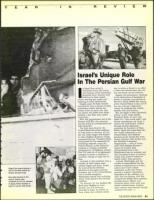
(Right) Gas masks became a
part of the daily routine for
Israelis during the war.
(Top right) America to the
rescue: Israelis were
comforted by the U.S. decision
to deploy Patriot missiles in
Israel to counter Iraqi Scuds.
was to strike at Israel in an effort
to draw the Jewish state into the
war and break up the coalition.
Despite the provocation, resulting
in the destruction of hundreds of
homes in sections and suburbs of
Tel Aviv, Israel heeded the urging
of the United States to stay out of
the war, scoring a diplomatic
victory by enduring the missile
attacks with stoic resolve.
But the depth of that diplomatic
victory is still under debate.
President Bush, at war's end,
spoke of a "new world order," and
almost immediately set about to
resolve the Arab-Israeli conflict
through shuttle diplomacy
conducted by Secretary of State
Baker. Israel had hoped that- the
war would underscore to the
United States that Mideast
tensions go far beyond the Arab-
Israeli equation, that Jordan and
the Palestine Liberation
Organization — both of whom
sided with Saddam Hussein —
cannot be trusted, that
relinquishing land to the
Palestinians may be suicidal, and
that Jerusalem's fears of military
attack from Arabs is based on
reality rather than paranoia.
Instead, Washington put the
burden of responsibility for the
success of negotiations on Israel,
and at year's end a peace
conference in the near future
seemed a realistic expectation.
Regardless of the outcome, it is
clear that the Persian Gulf War
changed the Middle East equation,
perhaps forever. Myths were
shattered about Arab unity and
Israeli combativeness; whether
these lessons were learned; though,
remains to be seen.
❑
THE DETROIT JEWISH NEWS
31