
Photo by Ruth Littman n
PEOPLE
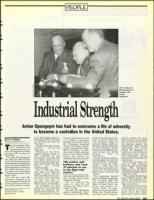
Anton, Teibe and
Max Opengeym lit
candles at the
temple
celebration.
Industrial Strength
Anton Opengeym has had to overcome a life of adversity
to become a custodian in the United States.
RUTH LITTMANN
Special to The Jewish News
- ll' he Birmingham Terri-
ple's custodian has
industrial-strength re-
solve. To congregants, Anton
Opengeym, 66, is a source of
inspiration.
Last April, Mr. Opengeym's
son, Josif, 35, died of brain
cancer. The funeral took place
one week after the Opengeym
family welcomed 102-year-old
Teibe Opengeym to America.
The mother of Anton, she is
the oldest Jew to immigrate
to Detroit from Latvia, in the
Soviet Union.
For over two years, Mr.
Opengeym struggled to ob-
tain a permanent visa for his
mother, brother and sister-in-
law. All the while, he worked
Ruth Littmann is an
assistant editor at Gale
Research Inc.
at the Birmingham Ibmple in
Farmington Hills and cared
for _ his dying son with his
wife, Sara.
Finally, last spring, reunion
occurred . . . and so did
separation.
Members of the Birm-
ingham Temple shared in
their custodian's joy and
bereavement, knowing that
the week's events did not
mark the first time Mr. Open-
geym experienced life's hap-
piness and sorrow
simultaneously.
Born in 1925, Mr. Open-
geym grew up in Riga, the
capital of Latvia. Between
1917 and 1934, Latvia was a
democratic state, exercising
its first and only in-
dependence from Germany,
Poland, Russia and Sweden.
Mr. Opengeym has fond
memories of his homeland
during his childhood. His
father, Josif Opengeym, own-
ed a prosperous herring
business and the family lived
in a midtown apartment
building they owned. Young
Mr. Opengeym attended
Jewish and Hebrew schools
with his three brothers, Max,
Hirsch and Beno. In class,
they spoke Yiddish and were
free to learn about Jewish
history and culture. On
weekends, the boys ventured
"My mother and
brothers and I had
10 minutes to run
to the Riga train
station."
into surrounding forests with
their Zionist youth group,
Hashomer Hatzair.
"For two weeks in the
woods we lived. We had
cookouts and talked about
Israel," he says.
Although Mr. Opengeym
speaks nostalgically about
the years prior to World War
II, they were good only by con-
trast. As early as 1934, Lat-
vian democracy began to
crumble. Strong fascist in-
fluences under the leadership
of Prime Minister Karlis
Ulmanis dismantled the elec-
toral system and denied
citizens a voice in
government.
Living conditions deterior-
ated throughout the land and
anti-Semitism increased.
Tragedy struck the Open-
geyms in 1940 when the
Soviet Union annexed Latvia
along with the neighboring
Baltic states, Lithuania and
Estonia.
The annexation resulted
from the Ribbentrop-Molotov
Pact of August 1939. The
pact, signed by Hitler and
Stalin, divided Poland into
Soviet and German ter-
ritories. Under the agree-
ment, Latvia was assigned to
Soviet rule. Though occupy-
ing Soviet forces alleged to
protect Lettish Jews from
Nazi takeover, they wreaked
their own havoc on the coun-
try. Banning religion, the
Communists closed Jewish
institutions. The Jewish
theater Mr. Opengeym at-
tended as a youth became a
Communist party school.
Josif Opengeym's herring
business was confiscated and
nationalized.
Then came the Nazis. On
June 27, 1941, Germany
broke the pact and bombed
Riga. Mr. Opengeym
remembers the city streets
teeming with people trying to
escape the chaos.
"The people shouted from
their windows," he says. "My
mother and brothers and I
had 10 minutes to run to the
Riga train station."
The invasion occurred while
Josif Opengeym was at work
on his new job as a factory
guard. Alone, Teibe Open-
geym had to make a choice:
167
Scanned image of the page. Keyboard directions: use + to zoom in, - to zoom out, arrow keys to pan inside the viewer.
September 06, 1991 - Image 167
- Resource type:
- Text
- Publication:
- The Detroit Jewish News, 1991-09-06
Disclaimer: Computer generated plain text may have errors. Read more about this.