

DETROIT
loome
YYjt1/4.1 -1.4 141
' 0 0.1t
41/4
AC,:ir
.
t tr`
•Vr
PHIL JACOBS
Managing Editor
L
arry Loewenthal can't
describe what happen-
ed to him last May.
There are the letters from
grateful patients he can
show you. There are the new
medical goals as an oph-
thalmologist that he came
away with that he can share.
But most prominent is that
caught feeling in the back of
his throat. He, like many of
us, used to stay composed
after recounting something
that will always remain
new.
With a successful oph-
thalmologic practice and a
comfortable lifestyle, Dr.
Loewenthal, a Southfield
resident, still had his
dreams. Quite simply, they
were to one day go to Israel
and practice what he loved
free for the people that he
loved.
It was the small story in a
spring edition of The Jewish
News that brought him
closer to the dream. The
story told about an Atlanta
doctor named Stephen
Kutner, a man who had
many of the same dreams
that Dr. Loewenthal held,
and a man who had created
Project Vision (Volunteer
Visual Services for Israelis
and Olim Now) for the eye
treatment of the Russian
and Ethiopian olim in Israel.
It seemed that Dr.
Kutner's story had been
seen in many parts of the
country. But the doctor only
received two inquiries, and
both were from Detroit. Dr.
Loewenthal's associate in
his practice, Dr. Jay Novet-
sky, had also called Dr.
Kutner. Neither Detroiter
knew that the other one had
inquired.
"I read the article in The
Jewish News on a Friday
night," said Dr. Novetsky,
"I want to do
something, make
good for Israel with
the skills I'm
trained in."
Dr. Jay Novetsky
also of Southfield. "I was
frustrated because I had to
wait all of Shabbos before I
could call Dr. Kutner. When
I got back to work I put a
letter on Larry's desk that I
was sending to Steve. He
laughed because he had his
own letter saying almost the
very same thing also on his
desk."
While Dr. Novetsky is still
trying to schedule his trip,
Dr. Loewenthal spent
several days in Israel per-
forming dozens of cataract
and corrective surgeries on
the eyes of olim who had
never been treated. The
largest challenge, besides
the lump in his throat he felt
after restoring sight to a
Russian or an Ethiopian,
came from the socialized
medical bureaucracy in
Israel.
As much as Israel is loved
by Diaspora Jews, it often
comes under criticism for the
months, sometimes years
that patients must wait for
treatment. A person needing
cataract surgery could wait
as long as 18 months to be
seen. Some critics have
called the medical system
one of a "Third World
nation," something that
would seem highly inap-
propriate for a country such
as Israel.
Dr. Loewenthal said be-
cause the socialized system
takes longer, patients who
have money seek private
treatment. When Drs.
Loewenthal and Kutner in-
troduced the latest eye
surgery techniques to col-
leagues in Israel, the recep-
tion was warm but also
skeptical. There were ques-
tions of medical bu-
reaucratic authority and
resistance to additional
competition for the private
practitioners.
The American doctors are
also working to set up an eye
clinic for the olim, a clinic
that would be run by an op-
thalmologist they trained.
There is also the non-
Photo by Glenn Triest
Going Off To Israel
With A Major Vision
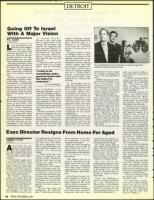
Drs. Jay Novetsky and Larry Loewenthal are hoping to expand their
treatment of newly arrived olim in Israel.
medical side of this project:
Dr. Kutner estimates the
clinic will cost $250,000 a
year.
A $400 contribution to Pro-
ject Vision will enable an el-
derly Ethiopian with
cataracts to see his or her
new homeland for the first
time. A $100 contribution
could possibly reverse blind-
ness in a diabetic patient.
The doctors are doing their
best to fund-raise. A great
deal of the money is coming
from their own pockets. Drs.
Loewenthal and Novetsky
arranged to keep their work
going last May with a
$29,000- gift from the Ben
Teitel Charitable Trust in
Detroit. With that money,
Dr. Kutner and Dr. Loewen-
thal were able to perform 45
cataract surgeries and 67
laser operations in a period
of five days.
But as Dr. Loewenthal has
Exec Director Resigns From Home For Aged
KIMBERLY LIFTON
Staff Writer
A
lan Funk, the ex-
ecutive vice president
for the Jewish Home
for Aged, resigned last week
after five years on the job to
"pursue other career oppor-
tunities."
"I would like to apply what
I know and the skills I have
learned to dealing with
senior citizens in some other
setting," said Mr. Funk, 39.
"I have been in the business
for 15 years and it is time to
check out something else."
Mr. Funk's resignation
comes six weeks after the
Jewish Federation formed a
committee to monitor day-to-
day operations and financial
management at the Home.
Federation officials said
they stepped in to find out
how the JHA has put to use
16
FRIDAY, SEPTEMBER 6, 1991
its supplemental allocations
totalling $4 million in the
past five years. The Home
has been operating on a
deficit, and Federation offi-
cials said they expect it to
operate on a balanced
budget.
A report from the com-
mittee is expected in the
coming month. Federation
officials said they do not
allege any intentional
wrongdoing at JHA.
Federation President
Mark Schlussel said Mr.
Funk took on the job "during
a difficult transitional
period for the institution and
he began the changes which
were necessary to continue
the Home as a vital provider
of services and care for the
aged for the next number of
decades.
"The job was trying and
demanding," Mr. Schlussel
said. "I wish him well in his
future pursuits as he gave
our community a real com-
mitment to the aged."
JHA has been struggling
financially, partly due to
skyrocketing costs of
medical care, a severe nurs-
ing shortage and insufficient
government reim-
bursements.
"The officers and the ex-
ecutive committee of the
Home have met with Mr.
Funk and have reluctantly
and with great sadness
acquiesced in his request,"
JHA President Jack Schon
said.
At the Home's request, Mr.
Funk agreed to remain in
his position through Oc-
tober. Afterward, Mr. Funk
said he will be available for
consulting for six months.
Some executive committee
and other board members
contacted said they were
surprised by Mr. Funk's res-
ignation, but said Mr. Schon
could speak for the board.
Mr. Funk joined JHA in
June 1986 as chief operating
officer. He took on the No. 1
position four months later.
Previously, he was ad-
ministrator of the Beth
Sholom Home of Eastern
Virginia in Virginia Beach.
He also held ad-
ministrative positions at the
Fairfield Division of the
Hebrew Home for the Aged
in Riverdale, N.Y., and the
Hebrew Rehabilitation
Center for Aged in Roslin-
dale, Mass.
Plans are underway to
launch a search committee
for a new administrator.
Meanwhile, a transitional
management team will be
formed to work with Mr.
Funk and the officers of the
board, Mr. Schon said.
❑
said, one week in May is
great but there is still much
more to do.
"I think I've always had a
dream to do what I can do to
help Israel," Dr. Loewenthal
said. "The week we were
there in May, I couldn't
think of anything else I'd
rather be doing."
Dr. Novetsky and his col-
league have bitter-sweet
feelings about their careers
here in America. Even
though they are successful
and fulfilled, there is still
that desire to be in Israel.
"I think I was very naive,"
Dr. Novetsky said. "I always
thought of Israel as this hi-
tech medical country. It is
militarily, but it's level of
medical technology is
relatively primitive. It's not
our intention to subvert this
system they have over there.
We just want to introduce
the successful utilization of
our skills so that there could
be a lasting result. We may
anger some people in the bu-
reaucracy. We realize there
are plenty of doctors there,
but we also realize that
there is a three-year waiting
list" for patients.
Dr. Loewenthal's intention
is to teach the Israeli op-
thalmologists the latest in
medical procedure. He said
the current level in Israel
uses techniques more ap-
propriate for the 1970s then
the 1990s.
The doctors are now hop-
ing their Project Vision
dream can gather momen-
tum. All three have said
they know no better way for
them to use their skills than
to make it work for Israel.
"We're not trying to step
on anyone's toes here," Dr.
Novetsky said.
Tax deductible contribu-
tions can be made to Project
Vision through the North
American Conference on
Ethiopian Jews (NACOEJ),
165 E. 56th St., New York
City, N.Y. 10022.
❑