

BACKGROUND
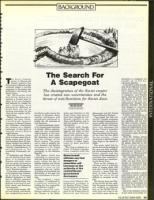
Artwork from Newsday by Gary Viskupic. Copyright o 1989. Newsday. Distributed by Los Angeles Times Syndicate.
T
he hero's funeral
given to 28-year-old
Jewish architect Ilya
Krichevsky in Moscow at the
weekend added a terrible
poignance to the drama and
turbulence convulsing the
Soviet Union.
Mr. Krichevsky died
defending democracy
against a system that so
many of his own forebears
had believed in, fought for
and, ultimately, were
betrayed by. Millions of
Soviet Jews will now be
waiting anxiously to see
what the new regime will br-
ing for them.
Western observers who at-
tended the joint Chris-
tian/Jewish funeral
ceremony in Manezh Square
last Saturday interpreted
the occasion as a hopeful
harbinger of the kind of
tolerant society Russia
might become.
The truth, however, is that
little is known about the at-
titude toward Jews of Rus-
sian President Boris Yeltsin,
whose republic has blazed a
trail in producing the most
virulent manifestations of
anti-Semitism in the
crumbling Communist em-
pire.
If moderates and liberals
are now hailing him as their
hero, it is certain that
Russia's extremely active
and growing nationalist
groups will also be expecting
him to act in defense of
"pure" Russian interests.
It has been a phenomenon
of the glasnost era introduc-
ed by Soviet President
Mikhail Gorbachev in 1985
that as officially sponsored
state anti-Semitism has
declined, so the level of unof-
ficial street anti-Semitism
has burgeoned.
As the heavy-handed offi-
cial anti-Zionist, anti-Jewish
line vanished from much of
The Search For
A Scapegoat
The disintegration of the Soviet empire
has created new uncertainties and the
threat of anti-Semitism for Soviet Jews
HELEN DAVIS
Foreign Correspondent
the Soviet media during the
period of glasnost, many
smaller newspapers and
periodicals continued to
peddle the old nostrums of
anti-Semitism.
A report published recent-
ly by London-based Institute
of Jewish Affairs acknowl-
edges the very considerable
improvements in the posi-
tion of Soviet Jews under
Mr. Gorbachev, but it warns
that the collapse of the
Soviet system "has given
rise to what is possibly the
most dynamic anti-Semitic
movement to be found
anywhere in the world,"
principally in the Russian
Republic.
The report, which was
published in association
with the World Jewish Con-
gress, echoes the fear of
leading scholars and Soviet
Jewry activists that the
search is now on for
scapegoats who are "guilty
of causing the bloodshed and
destruction of the past and
the wretchedness of the pre-
sent.
"This tendency," warns
the report, "is reinforced by
a historical tradition of
holding the Jew responsible
for all Russia's ordeals."
While powerful anti-
Semitic traditions remain in
the Ukraine, in the Baltic
states and elsewhere in the
Soviet Union, there have at
least been attempts by non-
Russian republics to con-
demn anti-Semitism and to
seek the support of the Jew-
ish minority.
In Russia itself, though,
the reaction has been the
opposite and today at least
120 social, political, re-
ligious and cultural organ-
izations embrace anti-
Semitism, making it "a tool
of greater or lesser impor-
tance in their political
arsenal."
The virus is rampant in a
clutch of Russian organiza-
tions, ranging from the
Some Israeli
officials say that
dangers to
minorities will
increase as the
authority of the
central Soviet
government
decreases.
chauvinist Pamyat (Re-
membrance) movement to
the Russian Writers' Union,
the Brotherhood of Russian
Visual Artists, the Associ-
ation for the Preservation of
Historical and Cultural
Monuments and the United
Front of Russia's Workers.
They blame the Jews for
the 1917 October revolution
that brought Communism to
power and for the Gorbachev
reforms, whose half-steps
have only deepened the
Soviet Union's economic
predicament. In between,
they also blame the Jews for
all the other ills that afflict
Soviet society —from
alcoholism to food shortages,
from drugs to the spread of
AIDS.
The acute relief felt by
Soviet Jews at the collapse of
the coup was fully justified,
but the disintegration of the
Soviet empire and the
demise of the instruments of
repression that sustained it
have created new uncertain-
ties for Soviet Jews.
Even as the collapse ac-
celerates; there is a growing
sense of unease about who
and what will fill the power
vacuum; a sense that, for
Jews, at least, the future
might be every bit as
difficult to navigate as the
past.
Few Soviet Jews now fear,
as they briefly did last week,
that the gates of emigration
will suddenly be slammed
shut on the 60,000 who al-
ready have exit visas or the
one million more whose ap-
plications to emigrate are
caught up in the bu-
reaucratic pipeline.
It should be noted, though,
that Soviet officials in some
Asian and Islamic regions
have begun setting up
obstacles for Jews who wish
to emigrate, and Simcha
Dinitz, chairman of the Jew-
ish Agency in Israel, said
that coup has not
substantially changed anti-
Semitic attitudes. He said
that dangers to minorities
will increase as the au-
thority of the central Soviet
government decreases.
Further, the emergence of
a new constitutional order,
with greater autonomy for
the republics, will not heal
the deep economic malaise.
There are growing fears
about the implications of the
looming social and political
catastrophe as the dying
Communist empire descends
into chaos.
With Mr. Yeltsin setting
the pace and writing the
agenda for the changes that
lie ahead, observers in the
West caution against
perceiving the successful
counter-revolution against
totalitarian tyranny as a
precursor to Western-style
liberalism and democracy.
The republics which con-
stitute the Soviet Union
suffer not only from seven
decades of Communist heg-
emony, but also from a lack
of liberal tradition and a
total absence of a democratic
culture.
It seems churlish to admit
reservations and to suspend
final judgment on the com-
prehensive defeat of a
tyrannical regime that has
terrorized its own people and
the entire free world since
the October Revolution of
1917.
But if the dramatic events
of last week were totally un-
THE DETROIT JEWISH NEWS
35