

telligence specialist told
U.S. News and World Report
in 1986 that "Assad will go
to whatever lengths he
deems necessary to insure
that the Israelis, the West
and fellow Arabs respect
him." Mr. Assad is said to be
determined that he, not
Egyptian leader Hosni Mu-
barak, be considered leader
of the Arab world.
"He thinks first and
foremost of his image," adds
Moti Zaken. A London
Observer report noted Mr.
Assad's love of "military
pomp" and passion for riding
in a "black-curtained
Mercedes escorted by
jeeploads of bodyguards
armed to the eyeballs."
Over the years, Syria has
been at odds with various
Muslim and Christian sects
in the region, with other
Arab nations — most often
Jordan and Egypt — and the
PLO. Mr. Assad has accused
PLO leader Yassir Arafat of
making too many conces-
sions and doing nothing to
advance peace.
Former Israeli Prime Min-
ister Yitzhak Rabin once
termed Mr. Assad "the best
enemy Israel has." For
despite the Syrian leader's
hostility toward the Jewish
state and his determination
to regain control of the
Golan Heights, Israel's nor-
thern border remains a place
of uneasy peace. Mr. Assad
has ,stuck to his agreement
to keep apart Israeli and
Syrian forces stationed in
the area.
The ADC's Mr. Nasr says
Hafez al-Assad has always
been interested in Middle
East peace. Syria is agreeing
now to participate in a con-
ference because "this is the
first time that a U.S. ad-
ministration has come with
a comprehensive plan based
on United Nations Resolu-
tions 242 and 338 and
trading land for peace. The
change was in the U.S. posi-
tion, not the Syrian posi-
tion."
Mr. Zaken believes Mr.
Assad's interest in the peace
conference is motivated by
his desire for good relations
with the West.
With his country billions
of dollars in debt, Mr. Assad
is said to be eager to secure
American financial aid.
Syria's economy has been
seriously affected by a mas-
sive trade deficit resulting
from extensive imports and
limited exports, as well as
defense demands which ab-
sorb some 50 percent of the
country's annual budget.
Mr. Assad was for years
dependent on Soviet support,
says Mr. Zaken, who holds a
master's degree in Islamic
and Middle Eastern studies
and is the author of a
number of articles on the
Middle East. But as the
Soviet economy and
government suffered
through months of turmoil,
Mr. Assad went in search of
a more dependable power.
His target: the United
States.
The Syrian leader began
currying favor with Presi-
dent George Bush during the
Gulf War, when Mr. Assad
opted to side with the United
States, not his Arab brothers
in Iraq. This was a shock to
more than a few Syrians,
Mr. Zaken says, who had
always heard "that the U.S.
is a horrible country and the
enemy because it supported
the Zionist entity.' "
Similarly, Mr. Assad's
decision to help secure the
release of two Western
hostages earlier this month
also is prompted by his in-
terest in increasing ties with
the United States, Mr.
Zaken says. The question is,
why are his actions being ac-
cepted without question?
Syria itself has been
implicated in numerous ter-
rorist activities, including
the 1989 bombing of Pan Am
Flight 103, said to have been
planned by the Syrian-
backed Popular Front for the
Liberation of Palestine-
General Command; a 1986
Abu Nidal attack on an
Istanbul synagogue and the
attempted bombing of an El
Al jetliner; a 1984 car bomb
explosion at the U.S. Em-
bassy in Beirut; and the 1983
truck bombing of U.S.
Marine barracks in Beirut
that left 241 American dead.
In a 1986 interview with
Time magazine, Mr. Assad
was asked about claims of
Syria's terrorist in-
volvement. He replied, "The
accusations do not worry us
because they do not repre-
sent the truth. Certain per-
sons in the U.S. are leading
this campaign. We believe
the accusations do not repre-
sent a purely American will
but a Zionist-Israeli will."
Syria, he said, "has no con-
nection with terror .. .
(though) we do advocate
struggle against Israel, by
all means, to expel the
Israelis from our occupied
lands."
Amid his past support for
terrorist activities, Mr.
Assad has interceded to save
hostages, notably during a
1985 TWA hijacking. Being
unpredictable — helpful one
minute, planning a bombing
the next — is said to be an
Assad tactic to keep his
friends and enemies unnerv-
ed.
Moti Zaken believes Syria
must show itself a consistent
friend and reliable ally for
many years before Mr.
Assad can be "welcomed into
the community of nations."
One proof of the Syrian
leader's good will, he sug-
gests, would be releasing the
4,500 Jews still in the coun-
try.
Despite his mistrust of Mr.
Assad, Mr. Zaken says he
welcomes the prospect of
Israeli-Syrian peace negotia-
tions.
"To sit and talk is very
important," he says. "It
moves the conflict from the
battlefield to negotiations on
paper."
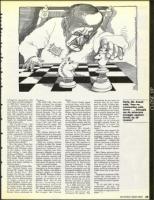
Syria, Mr. Assad
said, "has no
connection with
terror . . . (though)
we do advocate
struggle against
Israel, by all
means."
❑
THE DETROIT JEWISH NEWS
29