

DETROIT
Soviet Jews Tell Of
Flights To Freedom
AMY J. MEHLER
Staff Writer
W
hen Roman
Tounkel woke to
the soothing strains
of Bach and Prokofiev in his
Leningrad apartment last
week, his first conscious
thought was, "My God,
someone important must
have died."
"Russian radio doesn't
play that kind of music so
early in the morning unless
someone is dead or dying,"
said Mr. Tounkel, 37, who is
now in Oak Park visiting
family.
Mr. Tounkel thought
Soviet President Mikhail
Gorbachev was dead.
"I usually listen to music
or news at 7 a.m.," Mr.
Tounkel said. "I didn't find
out until I got to work that
Gorbachev was under house
arrest in the Crimea and
that right-wing Communists
had taken control of the
country."
Mr. Tounkel and fellow
workers at his laboratory
heard news of the military
coup 9 a.m., Aug. 19.
It was almost two weeks
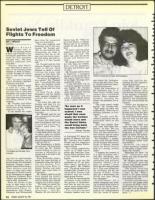
Yuri Shapiro and his sister, Dina
Kostinsky
ago that an eight-member
ruling committee, led by
former Soviet Vice President
Gennady Yanayev, made a
bid for control of the country.
Their military coup fell
apart in three days when
thousands of Soviets march-
ed on Parliament in support
of Russian President Boris
Yeltsin and demanded the
return of Mr. Gorbachev.
Since the failure of the
coup, at least seven of the
country's 15 republics have
demanded their in-
dependence. Only France,
Germany and Switzerland
14
FRIDAY, AUGUST 30, 1991
have thus far recognized
their new sovereignty.
"The radio program said
Gorbachev was ill and vaca-
tioning," Mr. Tounkel said.
"But no one believed that.
Communists are right in
whatever they do, so the
only way they can be remov-
ed from power and still re-
tain face is if they become
sick."
Mr. Tounkel said the first
thing he thought of was his
ticket to Detroit. He'd
planned to spend a month
visiting his sister and
parents in Oak Park. His
ticket was stamped Aug. 24.
"As soon as it happened I
was scared," Mr. Tounkel
said. "I was afraid that once
again the borders would
close and the Soviet Union
would bring back the Iron
Curtain."
In Oak Park, Adel
Kozadayev and her family
made repeated attempts to
contact her brother by
phone.
"You know the calls are
blocked and that it's im-
possible to get through,"
said Mrs. Kozadayev, who
hadn't seen her brother for
two years.
Mr. Tounkel said he was
more concerned for his fami-
ly in Detroit.
"I knew they didn't know
what was going on and I was
frustrated knowing I
couldn't reach them," he
said.
Said Mrs. Kozadayev, "All
I could think about was why
we didn't make my brother
and his family leave with us.
We should have broken
down his apartment and car-
ried him with us."
The Kozadayevs, a family
of musicians, left Leningrad
21/2 years ago. Mr. Tounkel
stayed behind in part to
oversee a laboratory he
opened and to be close to his
wife's parents.
Dina Kostinsky experi-
enced the same feelings of
frustration when she tried to
call her brother, Yuri,
ticketed from Kiev to
Detroit. Brother and sister
hadn't seen each other in
three years.
Mr. Shapiro said he would
have missed his sister's
trans-Atlantic call since he
and his family were already
on their way to Kiev airport.
"We found out about Gor-
bachev on Monday and we
left for the airport that
afternoon," said Mr.
Shapiro, 40, who arrived in
Detroit Aug. 20. "When we
got to the airport, a customs
official told us we probably
caught the last plane out of
Kiev.
"It wasn't until the plane
stopped in Ireland that we
felt safe," he said. "We
didn't rest until the Soviet
Union was behind our
back."
Mr. Shapiro left Kiev with
his wife, Inna, her mother,
Riva, and his daughters,
Veronica and Victoria, ages
11 and 3.
Mr. Tounkel said he drove
to Pulkovo-2, a Leningrad
airport, on the second day of
the coup to check the status
of his flight. His bags were
packed just in case.
"I was told there was no
word from upstairs to cancel
any flights," Mr. Tounkel
said. "There were about five
other Jewish people waiting
there when I got there."
Mr. Tounkel said the
mayor of Leningrad, known
to be a radical, told the city
"As soon as it
happened I was
scared. I was
afraid that once
again the borders
would close and
the Soviet Union
would bring back
the Iron Curtain."
Roman Tounkel
on Leningrad TV about the
protest in Moscow and that
Mr. Yeltsin barricaded
himself and his supporters
inside the Russian Parlia-
ment building.
The ruling committee,
made up of KGB secret
police and hard-line Com-
munity Party members, held
a live, televised press con-
ference.
"As soon as we saw the
committee on TV we knew
there wasn't anything to
worry about," Mr. Tounkel
said. "The group looked and
sounded like a bunch of ig-
norant idiots. Yanayev is an
alcoholic and can hardly
speak proper Russian.
"At first he was saying the
committee would continue
the policies of Gorbachev,
and then he said the com-
mittee would restore federal
powers above republic law."
The self-proclaimed
Kremlin leaders took over
Roman Tounkel and his sister, Adel Kozadayev.
days before Mr. Gorbachev
was to sign the Union Trea-
ty, which would have decen-
tralized Soviet power.
Since the restoration of
Mr. Gorbachev Aug. 21, at
least three former coup
leaders have committed
suicide. Other committee
members, including the
former vice president, are in
prison.
"The junta wasn't tough
enough," Mr. Tounkel said.
"They spoke too softly and
halfheartedly. There was no
military presence in Len-
ingrad."
Mr. Tounkel said Mr.
Yeltsin's popularity was un-
diminished when he left
Russia.
"He's more popular than
ever, even more than Gor-
bachev," he said. "But you
can't dismiss Gorbachev. I
think now there should be a
new election and an entire
restructuring of leadership."
Rae Sharfman, a spokes-
woman with the new Soviet
Jewish Prisoner Information
Center in Detroit, worries
about the Soviet Union's
lack of a strong, central
leader.
"I imagine the country is
in a state of anarchy now,"
said Mrs. Sharfman, who
works on behalf of Soviet
refuseniks and political
prisoners. "There's a lot of
panic all around. I worry
about the Jews being blamed
for it. They were blamed for
the revolution and for the
excesses of Stalin. Unless
they get a dictatorship, the
Soviets may come looking
for a scapegoat."
Leonid Stonov, 59, a
former refusenik now work-
ing on behalf of the Union of
Councils for Soviet Jewry,
fears the bids by Soviet re-
publics for independence
will stir waves of nation-
alism that could be dev-
astating for the republics'
Jewish populations.
Mr. Stonov, who came to
Chicago in 1990, is par-
ticularly concerned about
anti-Jewish recriminations
in the republics of Georgia,
Azerbaijan, Tadzhikistan,
Moldavia and Kazakhstan.
He is less worried about the
Ukraine.
"These are dangerous
places for Jews," Mr. Stonov
said. "Now that the old
system is in ruin, many
Soviets will blame the Jews
for bringing it about. They
say Jews created the system
and now they are the ones
running away from the
country.
"When the USSR was
under one ruler," he said,
"the people of the republics
could vent their anger and
frustration on Russia, a re-
public of about 150 million.
Now that it's breaking up,
populations will be looking
for scapegoats within their
own borders."
However, any move
toward democracy, republic
or otherwise, is good, accor-
ding to Mr. Tounkel.
"Especially for Jews," he
said. "Democracy and
reform can only be good for
Soviet Jews."
Mr. Shapiro said the coup
was inevitable since the
country had already passed
the point of desperation.
"The Soviet Union has
been crumbling one piece at
a time," he said. "When I
heard on the plane coming
over that troops had moved
in, I feared a civil war.
"It wasn't until later that I
heard how the people stood
up against the KGB. I felt a
great pride for those who
gave their lives for freedom.
It took me quite by sur-
prise." O