

OPINION
The Lost Weekend
The leisure of the weekend has gone down
the black hole of drudgery. Our task is to
regain it.
ARTHUR J. MAGIDA
Special to The Jewish News
B
eginning Friday mor-
nings and on 'til the
evening, the fre-
quently heard buzzword —
or, rather, buzz letters — are
"TGIF," "Thank God It's
Friday." .
For most people, this is not
a reference to the corning of
the Shabbat and the oppor-
tunity to keep it holy. With a
large percentage of Jews
either occasionally — or
never — lighting Shabbat
candles and only a small
percentage never driving on
the seventh day of the week,
the sanctity Of the Day of
Rest is uppermost in few
minds. There is no great
rush toward worship or in-
trospection, no traffic or
pedestrian jams toward
ghuls or temples.
Instead, when the end of
the workweek comes, the
rush is toward the hammock
in the backyard where we sit
idly 'til Monday morning.
Or the beach where we
build sand castles all day. Or
watch birds gather for
breakfast at dawn near a
babbling brook a few -steps
from the front porch, or we
gather around a campfire in
the evenings, roasting mar-
shmallows while • we get
misty-eyed singing songs
from our sweet and virtuous
youth.
Hogwash and balderdash!
Such weekends may occur
once — possibly, twice — in a
year. The more ordinary
weekend is crammed full of
such jobs, tasks, drudgeries,
duties, labors and toilings as
mowing the lama, doing the
laundry, going to the dry
cleaners, shopping for food;
clothes, toys and other ne-
cessities, shuttling the kids
to piano, swimming or la-
crosse lessons, balancing the
checkbook, paying the bills
and doing the dishes.
With two-income families
commonplace and just
everyone working harder to
avoid being targeted for a
recession-era layoff, gone are
the weekends of yesteryear.
My own past weekend, for
example, included making
Saturday breakfast for
departing overnight guests,
Arthur J. Magida is senior
writer for the Baltimore Jew-
ish Times.
waxing my car, returning a
tablecloth that I had pur-
chased the previous
weekend that was too small,
calling a sitter to watch the
kids on Tuesday, buying
provisions for a sleep-over
birthday party for my 12-
year-old, renting a video
tape and buying supplies for
a group art project for the
party, telling the party
guests to be silent at 1:05
a.m. on Sunday, making
breakfast for them, ushering
them out the door — then
vacuuming the house from
the mess they had made.
From 3:30 p.m. to 7:30 p.m.
on Sunday, we joined friends
at a poolside picnic, then
returned home, where I did_
three loads of laundry and
read two Sunday news-
papers to prepare for work
the next day.
My weekends are not that
much different from the
average American's, accor-
ding to "Waiting for the
Weekend," the cover article
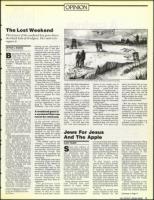
Artwork from Newsday by Bernie Cootner. Copyright° 1991, Newsday. Distributed by Los Angeles Times Syndicate.
clerks, fast-food attendants),
where the only talent re-
quired is to smile and say,
`Have a good day.' "
But ignored by many of us
who say (or hear) that salu-
tation is just what comptises
a "good day." -
Is a weekend in which
every moment -is packed
necessarily "good,' ' even if it
means we are exhausted by
the time Monday comes?
Or does "goodness" better
emerge from a .few activities
that are scattered amid
valued, cherished moments
in which we pause, reflect,
and -figuratively or lit-
erally — sit - still and hear
the vast and awesome
.
A weekend gone is
a weekend that can
never be retrieved.
in the current Atlantic.
Witold Rybczynski, a pro-
fessor at Montreal's McGill
University, writes that "the.
weekend has imposed a rigid
schedule on our free time,
which can result in - a sense
of urgency (`soon it will be
Monday') that is at odds with
relaxation.
"The weekly rush to the
cottage," continued the
writer, "is not leisurely, nor
is the compression of various
recreational activities into
the two-day break: The
freedom to do anything has
become the obligation to do
something . . ." -
Prof. Rybczynki notes that
overlaying sports and other
recreation is the "desire to
do something well . . . that
was previously met in the
workplace. Competence was
shown on the job — holidays
were for messing around.
Now the situation is re-
versed. Technology has
removed craft from most oc-
cupations."
The professor cites
"assembly-line jobs, where
almost no training or expe-
rience, hence no skill, is re-
quired, as well as in most
service positions (store
.
.
.
lences of our minds and of
the universe; gauge the
forces — good and bad,
tiresome or invigorating —
that buffet us about the rest
of the week; feel the love —
and the tensions — that flow
between the moments and
between those we encounter
within them?
In The Condition of Jewish .
Belief, Richard Israel wrote,
"A Shabbat that I miss can
never happen to me again. I
have lost it."
The same is true with the
more secular Saturday and,
for Jews, the always secular
Sunday. A weekend gone is a •
weekend that can never be
retrieved: Two days lost
down the black hole of scat-
tered busyness and self-
assigned tasks that we fear
will never get done unless
we pack them into the 48
hours of the two days that
'end and begin the week.
"We work to have leisure,"
wisely wrote Aristotle
.
But too many Americans
now work to have work. The
pace of the weekend, the
compressed chores of the
weekend, the occasional
ferocity .of the weekend have
robbed us of a respite from
the ferocity of the week.
It is our task to regain our
freedom to be leisurely- — if
we can remember how. 0
Jews For Jesus
And The Apple
ALON TOLWIN
S
ince the advent of
Christianity, Jews have
born the brunt of Chris-
tian missionary zeal. The
Jewish response has been
uniform: Even the youngest
and the most ignorant of Jews
withstood the most barbaric
tortures and ultimately pe-
rished rather than capitulate
to false beliefs. Jews have
known throughout the cen-
turies that the responsibility
to live a sanctified and
spiritual Jewish life demand-
ed from them to die rather
than embrace Jesus.
Today, Jews for Jesus claim
that 150,000 Jews now
believe in Jesus. Other
Rabbi Alon Tolwin heads
Aleynu, a Detroit area adult
Jewish education program.
sources proclaim that 12 per-
cent of Jews (which is approx-
imately 504,000) consider
themselves to be adherents of
other belief systems. -The
sources add that 22 percent of
Jews claim no affiliation to
any belief system. The
statistics of doom go on and
on.
In Phil Jacobs' article
(Jewish News, July 5), several
Jews are interviewed who
described a Judaism so devoid
of anything spiritual that
they felt compelled to look to
Jesus for Jewishness. Mr.
Jacobs also interviewed Jews
who spoke with sadness and
frustration at the present con-
ditions which foster such deci-
sions. They spoke of the hoax
of spirituality offered by Jews
for Jesus.
How can the Jewish com-
munity respond to this most
serious assault by the
assimilation monster? What
• can he done? This problem of
Jews believing in Jesus does
not exist in a vacuum. This is
just one more of the ugly
heads belonging to the
assimilation _monster. .
Rabbis and teachers. need to
tell the truth about Judaism.
The Jews that leave Judaism
rightfully complain about a
Judaism lacking spirituality.
In our society's haste- to be
modern and scientifit, some
rabbis, in their failure to
achieve or grasp Jewish
spirituality (kedusha), or
their fear that it wouldn't go
over well with the troops,
jetisoned it.
Jewish spirituality is real.
Judaism unequivocally in-
cludes and lives with a soul,
a personal relationship with
a God who created, sustains
Continued on Page 10
THE DETROIT JEWISH NEWS
7