

PROFILE
The Man Whose Tales
Hover Over Us
Isaac Bashevis Singer, who died last week,
left a bountiful legacy of literature combining.
the Old and New World.
ARTHUR J. MAGIDA
Special to The Jewish News
C
reation was no acci-
dent," Isaac Bashevis
Singer once said.
"God had an intention to
breathe life • into the world
and to make His masterpiece
— so it is written in the Bi-
ble."
For Isaac Bashevis Singer,
who died last Thursday of a
stroke at the age of 87, crea-
tion, also, was no accident.
His was a life of creation, of
endlessly fabricating tales
and narratives and parables
and great, spellbinding
yarns that were part other-
worldly, part eastern Euro-
pean shtetl, part New
World/New York, and part
— and this, indeed, is the
most important and in-
dispensable element — pure
Singer.
Isaac Bashevis Singer —
author and puckish gnome
and symbol to those who had
never known pre-Holocaust
Europe and/or had never
known their grandfathers
from the pre-war - era —
wrote of a world that he in-
habited and in which he long
trafficked:
A world of great, roiling
and, sometimes, sadly miss-
pent passions.
Of spirits and imps and
witches and dybbuks and po-
tent, swirling incantations.
Of the heart's frailties and
tenderness and furies.
A world of the unknown
depths and the unforeseen
longings of the soul.
"God is life and life is
God," said Mr. Singer, and,
in his own way, this man
who once said he was
"disillusioned with the
whole world," celebrated the
world and the life that
animated it, and, especially,
God's place in it.
Mr. Singer came from a
family of story-tellers. His
father, he wrote, told tales of
miracles performed by
Arthur J. Magida is senior
writer for the Baltimore Jew-
ish Times.
rabbis "to strengthen our
belief in God and in the good
and evil powers who reign in
the world." His mother re-
membered Bilgoray, the
Polish town "where her
father was the rabbi and ran
the community with a strong
hand." His brother, who had
a worldly bent, told of
"Germany, France,
America, about unfamiliar
nations and races . . ."
And his sister, he recalled,
"told romantic stories about
counts who fell in love with
servant girls."
And young Isaac, who had
read the Brothers Grimm in
German and Sherlock
Holmes in Yiddish, had his
own fantasies.
At the age of 22, while still
in Poland, this son and
grandson of rabbis, began to
write. For seven years, he
had studied in a yeshiva and
a rabbinical seminary in
Warsaw, and now, he was
"We are living in a
time of little story-
telling. Children
may save us.
Children are the
last readers of
stories."
Isaac Bashevis Singer
following in the footsteps of
his elder brother, I.J. Singer,
a well-known novelist in his
own right whom Isaac later
called his "master and
teacher."
He wrote, as he did all his
life, in Yiddish, the lang-
uage that, a few decades and
six million deaths later,
would become a ghostly
tongue from a now-ghostly
Jewish Europe.
The evening before he
received his 1978 Nobel
Prize for Literature, Mr.
Singer told fellow laureates-
to-be at a dinner in their
honor in Stockholm that he
wrote in Yiddish because,
"first of all, I like to write
ghost stories and nothing
fits a ghost better than a dy-
ing language. The deader
-
the language, the more alive
the ghost."
Mr. Singer's belief in res-
urrection had also convinced
him to write in Yiddish.
Without his efforts (and
those of the very few other
Yiddish writers still practic-
ing today), he said, there
wouldn't be much of an an-
swer for the "millions of
Yiddish-speaking corpses
(who) will rise from their
graves one day asking their
first question: 'Is there any
new Yiddish book to read?' "
And, anyway, added Mr.
Singer, he also writes in
Yiddish because it "is the
only language I really know
well."
The next day, Mr. Singer
told the Swedish Academy
that by honoring him, it was
also honoring "a loshon fun
golus, ohn a land, ohn
grenitzen, nisht gshtitzt fun
kein shum meluchoch":
"a language of exile,
without a land, without
frontiers, not supported by
any government."
In 1935, Mr. Singer came
to America. For the first few
years, as a contributor to the
Yiddish-language news-
paper, the Jewish Daily
Forward, he earned about
$15 a week, $4 of which went
toward a furnished room. It
was not until the early
1950s, with the English
translation of his novel, The
Family Moskat, that he
achieved broader acclaim
and a wider audience.
Despite having over 59 of
his books published, being a
Nobel laureate and twice
winning the National Book
Award, it was probably
Hollywood that gave Mr.
Singer his greatest fame.
His short story, "Yentl,
the Yeshiva Boy," was the
basis of the 1983 Barbra
Streisand film, Yentl, which
got mixed reviews, even
from Mr. Singer. Its adapta-
tion and directing, he said,
lacked "artistic merit."
Besides, he said, "there was
too much singing, too
much."
Critics preferred the 1989
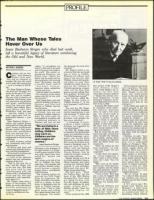
I.B. Singer: Wrote of imps and dybbuks.
film version of Mr. Singer's
novel, Enemies, A Love
Story. Janet Maslin, for in-
stance, the New York
Times film reviewer, called it
a "deeply felt, fiercely evoc-
ative adaptation "of the
brilliantly enigmatic novel"
about Holocaust survivors in
New York in 1949.
In person, Mr. Singer could
be outspoken about others.
For instance, American
Jews, he said a few years
ago, "are always ready to
fight, to express their opi-
nions, to protest. In some
cases, I think it would be
healthy to be a little more
modest, a little more silent.
We don't have to immedi-
ately accuse someone of be-
ing an anti-Semite."
But he could also be self-
deprecatingly humorous
about himself. He relished,
for example, telling about
being swamped by reporters
after his Nobel Prize was
announced.
"They all asked me the
same questions," he said.
" 'Are you happy? Are you
surprised?' "
"I said, 'Sure, I'm surpris-
ed.' About happiness, I
didn't want to have discus-
sions. So I said, 'Yes, I'm
happy.' "
"This went on for maybe
half an hour. Then came in a
new reporter and he asked
the same questions: 'Are you
happy? Are you surprised?' "
"I said to him, 'How long
can a man be happy? And
how long can a man be sur-
prised? I've already been
surprised. I've already been
happy.'
Although dybbuks and
spirits pervaded his
writings, Mr. Singer often
said he had "never met a
single demon in New York."
Yet his long-time secretary
and translator, Devorah
Menashe Teluskin, recalled
that, "Singer, in his own
funny way, would always
knock on the door before he
went into the house. He
always wanted to let the
demons know that he was
coming in."
In the 1970s and until his
health declined in the late
1980s, Mr. Singer often read
from' his works to audiences
around the nation. One of
his great enjoyments was
writing for children — and
reading these tales aloud to
them. Adults, he said, come
to him for explication and
explanation; children come
to savor the moment and en-
joy watching an old man ex-
cite them with his improb-
able tales.
Children, he said, "have
no use for psychology. They
detest psychology. They
don't try to understand
Kafka or Finnegan's Wake.
They still believe in God, the
family, angels, devils and
witches. They love inter-
esting stories, not commen-
tary, guides or footnotes.
When a book is boring, they
yawn openly without shame
or fear of authority. They
don't expect their beloved
writer to redeem humanity.
Young as they are, they
know it is not in his power.
Only adults have such
childish delusions."
"We are living," he said,
"in a time of little storytell-
ing. Children may save us.
Children are the last readers
of stories."
A few years ago, Mr.
Singer read "Rachel and
Menashe," a short story
about two blind children, to
an auditorium full of
elementary school children