

ISRAEL
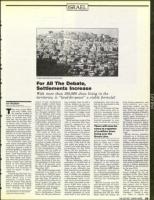
Israeli construction at a fever pitch.
For All The Debate,
Settlements Increase
With more than 100,000 Jews living in the
territories, is "land-for-peace" a viable formula?
INA FRIEDMAN
Special to The Jewish News
r
ime was, in the 1950s
and early 1960s, that
the popular symbol of
Israel was a spunky-looking
sabra in sandals and silly
cloth hat. An eye patch was
added after the Six-Day War
to honor the victory or-
chestrated by Moshe Dayan.
Yet if one had to choose an
appropriate symbol today,
especially in the eyes of non-
Israelis, it would undoubted-
ly be not a caricature at all
but a chunk of real estate:
the slanted, pink-tiled roof.
On mountain tops and
sand dunes throughout the
occupied territories, these
roofs have become a form of
political graffiti, a signature
announcing "Israel was
here." And with Israeli con-
struction at a fever pitch in
the West Bank and Gaza,
just when the government is
being wooed into sitting
down at the bargaining
table, it is -cArorth asking
whether the formula of
"land for peace" is still a
viable one.
A decade ago the mark of a
typical settlement in the
West Bank was a few
caravans, a watch tower,
and the Israeli flag flying
from a rock-strewn hilltop
fenced around with barbed
wire. "Stalags" the oppo-
Ina Friedman is a Jerusalem-
based free-lance writer.
nents of the settlement
policy snidely called these
eyesores. But today the look
and nature of Israeli set-
tlement in the territories
has changed radically. Few
are the families still living
in temporary (and thus eas-
ily dismantled or abandon-
ed) housing. Instead they are
comfortably ensconced in
well-appointed apartments
or houses of various shapes
and sizes, topped with the
ubiquitous pink-tiled roofs.
The scope of these set-
tlements gives serious
reason for pause. According
to the settlers' lobby, the
Council of Jewish Com-
munities in Judea, Samaria,
and Gaza, there were, as of
May, 103,855 Israelis living
in 144 communities in the
territories (all but 6,000 of
the settlers and 17 of the set-
tlements in the West Bank).
Contrary to expectations,
these figures represent more
than a doubling of the Jew-
ish population in these areas
(a rise of 68 percent) since
the start of the intifada in
December 1987.
The 13,000 housing units
scheduled to be built in the
territories in 1991-92 repre-
sent, by the council's reckon-
ing, less than 10 percent of
the construction going on in
Israel proper (to meet the
needs of the 315,000 Soviet
immigrants who have arriv-
ed since the start of 1990).
But according to Peace
Now's Settlement Watch
Team, the Housing Ministry
has invested close to half a
billion dollars in the ter-
ritories in the 1990/91 fiscal
year alone — and that
translates into 20 percent of
the ministry's budget sunk
into areas containing less
than three percent of Israel's
population.
Much has been made of the
rash of caravans that have
recently appeared in the
West Bank. But the real
drama going on in the ter-
ritories is a race to expand
the settlements with perma-
nent structures. Cranes,
bulldozers, cement trucks,
and an army of laborers are
working feverishly wherever
you turn. Fully half of the
new units are going up in
Israel's two large urban con-
centrations on the West
Bank: Ma'ale Adumim, a
few miles east of Jerusalem;
and Ariel, in the heart of
Samaria (the northern half
of the West Bank).
Ma'ale Adumim, with a
population of 15,000 that is
expected to increase by a
third within the next two
years, is now, officially, the
first Jewish city on the West
Bank. Ariel, with a popula-
tion of 10,000, two shopping
malls, two industrial parks,
a department store, a col-
lege, and a soon-to-open five-
star hotel, has plans to con-
struct 3,000 more units in
the next four years, bringing
its population up to 25,000.
The availability of jobs has
already attracted to Ariel
about half of the 3,000 new
.
immigrants who have set-
tled in the territories in the
past 18 months.
But it is the price of hous-
ing in these towns, plus at-
tractive mortgage terms,
that have long made them a
lodestone for young couples
and upwardly mobile
families prepared to com-
mute in return for owning a
There will soon be
close to a quarter
of a million Jews
living over the
Green Line.
private home. Two-bedroom
flats in Ariel run a mere
$70,000 — fully 50 percent
less than their most modest
counterparts in Tel Aviv.
Indeed, "improving the
quality of life" has long been
the government's slogan for
drawing settlers into the
territories.
The 140 or so smaller set-
tlements in the territories
range from upper-middle-
class suburbs hugging the
Green Line (the 1967 border)
to improved versions of
the caravan-and-watchtower
types inhabited by Israelis
who have moved to the ter-
ritories for ideological
reasons.
Ma'ale Levona and Eli,
both perched high on moun-
taintops in the stony wilds
of Samaria, are two of the
many "ideological" set-
tlements that dot the West
Bank. Here the homes, far
from being expansive and
fashionable, are con-
spicuously modest, and the
landscaping is scrappy at
best. Even the present con-
struction (courtesy of Israel's
Ministry of Housing) is of
small, squat structures or
equally drab row houses.
There is a sports center in
Eli (which presently boasts
40 families and is building
for 50 more) but not even a
grocery store, to say nothing
of more sophisticated ser-
vices.
Ma'ale Levona, similarly
isolated on a hilltop and
similarly about to double in
size, seemed deserted at
midday, with the population
at school or work somewhere
beyond the perimeter, The
overwhelming majority of
the settlements in the ter-
ritories resemble these two,
and recently published
statistics show that the
Housing Ministry has long-
term plans to augment them
with some 40,000 units, aim-
ing for a Jewish population
of 250,000 in the territories
by the year 2010.
Where is the building
frenzy leading? To the an-
nexation of the West Bank
and Gaza, the settlers hope.
Other Israelis are choosing
not to pay attention. On the
eve of Secretary Baker's
most recent visit to Israel,
just 600 demonstrators from
the left-wing parties pro-
tested against the set-
tlements — hardly a turn-
out likely to inspire the
THE DETROIT JEWISH NEWS
29