
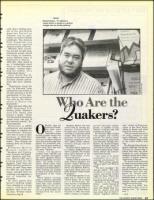

Richard Cleaver, "It's difficult to
impose tactics on people in a political
struggle who are actually suffering."
wald, later a leading mem-
ber of the anti-Zionist
American Council on
Judaism, was an isola-
tionist, as was Col. Charles
Lindbergh. The America
First Committee was
vehemently against
America's entry to the war.
Whether their orienta-
tion was left- or right-wing,
isolationist groups shared
one thing in common,
writes Manfred Jones in
Isolationism in America,
1935 1941. They failed to
see "a fundamental moral
issue in the European
struggle," instead regar-
ding the conflict "as a
jockeying for power."
After World War II,
Quakers took a dim view of
militant Jewish nation-
alists like Ze'ev Jabotin-
sky.
"Somewhere along the
way," Dr. Kirk said, "Arab
nationalism was written as
all right and seen to be the
nationalism of the poor.
But Jewish nationalism
was seen as the nation-
alism of Baron von
Rothschild."
More and more often, the
AFSC denounced U.S.
military power. America's
close ally, Israel, also
became a target. "Israel
was seen as this immensely
armed entity and part of
the American arsenal," Dr.
Kirk explained.
References in AFSC
publications and speeches
also began to compare the
Palestinians' situation
with that of Jews in Nazi
Germany. A 1978 New
England AFSC publication
stated, "Now Israelis are
making Jews out of Pales-
tinians."
Professor Marvin
Maurer, author of
"Quakers and Commu-
nists: Vietnam and Israel"
and "Quakers and Poli-
tics," believes 1967 was a
turning point for the
Quakers. Until then, the
AFSC was fairly neutral on
Israel, he said. Then came
the 1967 war, and Israel's
image changed from an
underdog to an aggressor, a
tool of American im-
perialism.
Dr. Kirk agrees that
Israel's shifting image
from underdog to a strong
nation influenced the
Quakers' view of the Jew-
ish state. "Friends readily
Continued on Page 28
Photo by Dan Rose n
-
0
• fficially, they are
known as Friends.
But their more
popular name
came about when
Friends founder George Fox
(1624-1691) was taken to
court for his radical religious
views. Fox told the judge that
despite his prominent posi-
tion, even he must quake at
God's word. Thus was born
the name "Quakers."
Today, the Quakers
number some 120,000 and
have churches throughout
the world. Quakers believe
they are guided by "an inner
light," not unlike a cons-
cience, which comes when
God speaks to them. Quaker
worship is characterized by a
silent meeting, the purpose
of which is to allow time for
development of the "inner
light."
While Quaker writings
make numerous references
to Jesus, a Friends' brochure
states that some members
regard . Jesus as the son of
God, "while others rank him
only as a great teacher who
exemplified the Inner
Light."
Quakers believe one best
serves God by serving hu-
manity. Consequently,
Friends have always been
involved in numerous social
causes. They were early op-
ponents of slavery and
longtime supporters of In-
dian rights, prison reform,
women's and gay and les-
bian rights.
Because of their opposition
to violence, Quakers do not
serve in armies. Nor do they
take oaths because of the
New Testament verse,
"Swear not at all."
Among some of America's
most famous Quakers are
author James Michener,
former presidents Richard
Nixon and Herbert Hoover,
flag-maker Betsy Ross and
early feminist leader Susan
B. Anthony.
The Friends operate 14 col-
leges and 77 schools in the
United States, 32 of which
are in Pennsylvania. Ed-
ward Jacomo is headmaster
of the one local Quaker
school, the Friends School in
Detroit on St. Aubin Street.
Founded in 1965, the school
offers classes in kinder-
garten through eighth
grade. A number of the
school's teachers and 120
students are Jewish.
Dr. Jacomo's office is filled
with puppets and colorful
posters for peace; fresh
flowers rest on a small table
near the back. Though not a
Quaker, Dr. Jacomo strongly
supports Friends' ideals of
nonviolence and the sanctity
of each human being. These
ideals define the school's
curriculum, he said.
"Our goal is to teach
academics in a value-
centered environment," he
said. "We're always asking,
`What is right?' and 'What is
good?'
"We don't inculcate," Dr.
Jacomo added. "We want
children to look at the
matter and decide what's
right for them. That's the
difference between
preaching and teaching."
Students at the Friends
School — mostly because of
their age — study little
about the Middle East con-
flict, Dr. Jacomo said. And
that which they do study is
strictly "cognitive informa-
tion: where is Palestine,
where is the West Bank,
where is Israel and what
part of the world is this in.
"We try to study how we're
all alike instead of how
we're different," he said.
"Then students begin to look
at the whole conflict that
way."
The Friends School faced a
special challenge during the
Gulf war, Dr. Jacomo said. A
school that does not allow
students to wear fatigues
suddenly found itself with a
number of pupils cheering
America on in the war.
The school itself continued
to teach values of peace and
nonviolence which students
are obligated to hear —
though in the end they must
formulate their own opi-
nions, Dr. Jacomo said.
Throughout the war,
students spent a lot of time
discussing their feelings
without adults mediating
and directing the talks.
"To say to a child, 'You
must believe this,' is not to
educate him," Dr. Jacomo
said.
❑
— E.A.
THE DETROIT JEWISH NEWS
27