

J
r - lends?
ing to "build up a PLO in-
frastructure under the very -
nose of the Israeli military
administration."
A number of AFSC
teachers, physicians,
lawyers and social workers
are in Israel. The. AFSC
operates 15 kindergartens
— 13 of which are in Pales-
tinian refugee camps —.in
the administered ter-
ritories. In 1974, it estab-
lished a Quaker Legal Aid
Center. According to an
AFSC brochure, "most
center cases concern the
detention of an individual
on security charges, rang-
ing from membership in an
`illegal' — generally Pales-
tinian nationalist — organ-
ization to unlawful demon-
stration."
The Quaker Legal Aid
Center provides funding
and assistance to some 60
Palestinian detention cases
each month. AFSC officials
say the center's work is
merely a kind of social ser-
vice, though Israeli news-
papers have charged on
several occasions that the
center is involved in polit-
ical activities.
In addition to Ann Lesch,
Israel also expelled Muba-
rak Awad, a Palestinian
whom the AFSC has since
sponsored on tours in the
United States. Mr. Awad
was ousted for encouraging
civil disobedience in the
administered territories.
Among Mr. Awad's stops
on an AFSC-sponsored tour
last year was Detroit,
where he said Quakers
served as his inspiration.
He labeled the PLO non-
violent, but told Jews "you
are doing to us exactly
what the Germans did to
you. Only the gas chambers
are not built."
Another AFSC-sponsored
tour was that of Terre
Fleener. In 1977 an Israeli
court convicted Ms.
Fleener of espionage, the
only American ever so
charged. As reported by
both Rael Jean Isaac and
Near East Report, Ms.
Fleener had traveled
throughout Israel, taking
photographs and collecting
information for Palestinian
terrorist groups.
Two years ago in Boston,
the AFSC was a cosponsor
of the "Apartheid's Arc
and the Palestinian Upris-
ing" conference at the
Massachusetts College of
26
FRIDAY, JULY 26, 1991
Art. Other hosts included
the Coalition for Palestin-
ian Rights, the Palestine
Solidarity Committee and
the Committee for a Free
Palestine.
According to The Boston
Jewish Advocate, Israel
was referred to at the con-
ference as "occupied
Palestine." Guest lecturer
Benjamin Beit-Hallahmi of
Haifa University said,
"The principle of Zionism
means discrimination and
colonialism," while Gus
Newport, former mayor of
Berkeley, Calif., declared,
"The fascist government of
Israel are the real ter-
rorists. Those who are
called terrorists, the PLO,
are fighting for political
identity."
Today, AFSC members
speak not of Arab-Israeli
problems in the Middle
East but of the "Israeli/
Palestinian/Arab conflict."
Denis Doyon is national
coordinator of the AFSC's
Middle East Peace Edu-
cation Program. That
many members of the Jew-
ish community might find
the AFSC's policies and ac-
tivities objectionable "is
not true," Mr. Doyon said.
But he acknowledges that
the Israeli government
"clearly doesn't agree with
many of the political posi-
tions we hold."
The AFSC was an early
advocate for dialogue with
the PLO, calling for talks
in 1970. Mr. Doyon says
PLO voices of moderation
were emerging that year,
"and we felt it was impor-
tant to make those voices
heard."
Two years later, in 1974,
PLO terrorists would
murder 11 Israeli athletes
at the Munich Olympics.
But this did not affect the
Quaker view. By 1976, a
Quaker Life article de-
scribed the PLO as "an
umbrella association of
moderate, independent Pa-
lestinian resistance
groups."
While the AFSC does not
condone PLO terrorist acts,
"we often work with people
we don't agree with," Mr.
Doyon said. "We feel bring-
ing people into dialogue is
the way to find alter-
natives to violence."
He said the AFSC also
has met with represent-
atives of Gush Emunim, an
Israeli group that ad-
vocates settling the ad-
ministered territories, as
well as Jewish residents of
Judea and Samaria and
right-wing Knesset mem-
bers. Meetings, he said, "do
not mean endorsements."
"Violence by the PLO is a
terrible thing," added
Richard Cleaver, secretary
for peace education at the
AFSC Great Lakes Region,
which is based in Ann Ar-
bor. "Violence by the
Israeli military is also a
terrible thing."
While he himself is a
pacifist, "as I sit here safe
in the United States, it's
difficult to impose tactics
on people in a political
struggle who are actually
suffering," he said. And
he's willing to overlook Pa-
lestinian violence because
he believes the PLO is
necessary for negotiations,
and only negotiations can
bring peace. Similarly, the
AFSC bases its policies on
two factors, he said: E)
violence doesn't lead to a
solution and 2) one can
only make peace with his
enemies.
- The AFSC supports talks
with the PLO "because it
can deliver in negotia-
tions," Mr. Cleaver said.
Professor Maurer be-
lieves the Quakers have
"long admired liberation
fronts." So the PLO, as a
self-titled "liberation
group," was a natural for
their sympathy.
"In theory, the Quakers
oppose all violence," Pro-
fessor Maurer said. "But
they believe that when the
tenant acts violently
toward the landlord, it's
because the landlord is the
persecutor and the ag-
gressor. Similarly, they see
the occupation as an
Israeli-run, police-state
operation. The PLO is
simply the reactor."
A
t its founding, the
AFSC's initial con-
cerns were "general
humanitarian activity," ac-
cording to H. David Kirk, a
former Quaker and author
of the booklet The Friendly
Perversion, which details
AFSC activities.
In the early part of the
♦■
•
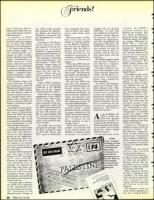
At left, "envelope"
illustrating an article
in the AFSC's June
1991 Middle East
Peace Notes,
criticizing the U.S.
`
'government
for
41,
,t.€ participating in the
Gulf War. Below, an
AFSC pamphlet
charting American
arms sales in the
Middle East.
•
century, the AFSC's
primary concern was
feeding the hungry. But
like other progressive
groups of its day, including
Christian clergy, the AFSC
was deeply influenced by
World War I. Anti-war
forces touted the battle as a
business of " 'greedy capi-
talists' and 'imperialists' "
and "saw the world in the
hands of armaments
manufacturers," said Dr.
Kirk, a retired professor
living in Canada. The
AFSC, which always has
defined itself as non-
violent, became an
outspoken opponent of
World War II.
Throughout the early
1940s, the AFSC sent
Krishnalal Shridharani,
author of War Without
Violence: A Study of Gan-
dhi's Method and Its Ac-
complishments, to address
groups of young Ameri-
cans. In one chapter of War
Without Violence, Dr.
Shridharani discusses the
situation of Jews in Ger-
many. He wrote that the
German people may
"appear" to support Nazis,
yet "thousands of Ger-
mans" expressed their
"disapproval" at Kristall-
nacht, the Nazis' 1938
purge that left thousands of
Jewish stores and syna-
gogues destroyed and hun-
dreds of Jews dead.
Instead of "falling as
helpless victims of the op-
ponent's wrath," Dr.
Shridharani suggested,
Jews in Nazi Germany
should have "dramatized
their sacrificial suffering,"
which would have roused
the sympathies of German
citizens and sparked them
to action._
David Kirk was among
those who heard
Krishnalal Shridharani.
A Jew born in Germany,
Dr. Kirk moved to England
in 1934 and attended a
Quaker school. He im-
migrated to the United
States in 1938 and joined
the Society of Friends,
When America entered
the war, "I refused to wear
a uniform," Dr. Kirk said.
"But toward the end of the
war, I realized I was
wrong." He later ended his
affiliation with the
Quakers.
The Quakers were not
alone in their opposition to
the war. Lessing Rosen-
'10
4
—1
-
1
-o