

bereavement counseling
for loved ones left behind
become part of that order.
It's empowerment for the
patient, a chance to make
decisions, be it what
medication to take or not
take or what television
show to watch that night.
Hospice care isn't easy,
and it often isn't smooth for
the family. Families with
single-parent households,
spousal abusers, drug
abusers and even AIDS pa-
tients are part of Hospice.
Staff members have taken
care of husbands whose
abused wives and children
were not unhappy to see
them go. Some patients are
alone, without a family
member or friend to help.
The Hospice of
Southeastern Michigan
covers Wayne, Oakland
and Macomb counties. Its
patients aren't always 85-
year-olds who have lived
full lives. They also work
with young parents who
don't understand why their
child is terminally ill. And
they see their share of
young adults, bitter that
they didn't have a chance
to fulfill their lives.
This is where Pete
Glassgold, a bricklayer
who loved traveling, fits in.
Brain cancer has taken
away part of his memory.
But most of all, it has
taken away his in-
dependence. He speaks
with defiance when
describing the numerous
times the doctors gave him
up for dead, only to watch
him rebound.
"It's important to under-
stand that we don't take
hope away from people,"
Hospice Vice President
Lois Armstrong said. "If
they want one more hit of
chemo, we say go for it."
Mr. Glassgold has been
pleased with the Hospice
care. The Hospice per-
sonnel, he said, have been
good to him. The difference
is dignity. When you are in
your own home, they are
visitors and they treat you
like you are the host, he
said. In the hospital, the
patient is the visitor.
Mr. Glassgold is a hand-
some young man who has
lost chunks of black hair
because of cancer medica-
tion. Today is a good day
because there isn't the
crushing headache assoc-
iated with his tumor. He
lies in bed and tells a cou-
ple of jokes. When he talks
about the Hospice, the
words are spoken carefully,
with time taken for
thought.
"I think that Hospice
understands what I'm go-
ing through," he said.
"They understand that on
one day I'm ready to give
up, to die. The next day,
though, I'm not ready to
accept the fact that I'm dy-
ing. Every time in the past
when I've gotten ready to
die, it didn't happen."
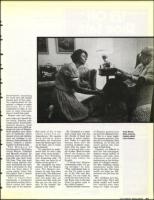
Marilyn Brady is director
of Hospice patient-care
services for Oakland Coun-
ty. She is a team leader
who assesses patients. This
day she is examining Celia
Goldberg, an 87-year-old
cancer patient who lives
alone in Oak Park.
Typically, it's difficult to
find the salt-and-pepper
shakers among bottles of
vitamins, pain pills, stool
softeners and other
medications on the kitchen
table of a Hospice patient.
For Mrs. Goldberg, taking
medications marks time
during the day. Her home
health aid helps her diff-
erentiate one pill from the
other.
Mrs. Goldberg isn't feel-
ing good today. She's still
losing weight and would
love nothing more than
sleep for eight straight
Nurse Marilyn
Brady examines
Hospice patient
Celia Goldstein.
A