

When
Dying
Means
Living
he 11-year-old Hospice
of Southeastern Mich-
igan serves Wayne, Oakland
and Macomb counties.
Hospice addresses the
physical, emotional, social
and spiritual needs of pa-
tients and their families.
Based on the idea that death
is part of life, Hospice pro-
vides pain treatment
without aiming to cure.
Instead, quality of life, in-
volving the entire family is
stressed. Also Hospice is an
umbrella concept of care. It's
not a facility where people
come to die. Instead, care is
provided at a patient's home,
nursing home or other set-
ting that meets a patient's
needs.
Empowerment of the indi-
vidual patient is stressed in
areas that range from the
control of pain to family mat-
ters that a patient feels must
be taken care of before death.
The patient is able to live the
final stages of life with as
much control and
dignity as possible.
A patient will be admitted
to the Hospice if he or she
has a terminal illness with a
prognosis of six months or
less, certified by an attend-
ing physician or the Hospice
medical director.
Hospice services include
evaluation and care by a
registered nurse, physician
house calls as needed, social
work services, volunteer
assistance, homemakers,
physical therapy and occupa-
tional therapy.
For further information
about the Hospice, call
313-559-9209. ❑
Jewish
Hospice
Jewish feelings; to Jewish
spiritual questions never
asked; to fears never felt
before; to families searching
for a Jewish response to
tragedy, and to a Jewish ex-
pression of bereavement.
body. But when a cure is not
possible, we are responsible
for palliative care. Therefore,
a physician's efforts to aid
and comfort are not per-
ceived as a denial of God's
prerogatives, but rather as a
duty. The physician is seen
as God's partner in main-
taining health, and in reliev-
ing pain.
Hospice
Defined
T
=1111111110111111111
T
he National Institute
For Jewish Hospice
(NIJH) offers practical and
moral guidance for Jewish
patients and professionals as
well as for non-Jewish profes-
sionals and volunteers.
A Jewish Hospice, accor-
ding to NIJH, must be
responsive to deep untapped
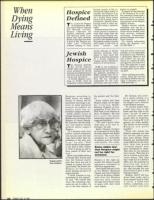
Hospice patient
Celia Goldstein.
FRIDAY, JULY 19, 1991
Hospices, according to
Rabbi Lamm, are largely
secular in nature, but do
sometimes encourage a pa-
tient to seek spiritual
sources of comfort no
matter what the in-
dividual's religious beliefs.
Rabbi Albert Lewis of
Temple Emanuel of Grand
Rapids was a founder of the
Hospice of Grand Rapids.
He said that Jewish tradi-
tion and modern Jewish
medical ethics support
Hospice.
"If it becomes clear that
further curative treatment
will not cure and will only
make them sicker, then the
palliative is the only way
to go," he said. "That
allows people to participate
to the best of their ability
in what is going on and to
have control of their own
lives."
Rabbi Arnold Sleutelberg
of Temple Shir Tikvah said
that the Talmud clearly
says that Jews are not to
impede or hasten the corn-
ing of death. He doesn't see
Hospice as hastening
death. Instead, he sees it as
improving life.
"I think Judaism is com-
passionate in this regard,"
he said. "We realize that
when life sustaining mea-
sures are not in order, it's
not in the best interest of
NIJH is also working to
bring Hospice to Jewish com-
munities all over the coun-
try. Judaism, according to
NIJH, stresses that we in-
habit a body that belongs to
God. We are, therefore,
responsible for the cure,
prevention and care of that
the patient and the fami-
ly."
Some rabbis feel that
Hospice might not be right
for everyone. Rabbi
Solomon Gruskin of Con-
gregation B'nai Zion in
Oak Park is not always in
favor of Hospice. He said
he's seen too many
miraculous recoveries on a
supposed deathbed.
"We don't know what
God's plan is for each in-
dividual," he said.
Rabbi Chaskel Grubner
of Congregation Dovid Ben
Nuchim agreed with Rabbi
Gruskin. He said that
treatment of a terminally
ill patient must be viewed
individually. For some,
Some rabbis feel
that Hospice might
not be right for
everyone.
Hospice is the right ap-
proach. For others, he said,
aggressive treatment to
the end is appropriate.
Both Rabbi Boruch Levin
of the Hebrew Memorial
Chapel and David Techner
of the Ira Kaufman Chapel
said that the Hospice
families they counsel
through bereavement seem
at peace with their loved
ones' deaths.
Those needing more infor-
mation about the services
provided by NIJH or the con-
cepts it discusses can call
1-800-446-4448.
❑
Mr. Techner, who surviv-
ed a cancer illness, is a
former board member of
the Hospice and a believer
in the Hospice concept.
"In ancient Judaic days,
people were born in the
home and they died in the
home," he said. "It used to
be, however, that most
people died in hospitals.
Now we're seeing 35 to 40
percent are home deaths.
The deaths we see through
Hospice are quite
peaceful."
Those who choose the
Hospice approach say that
the service offers more
than pain killing. These
families are automatically
made different by the mere
fact that the words
"terminal illness" have
been introduced to them.
This time it's not someone
else's cancer. This time it's
not in a movie or on a tele-
vision drama. This time
they walk out of a doctor's
office into the parking lot
knowing the cancer
belongs to a family mem-
ber; and through the care
they'll have to give, it also
belongs to them.
Hospice, they'll tell you,
gives them order and a
much-needed hand to hold.
A nurse, a home-care
worker, a physician, a so-
cial worker and even