

WATER WONDERLAND
West Bloomfield boasts some 25 lakes.
Special to the Jewish News
A
Thousands of acres of
lake water draw residents
and visitors to West
Bloomfield.
WB-8
FRIDAY, JULY 12, 1991
side from West Bloom-
field's boutique-dotted
streets and manicured
homes of grandeur, there are
a multitude of lakes both
large and small. Thousands of
acres of lake water furnish
West Bloomfield with its
claim to fame — of having
more lakes than any
populated township around.
"How lucky we are that we
have so many lakes," said
Carol Fink, owner of Happy
Trails, Inc., an excursion com-
pany for local groups. "Get-
ting back to that peaceful
beauty of nature is very im-
portant. Enjoy the blue heron
flying over the lake and the
sunset rippling over the
water," she said.
Over 25 lakes, more than
1/5 of West Bloomfield's area,
are located within this
beautiful township. The lake
area itself, in total, measures
over 4,000 square acres.
Whether the lakes are tiny
duck ponds four acres in size
or vast bodies of water with
boating privileges, each lake
offers something special to all
who are near. Residents who
live on or near the lakes,
those who just visit for the
boating or people who simply
drive by to admire the view
all benefit from the existence
of nature's West Bloomfield
waters.
The following passage
paints a clear and rather
humorous picture of how
Oakland county and its lakes,
including those in West
Bloomfield, were viewed dur-
ing the early 1900s — truly as
a resort area:
"Most of the beautiful lakes
of Oakland County are readi-
ly accessible by means of
either the Detroit United
Railway or the Grand Trunk
lines. The country roads are,
as a rule, well-built and kept
in good repair, and, in all
seasonable weather, auto-
mobilists are much in evi-
dence. The season of the sum-
mer resorters in Oakland
County commences early and
lasts well into October, which
makes both summer homes
and hotels profitable. This
fact ensures reasonable rents
and steady income. While
there are no mammoth
hotels, such as are found at
short-season resorts, there is
an abundance of fair-sized
hostelries and comfortable
boarding houses." — (History
of Oakland County, 1912)
In addition to Carol Fink,
another individual familiar
with West Bloomfield and its
lakes is Jim Laarman. He's a
certified hydraulic and hy-
drology engineer, who is
president of the Greater West
Bloomfield Historical Society.
As West Bloomfield's local
historian, Mr. Laarman has
an interest in and knowledge
of his city's lakes which keeps
him busy working at the
lakes and presenting
speeches to many groups
around town.
"The lakes of West Bloom-
field have formulated the
characteristics of our com-
munity," he said. Jim is atten-
tive to every aspect of these
beautiful bodies of water, in-
cluding their use, treatment
and how they are perceived.
"We had one of the first pro-
fessional lake planners in
Michigan," said Jim. "The
planner helps insure proper
usage of the lakes, which is a
significant aspect of lake
management."
Mr. Laarman provided some
fascinating tidbits about the
lakes of West Bloomfield.
Some might be fact, and some
might be fiction. You can be
the judge. For instance, there
are a house and a Volkswagen
at the bottom of Walnut Lake
. . . The cottages that once
stood on Orchard Lake's Ap-
ple Island were moved to the
mainland via the winter's ice
. . . Cass Lake is bottomless —
drowning victims never re-
appear . . . A young fisher-
man caught a pickerel out of
Bloomfield Lake which bit
him so badly that he needed
stitches . . . And some claim
that swans are man-killers,
but in Walnut Lake the swans
eat out of people's hands.
Sometimes lake dwellers do
not appreciate the ducks and
geese that frequent the lakes,
and some do not take proper
care of the lake environment.
"This can become an impor-
tant conflict," said Mr. Laar-
man. He feels strongly that
the lakes are not just for
humans, but are also a home
for the wildlife. "Ducks and
geese own the lakes. We must .
preserve the wetlands in
order to preserve the environ-
ment," said Mr. Laarman.
Mrs. Fink agreed. "We have
to respect, love and take care
of our natural resources. They
were here first, and once we
pollute them, we won't have
them anymore."
Along these lines, lake
owners who use fertilizer on
their grass are severely hur-
ting the lakes. "Fertilizer is
P hoto by Mars ha Sundq u ist
ANAHID LISA DERBABIAN
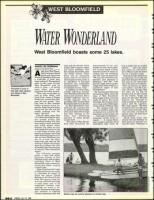
Boaters enjoy the summer pleasures on Orchard Lake.