

her
Survivors
Hundreds of thousands ci Jews sinned
the Moons! by eso3piv b the Sone( Union.
F hunger and loess we their
'
constant companions.
Soviet Union. The Nazis
had been especially eager
to "exterminate" Polish
Jews and set up the
majority of death camps
throughout Poland. These
included Auschwitz,
Dachau and Buchenwald.
The Soviets' decision to
build up Birobidzhan, and
to allow refugees into the
country, saved the lives of
some 2.5 million Jews, ac-
cording to historians.
At the same time, Soviet
authorities persecuted both
their own Jewish citizens
— in the now infamous
purges initiated by Stalin
— and the new refugees.
Invariably, Jewish immi-
grants were sent to labor
camps in Siberia where
food was scarce and freez-
ing temperatures were the
norm.
But the purges were not
limited to Jews, and Jews
who survived the Soviet
camps say they were simp-
ly part of a wave of
persecution with little
rhyme or reason. Indeed, a
1940 NKVD report
demanded deportation of
all landowners, bankers,
members of pre-
revoluntionary parties
(namely, comrades of V.I.
Lenin, especially the man
he designated his suc-
cessor, Red Army founder
Leon Trotsky), citizens of
foreign countries, persons
who have traveled abroad,
the staff of the Red Cross
and clergymen and "active
members of religious com
munities," • among others.
Most of those who fit these
categories were either ex-
ecuted or sent to labor
camps.
Not all Jews who ended
up in the Soviet Union
went willingly. In the
Molotov-Ribbentrop Pact,
the Soviets and Germans
agreed to divide Europe;
the Soviets invaded "their
half" of Poland and tried to
eliminate all ethnic Poles
from the sector, so as not to
give a future Polish state
the opportunity to demand
restoration of territory.
Hundreds of thousands of
ethnic Poles — many of
them Jews — were arrested
and transported to work
camps within the Soviet
Union.
M
artin Ryba heard
the first sounds of
war on Sept. 1,
1939. Germany was invad-
ing Poland.
The family had just fin-
ished Shabbat lunch at
their home on the main
street of Chorzele, Poland,
about 70 miles from War-
saw, on the Polish-German
border. Martin was 14.
Several days later, the
Ryba family headed deeper
into Poland. The central
figures in the family were
Martin's mother, Golda,
and his grandmother,
Sarah. His father, Aaron
Feival, had died years
earlier after his appendix
burst, and lay buried in the
Warsaw Jewish Cemetery.
"I never knew him,"
Martin Ryba, of Oak Park,
says today. "I was 9 mon-
ths old when he died. My
mother never talked about
it."
Because large cities had
been the safest places dur-
ing World War I, the fami-
ly sought refuge in War-
saw. Friday morning, six
days after the first
shooting, the war began in
earnest.
"Day and night, day and
night, day and night we
heard the bombs," Mr.
Ryba recalls.
Food and water were lim-
ited. Martin's job was
securing water for the
family, which included his
grandparents, mother,
Uncle Moshe, Uncle Chaim
and Chaim's wife and three
children. It was a two-hour
walk to the nearest river to
get water.
Once, while on his way to
the river, "I saw Warsaw
burning," Mr. Ryba
recalls. "Dead horses were
everywhere; people were
cutting them open to get
meat. I looked at some-
thing I didn't understand
and there was nobody to
explain it to me. This
image would come back to
me again and again."
Martin's grandmother
Sarah was in poor health
when the family first left
home; her heart trouble in-
creased during the next
few months. One evening,
Sarah became noticeably
worse. Though all Poles
were subject to curfew after
dark, Martin was sent to
get the doctor.
"I ran through the fields
to the doctor's house," Mr.
Ryba says. "He came, took
one look at my grand-
mother and started walk-
ing away. He said, 'If she's
still alive in the morning,
come and get me and I'll
see what I can do then.'
"In the morning, she
died. I thought she would
live forever."
After Sarah was buried,
Martin, his mother and
Uncle Moshe left for
Bialystok, by then occupied
by Soviet forces, where a
large Jewish population
lived. Chaim stayed in
Warsaw; the family never
saw him again. Sarah's
husband was among a
crowd of Jewish elderly,
women and children forced
into a barn which the Nazis
set afire.
Martin, his mother and
uncle managed to find
housing with relatives and
friends. They were luckier
than most. Many refugees
were living in synagogues,
where privacy was
nonexistent and food was
scarce.
The government was
eager for the refugees to
become Soviet nationals
and offered free citizenship
papers to all Poles. Those
that did not want to
become part of the Soviet
Union, officials said, need
only register and would be
sent to the destination of
their choice.
Despite Moshe's in-
sistence that the an-
nouncement was a trick,
Sarah asked to be _sent with
Martin to Detroit, where
the family had relatives.
The next night, three
Soviet policemen arrived at
Sarah's door. Martin and
Sarah were put on a train
with hundreds of other
refugees who had believed
the false proclamation.
No one knew the destina-
tion. The train traveled
every night for 12 nights
and stopped during the
day. Once, a man on the
train saw a peasant in the
fields. He called out,
"Where are we?"
It was too dangerous to
answer even this simple
question. The peasant
replied, "I was born at
night; it was dark and I
don't know anything."
The train stopped in
Plesesk, near the Finnish
border, where the refugees
were taken by truck to
Kargopol, then settled in a
labor camp on the lake.
The camp already was
populated with men and
women persecuted in
Stalin's purges and covered
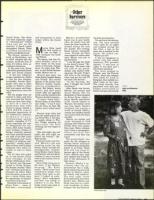
Photo by Glenn Triest
Lydia and Elkhonon
Yoffe.