

BACKGROUND
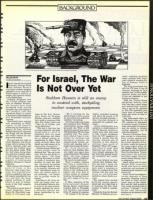
Artwork from Newsday by Gary Viskupic. Copyright° 1991, Newsday. Distributed by Los Angeles Times Syndicate.
HELEN DAVIS
Foreign Correspondent
I
srael regards the standoff
between George Bush
and Saddam Hussein
over Iraq's nuclear weapons
capability as an acid test of
Washington's ability to
shape a new post-war reality
in the Middle East.
Initially delighted with
the U.S.-led coalition that
took on Saddam Hussein,
the Israelis have been
burdened with second
thoughts since the ending of
the conflict left the
strongman firmly in control
of Iraq and a diminished but
still formidable military
machine.
The Israelis have watched
with incredulity as Wash-
ington, in the name of
preserving the territorial in-
tegrity of Iraq, allowed
Saddam Hussein to terrorize
the Kurds and the Shi'ites
and swiftly restore his iron
grip on the country.
The new post-war order in
which Egyptian and Syrian
troops were to remain in the
Gulf to maintain order and
security has trickled away
into the desert sands. With
the Gulf states facing their
own post-war trauma, there
is little hope of creating any
kind of regional force
capable of restraining
Saddam Hussein's future
ambitions.
Most serious, from Israel's
point of view, is the
discovery that Iraq's fear-
some non-conventional
military capability has been
left largely unscathed by the
war and that the Iraqi
regime continues to work
toward its goal of nuclear
terms of the Gulf ceasefire
agreement.
The result is a great deal of
Israeli skepticism. Accor-
ding to Dr. Dore Gold, a spe-
cialist in U.S.-Israel rela-
For Israel, The War
Is Not Over Yet
Saddam Hussein is still an enemy
to contend with, stockpiling
nuclear weapons equipment.
tions at Tel Aviv Univer-
sity's Center for Strategic
Studies, post-war realities
have made a nonsense of the
idea that Israel could now
"relax, go on holiday, give
up the territories.
"The fact is that Iraq has
not been defeated, the same
leadership is still in
Baghdad with the same
basic ambitions and there
are no defined security ar-
rangements in place. These
things certainly affect what
Israel can and cannot do in
terms of her own security."
Another Israeli official put
it more bluntly when he
declared that "the war is not
over. Iraq has the ability to
strike again." Far from
allowing Jerusalem to think
in terms of territorial com-
promise, he said, the Gulf
war convinced Jerusalem
that strategic depth is vital
to its security interests and
that "self-reliance must re-
main the central plank of
our planning - we cannot
rely on prompt rescue by
anyone."
According to Dr. Gold, the
Gulf war might have con-
vinced Saddam Hussein that
he must at all costs achieve
nuclear capability for use as
a deterrent against any
future interference by out-
side forces.
"He is waiting for the
allied troops to leave so that
he can pursue his ambitions
as before," he told me.
The Iraqi leader also hopes
that pressure from Western
humanitarian groups might
persuade the West to lift
sanctions against Iraq before
UN Resolution 687 has been
complied with. The resolu-
tion ordered Iraq to sur-
render its chemical and
biological weapons, its
weapons-grade nuclear ma-
terials and missiles with a
range of more than 95 miles.
Dr. Gold believes,
however, that Saddam Hus-
sein might once again have
underestimated President
Bush, who must respond
strongly to Iraq's violations.
"He cannot be ambivalent."
There is ample evidence
that Iraq is conducting a
secret nuclear weapons pro-
gram. Radioactivity was de-
tected on the clothing of for-
eigners who were held as
human shields at strategic
locations throughout Iraq in
the early stages of the con-
flict.
In May, inspectors of the
International Atomic
Energy Agency visited Iraqi
research sites at Tuwaitha
and Tarmiya and sealed
about 87 pounds of uranium
— 27 pounds of 93 percent
highly enriched uranium
and about 60 pounds of 80
percent enriched uranium —
that Iraq had declared it
possessed for peaceful pur-
poses.
Aerial photographs pre-
sented to a closed session of
the UN Security Council re-
cently show that Iraq tried
to hide nuclear equipment
from the UN inspectors by
moving it secretly from the
nuclear research site of
Tuwaitha to Abu Gharaib
military base north of
Baghdad. When UN inspec-
tors tried to enter Anu
Gharaib last week, they
were refused admission. By
the time they gained access,
the equipment had vanish-
ed.
An Iraqi defector has also
claimed that Saddam Hus-
sein has built a secret site
for producing enriched ura-
nium under a mountain in
Mosul in northern Iraq. The
scientist said that Iraq was
using an old-fashioned
method to obtain fissile ura-
nium.
The reports have revived
divisions among experts
about just how close Iraq is
to becoming the first Arab
country to build a nuclear
bomb.
Scientists from the British
Ministry of Defense are cur-
.
rently analyzing specimens
taken recently from Iraq's
main chemical weapons fac-
tory at Samara, north of
Baghdad.
The Iraqi government has
told the UN that it has 30
chemical warheads for Scud
missiles and 11,000 smaller
chemical bombs and shells.
It has not admitted to any
biological weapons.
Both the United States
and Britain, however, insist
that Iraq has a much larger
non-conventional arsenal
than it has so far admitted
to. The CIA reportedly puts
Iraq's store of mustard and
nerve gas alone at close to
3,500 tons.
Any determined effort by
the Western allies or by the
UN, whether by diplomatic
or military means, to destroy
these vast stocks of weapons,
and the ability to develop
nuclear capability, will be
welcome by Israel.
However, if President Bush
does succeed in eliminating
Iraq's nuclear weapons pro-
gram, he might then turn to
the nuclear capability of Isra-
el which, under the terms of
his arms control policy for
the Middle East, would be
expected to sign the Nuclear
Non-Proliferation Treaty
and place all nuclear
facilities under Interna-
tional Atomic Energy Agen-
cy safeguards.
Israel, along with all other
Middle East countries,
would also have to cease
production and purchases of
weapons-grade uranium and
plutonium.
So far, Israel has adopted a
low-key approach to these
proposals, stressing instead
the need to limit conven-
tional arms in the region.
But, said Dr. Gold, success in
Iraq would certainly lead to
nuclear "linkage" with
Israel and increased
pressure on Jerusalem to fall
into line. ❑
THE DETROIT JEWISH NEWS
33