

BACKGROUND
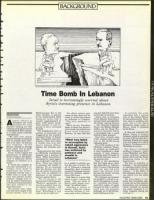
Artwork from Newsday by Anthony D'Adamo. Copyrights 1991, Newsday. Distributed by Los Angeles Times Syndicate.
Time Bomb In Lebanon
Israel is increasingly worried about
Syria's increasing presence in Lebanon.
HELEN DAVIS
Foreign Correspondent
senior official in
Jerusalem this week
sounded the most
ominous warning yet that
Lebanon could again become
a battlefield if Syria attemp-
ts to erode Israel's interests
and influence.
"We have very clearly
defined interests in Lebanon
and we consider these inter-
ests to be vital," he told me
last weekend. "If the
Syrians attempt to damage
them, there will be prob-
lems. We hope they don't."
Israel would regard the
deployment of additional
Syrian troops or the deploy-
ment of additional Syrian
weapons in Lebanon as a
threat.
It would also consider its
interests threatened if at-
tempts were made to
undermine the Israeli-
proclaimed security zone, a
buffer strip in south Leb-
anon that protects Israel's
northern villages from at-
tack by radical Palestinians
and Islamic fundamentalists
who have refused to lay
down their arms.
The security zone, which
runs the entire length of the
Israeli border, from the
Mediterranean Sea to the
Golan Heights, is patroled
by the Israeli-backed South
Lebanese Army and is
usually supplemented by
some 1,000 Israeli troops.
That number is now re-
ported to have increased
fourfold.
The heightened state of
anxiety in Jerusalem was
triggered by the recently
concluded Treaty of Friend-
ship, Cooperation and Coor-
dination, which gives Syria
a virtual veto over Leb-
anon's foreign affairs,
defense and economic poli-
cies.
Israel perceives the treaty
as effectively transforming
Lebanon into a province of
Syria: "What Iraq failed to
accomplish by naked aggres-
sion in Kuwait," said the of-
ficial, "Syria has achieved
by patience and stealth in
Lebanon. We are concerned
that the Syrians now feel
that the treaty has provided
them with an umbrella of
legitimacy to use Lebanese
territory against Israel.
"We are saying to the
Syrians and to the Lebanese,
`Whatever agreements you
may have reached, these are
our security interests — and
we remain committed to
them.' Everything is very
much in the air right now."
The official believes that,
sooner or later, Syria will at-
tempt to extend and deepen
its influence in Lebanon:
"The only question is
when."
While Syrian President
Hafez al-Assad has played a
protracted cat-and-mouse
game with Lebanon,
however, he may find that
"What Iraq failed
to accomplish by
naked aggression
in Kuwait, Syria
has achieved by
patience and
stealth in
Lebanon."
he is unable to entirely con-
trol the pace of events. For
all of Lebanon's seeming
tranquility, there is concern
among all Lebanese factions
about the political implica-
tions of the treaty.
And there is a sense that
sooner or later, violence will
erupt. "One car bomb in
Beirut could change every-
thing," the official noted.
According to sources in
London, while the various
sectarian militias in Leb-
anon made a show of disarm-
ing, they did little more than
go through the motions.
Aides close to Lebanese
Prime Minister Elias Hrawi
have privately conceded that
the former warring factions
— the Christian Lebanese
Forces, the Moslem Marada
militia and the Druse Pro-
gressive Socialist Party
—surrendered only a small
fraction of their arsenals.
Even then, virtually none
of the weapons were turned
over to the 40,000-strong
Lebanese Army.
The 6,000 members of the
Christian Lebanese Forces,
for example, are understood
to have transferred a large
quantity of their weapons,
including about 50 tanks, to
the South Lebanese Army in
the security zone.
There is also speculation
that the fragile peace which
has descended on Lebanon
after 16 years of devastating
civil war may end even
before the tenuous truce
between the former warring
factions breaks down.
The Lebanese government
has pledged to extend its au-
thority throughout the coun-
try, including the Israel-
controlled region of south
Lebanon, by July 1, and this
could pose the greatest
challenge yet to the Syrian-
backed Lebanese Army.
At present, the army
maintains only a tenuous
grip on the capital, Beirut,
on the predominantly Chris-
tian areas in northern Leb-
anon and on the Shouf
Mountain range south of
Beirut, which is inhabited
by the Druse.
It does not command the
Bekaa Valley of eastern
Lebanon, which is controlled
by some 3,000 Iranian Revo-
lutionary Guards who equip,
train and support the radical
Islamic fundamentalist
Hezbollah movement.
Nor does it command
southern Lebanon, where
armed Hezbollah and Pales-
tinian militias confront
Israeli forces and the South
Lebanese Army in the
security zone.
The key to stability in
Lebanon — the prerequisite
to restoring central govern-
ment authority over the
country — is the ability of
the Lebanese Army to exer-
cise control over the entire
country.
Yet even before it con-
fronts this formidable task,
it must root out the systemic
factionalism and corruption
which wrecked its morale
and which rendered it vir-
tually impotent during the
civil war. 0
THE DETROIT JEWISH NEWS
31