

EDUCATION
-
Th
Yavneh At Two
Like a fledgling business in a time of recession, Yavneh
Academy works to survive the move into its third year.
PHIL JACOBS
Managing Editor
D
r. Margaret Eichner
sometimes wishes it
was 10 or 15 years in
the future. Then she could
lean back in the comfortable,
cushy chair and talk about
the "good old days," the days
when the Yavneh Academy
had 14 students and was
struggling to survive.
She wouldn't have much
time for any sort of inter-
view, because the high
school's varsity soccer team
and pep squad were getting
ready to compete, and a
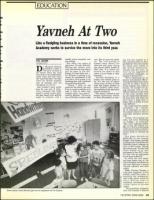
Yavneh teacher Donna Brennan goes over an assignment with her students.
middle school assembly was
just ending.
But after two years of
operation, Yavneh, Detroit's
Reform day school, isn't
even 100 percent sure that it
will be open in the fall.
Forget 15 years from now —
Dr. Eichner is looking to in-
crease its enrollment to 25
and add a third grade to its
kindergarten and combined
first and second grades.
"When I look at the
goals for the school, the way
I try to remain realistic is to
take a look at other day
schools after two years,"
said Dr. Eichner. "I'd love to
have 100 kids in school right
now. But it's just not realis-
tic. The real growth in
almost every school I've
observed took place during
the school's third, fourth or
fifth year. If a school can
survive for three to five
years, it is no longer a risky
business."
Yavneh Academy is a
bright and colorful place to
be. It's the sort of school
whose main corridor is filled
with the happy chatter of
little children. After lunch,
the melodies of the afternoon
prayers are heard.
The school, located at the
Jewish Community Center
in West Bloomfield, is mov-
ing over the summer to a
new rent-free home at Tem-
ple Beth El. The move places
the school more central to
the Jewish community.
Yavneh sees the move, as
well as an aggressive
recruitment campaign, as
the key to its survival.
"We're continuing our in-
tensive recruitment effort,"
Yavneh President Jim Jonas
said. "If we didn't think it
would happen (the school's
future), we wouldn't be go-
ing through with it. It's
difficult because at this time
of the year, people still
haven't made their decisions
for next year, and when you
don't have a large base to
begin with, it makes it even
more difficult."
Mr. Jonas said the number
of students — 25 — was bas-
ed on economics as well as
the school's desire to show a
somewhat dramatic growth
rate.
"Listen, we're paying our
bills, and we're balancing
our budget," he continued.
"But we're fighting battles
like all the day schools are.
There's a five-year threshold
of incubation during which a
school needs to increase its
base."
The base stands at
$200,000 as the annual
budget, with tuition, private
funding and a United Jewish
Charities grant making up
most of the monies. During
the school year, Yavneh had
fallen behind on its rent
payments to the JCC, a fac-
tor that will be eliminated
by its move to Beth El.
So while the rent factor
has been taken care of, the
issue of higher enrollment is
one that continues to puzzle
Yavneh officials and area
rabbis.
Rabbi Norman Roman, a
long-time supporter of the
school, said the trick is
teaching the community
that a day school, which for
many Reform Jews is
somewhat antithetical, is a
viable choice of private
school.
"The population, primarily,
that will consider a Reform
THE DETROIT JEWISH NEWS
57