

I
CLOSE-UP
When the Land of Milk and Honey
Becomes Wear y
Between new peace initiatives,
Soviet olim and increased
economic woes, Israel is undergoing
a dramatic metamorphosis.
.4
"INDEPENDENT?" the
poster reads. "We are slaves
of America!'
ELIZABETH APPLEBAUM
Assistant Editor
ne Israeli cab
driver believes
the Arabs are
the root of all
Israel's ills.
"Give the Palestinians a
state?" he cries, running his
hand over his head. "What,
are you crazy? Deal with
Yassir Arafat? A terrorist? A
man who hates us? A man
who wants the whole of
Israel to be Palestine?"
A second driver, younger,
says the establishment of a
Palestinian state is a
necessity. "Who are we to
tell the Palestinians they
can't have a homeland?" he
says. "Aren't they human
beings? Don't they want a
country, just like us?"
Air fresheners shaped like
pine trees hanging from
their rear view mirrors,
Israel's taxi drivers have an
opinion on, and an answer
for, just about everything.
Economic crisis? They know
how to solve it. Thousands of
Soviet o/im? They know ex-
actly what needs to be done.
How to handle tensions bet-
ween religious and non-
religious Israelis? Here, too,
the solution is as close as
the nearest taxi driver.
It isn't just taxi drivers,
though. Everyone in Israel
has an opinion on every-
thing. And there is plenty to
have an opinion about these
O
Elizabeth Applebaum
returned last week from
Israel, where she took part
in the Jewish Welfare
Federation of Greater
Detroit solidarity mission.
28
FRIDAY, MAY 10, 1991
amat Gan, a suburb
of Tel Aviv, was one
of the cities hardest
hit by the Iraqi Scud mis-
siles. Five Scuds fell in
Ramat Gan, damaging
3,000 apartments. One man
was killed; another 110
were injured.
Ramat Gan's Deputy
Mayor Moshe Meron, in
1985 a visiting scholar to
Detroit, was at home when
a Scud fell 26' away.
"Everything went dark," he
says. Cupboards flew open.
Dishes shattered and tum-
bled out. Splinters of glass
fell like sharp rain. There
was a smell of smoke.
"My wife screamed;' Mr.
Meron said. "And I said, 'I
think it hit us this time! "
Hours later, the rabbi ar-
rived. The Merons had just
hung an Israeli flag from
their balcony. The deputy
mayor, his wife and the rab-
bi all took shots of whiskey.
Then they said l'chayim,
"because we made it!"
A map in the Ramat Gan
city hall shows four sites
damaged by Scuds. It will
cost $25 million for repairs,
about 80 percent of which
must be paid by the govern-
ment. Among the Ramat
Gan buildings hit were a
memorial for soldiers, the
public library, kindergar-
tens and a school for the
dramatic arts.
Houses and apartments'
destroyed by the Scuds have
been razed. In their place
are piles of red dirt, paper
scraps and empty Coke cans.
Salvaged goods were taken
Photo by M ichael Jon Vigodda/Med ia
R
days. The Gulf war after-
math. Hundreds of thou-
sands of Soviet ohm pouring
into the country. A severe
shortage of jobs — all factors
many believe are dramatic-
ally reshaping the face of
Israel.
Among the most pressing
issues for many Israelis to-
day is U.S. Secretary of
State James Baker's peace
initiative. Mr. Baker has
been traveling throughout
the Middle East in an at-
tempt to establish direct
negotiations involving Is-
rael, the Arab states, the
Soviet Union and a Palesti-
nian representative.
■
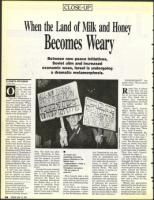
An Israeli man
protesting American
peace initiatives in the
Middle East.
"Independent?" reads a
poster plastered
throughout Jerusalem.
"We are slaves of
America."
Most Israelis take a dim
view of any Baker-sponsored
talks, fearing they'll be cor-
nered into a settlement they
do not want.
If forced to an interna-
tional conference without
certain guarantees — name-
ly, that the Palestine Libera-
tion Organization not par-
ticipate, that no Palestinian
state be established and
that Jerusalem remain one
city under Jewish control —
Israel is likely "to lose
everything," says Likud MK
Reuven Rivlin. "We don't
want anyone to decide our
future except us!'
Signs posted throughout
Jerusalem reflect Israelis'
frustration with attempts by
the American government
to influence the country's
political future. A - recent
poster, placed by the late
Meir Kahane's Kach Party,
decries James Baker's Mid-
dle East peace initiative.
"4
4
-4
-4