

•••••••••••••••••••••••••••• •••••••••••••••••••••••••••••••••••••••••••••••••••••••••••••••••••••••••••••••••••••••••••••
the past, she feels no permanent
commitment to Yiddish theater.
This above all is what Leon
Leibgold, a grand old man of the
Yiddish stage, really means when
he comments flatly that, "There
are no young Yiddish actors any
more; there are only young actors
who play in Yiddish."
Like the larger Yiddish culture
of which it remains a resonant
part, the Yiddish theater continues
to shrink painfully with age. Yid-
dish actors and playwrights, like
Yiddish journalists and poets, are
remnants. They've held on through
assimilation, the ascendancy of the
Hebrew language over Yiddish,
and the destruction by the Nazis
and Soviets of the source of Yid-
dish speakers. There is no longer a
range of Yiddish newspapers to
publish theater reviews, argumen-
tative critiques and columns of
backstage gossip. Gone is the
nightlife associated with Yiddish
theater-going, the sociable side-
walks and crowded cafes. Most of
the splendid artists and their
devoted fans are dead. The old
Yiddish quip sharpens its bite: "An
old Jew just died; move another
seat out of the theater?'
Yiddish theater has been an in-
stitution for zeydes and bubbes for
a long time now. The new season's
shows (there are three scheduled so
far) routinely offer more matinees
and fewer evening performances
than Broadway shows do because
their elderly audiences avoid cold
nights on scary streets. Although
the Yiddish theater was once as
famous for its literary avant garde
as for its popular entertainments,
now when audiences want some-
thing new and intellectual, they
find it more conveniently in
English. Most regular Yiddish
ticket-buyers crave a trip in a time
capsule: the old familiar repertory
performed in the old familiar style.
Nevertheless, in the hundred
years since the great Eastern
European Jewish immigration,
New York City has never gone a
season without Yiddish theater.
The older actors gallantly carry
the flame, scratch together the pro-
ductions, and preserve a theater as
much as possible in their own im-
age. The audiences still get them-
selves there, even if the nursing
home has to charter a bus. They
love to hear the language, they
love the link with their youth, and
besides, the shows are sometimes
terrific.
(There are also community in-
stitutions such as the Workmen's
Circle which chip in subsidies, for
the culture still feels strongly
about its theater, values it, and
even measures itself by it.)
On the fringe of this world, a
pool of several dozen younger ac-
tors like Eleanor Reissa perform
on the Yiddish stage. They per-
form mostly in New York City or
in NewYork-based companies that
tour Miami and elsewhere. Mon-
treal has its own troupe and small
amateur groups exist in other
cities. The young actors appear
with established Yiddish stars or
sometimes just pinch hit when a
tour comes through from Israel,
Latin America, or Eastern Europe.
About 30 actually belong to the
Hebrew Actors Union, which is af-
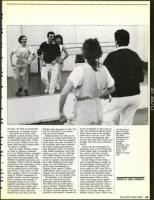
Lori Wilner, Bruce
Adler and Eleanor
Reissa in rehearsal.
Miss Wilner
performed around
the country in a
one-woman
dramatic
presentation of the
life of Holocaust
heroine Hannah
Senesh, in
English, for several
years.
PHOTOS BY CRAIG TERKOWITZ
THE DETROIT JEWISH NEWS
23