

• • • • • • • • • • • • • • • • • • • • • • • • • • • • • • • • • I
CLOSE-UP
• • • • • • • • • • • • • • • • • • • • • • • • • • • • • • • • • • • • • • • • • • • • • • • • • • • • • • • • • • • • • •
NAHMA SANDROW
Special to The Jewish News
T
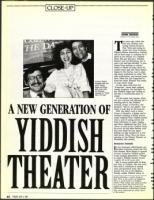
Producer Moishe
Rosenfeld (left) and
actors Eleanor
Reissa and Bruce
Adler pose under
the Broadway
marquee for "Those
Were The Days."
ANEW GENERATION OF
YIDDISH
THEA
22
FRIDAY, MAY 3, 1991
en years ago, when she
was just another cute
young woman living in
New York and trying to
break into show business,
Eleanor Reissa answered a casting
call in Backstage to audition for a
place in the chorus of a Yiddish
show. She got the part. Yiddish
theater was not Broadway, but it
was a job and she decided "it was
better than waiting on tables,"
which is where so many show biz
careers start and end. Miss Reissa
began in the chorus, rose to play-
ing saucy soubrettes in other Yid-
dish productions, and several years
later, when the star happened to
leave her show, Eleanor was ready
to step center stage.
At the same time that her
"American" career kept making
steady progress, the spotlight on
the Yiddish stage was coming to
feel like a comfortable place to
stand.
All the same, last season, when
she got a phone call offering her a
starring role in the Yiddish
musical, Songs of Paradise, she
groaned, "Oh no, not again!" and
made a rude face at the receiver.
Still, she didn't turn it down.
Songs of Paradise, a frisky and ir-
reverent retelling of Bible stories,
newly adapted from Yiddish poetry
with a cast of young actors and
fresh references to salsa, reggae,
and disco, delighted the New York
Times as well as the Yiddish Daily
Forward. So did Miss Reissa. And
this year finds her yet again
belting out big numbers in a Yid-
dish revue, Those Were the Days,
opening at the Edison Theater on
Broadway this month.
Bemused Attitude
n her bemused, affectionate, am-
.1. bivalent attitude toward the Yid-
dish theater, Miss Reissa is typical
of most American Yiddish actors
of the younger generation. ("Young"
in today's Yiddish theater means
roughly 20 to 45 years old.)
She is more comfortable in Eng-
lish than in Yiddish. She was born
here and is American in acting
style and personal style. She is
Jewish but not at all religious.
Finally, unlike Yiddish actors of
Nahma Sandrow, a writer living in
New York, is the author of Vagabond
Stars, a world history of Yiddish
theater. This article was made possible
by a grant from The Fund for Jour-
nalism on Jewish Life, a project of the
CRB Foundation of Montreal, Canada.
Any views expressed are solely those
of the author.