

DETROIT
Chaplain Finds Gulf War A Mix
Of Camels, Religion And Horror
ELIZABETH APPLEBAUM
Assistant Editor
R
abbi Ben Romer never
put his boots on
without first shaking
them out. With the numer-
ous snakes and scorpions in
the desert, "You never knew
what decided to move in," he
says.
And he never knew just
who might stop by for a visit
at his makeshift home — a
tent decorated with a
typewriter, a cot and a field
telephone. As the troops
neared Iraq, camels in sear-
ch of food often poked their
heads through Rabbi
Romer's door.
Life in the desert was
anything but predictable ac-
cording to Rabbi Romer, a
Michigan native who just
returned from serving as
military chaplain in the Gulf
war.
Rabbi Romer, a captain in
the army, was raised in
Rockford, just outside Grand
Rapids. His father moved
the family from West
Virginia to Rockford, where
he found work in insurance.
Though their Michigan
home was located in a
suburban area, the Romers
often woke up to discover
cows in their backyard.
Ben Romer graduated with
a degree in general studies
from the University of Mich-
igan, where he served as
student president of the
Hillel Foundation. After col-
lege, he began rabbinic
studies at the Hebrew Union
College-Jewish Institute of
Religion.
Ordained in 1979, Rabbi
Romer worked as assistant
rabbi/educator at Temple
Beth El in Hollywood, Fla.,
at Temple Israel in West
Lafayette, Ind., and at Beth
Israel in Northfield, N.J.
While in Indiana in 1984;
Rabbi Romer joined the In-
diana National Guard.
As a Jewish military
chaplain, Rabbi Romer was
a rarity. Many of those he
encountered "had never met
a Jew, let alone a Jewish
chaplain," he says.
He worked one weekend
every month and two weeks
each summer with the
Guard, as a counselor and
arranging services for Jew-
ish, Protestant and Catholic
soldiers. Among the first
lessons he learned: "No one
seeks peace more strongly
than the soldier because for
14
FRIDAY, MAY 3, 1991
him war is likely to mean
death."
In September 1988, Rabbi
Romer left civilian life and
became a full-time army
chaplain. He says he opted
for a military career both be-
cause of his positive experi-
ence with the Guard and be-
cause of his commitment to
the United States. The job is
not, he notes, the kind of
work that appeals to many;
14 rabbis are on active duty
in the army. He blames the
shortage on low pay and the
fact that "not everybody
wants the possibility of a
bullet flying at him."
Rabbi Romer, who is sta-
tioned at Ft. Stewart outside
Hinesville, Ga., says he was
trained for war, but rarely
envisioned actually going
into battle. "The idea was in
the back of my mind —
waaaay in the back of my
mind," he says.
But when the Gulf crisis
began, Rabbi Romer an-
"No one seeks
peace more
strongly than the
soldier, because
for him war is likely
to mean death."
Rabbi Ben Romer
ticipated his orders for Saudi
Arabia. As chaplain of the
724th Infantry, he works
with a rapid deployment
force trained to work in the
desert. Long before Presi-
dent George Bush announc-
ed U.S. troops would be sent
abroad, the 724th had
vehicles camouflaged for
desert use, and the soldiers
had trained for a month in
the California desert.
The 724th is the main sup-
port battalion of the 24th In-
fantry Division, which in-
cludes 18,000 men and wo-
men.
Rabbi Romer was just
returning from desert train-
ing when he was told to pack
for assignment in Saudi
Arabia.
Before the soldiers could
leave, they helped load
10,000 vehicles, including
70-ton tanks, onto 12 ships
for use in the Gulf war.
Rabbi Romer left the United
States for Saudi Arabia on
Aug. 29.
His unit spent their first
week at a base camp. Then
they moved into the desert,
where their frequent com-
panions were sand storms,
camels and 130 degree
weather. Rabbi Romer set up
his own tent, where he often
spent evenings writing
letters on a typewriter. "My
dad can't read my hand-
writing," he explains.
The first army chaplain to
arrive in Saudi Arabia,
Rabbi Romer served eight
companies based at one
large camp. Though some
men agonized over the
thought of killing and being
killed, and others suffered
severe separation anxiety
from their families, many
soldiers experienced
"spiritual regeneration" in
the desert, Rabbi Romer
says. He recalls setting up a
large tank filled with water
for a Pentecostal Christian
baptism.
The only rabbi serving on
the ground during Chanu-
kah, Rabbi Romer traveled
via helicopter from camp to
camp to hold services for
Jewish soldiers. "We used
mashed potatoes for latkes"
and enjoyed dreidels, and
Purim hamantashen, sent
with letters from the United
States.
"We got so much stuff, and
it was really important that
it came," Rabbi Romer says
of the gifts from home. "We
realized the Jewish com-
munity's support through
letters from individuals,
kids and synagogues. It
never stopped."
Rabbi Romer also found
himself in demand on the
High Holy Days. On Yom
Kippur, he served at four
different camps. He conven-
ed Shabbat services each
Saturday morning.
The U.S. Department of
Defense at the outset of the
war gave soldiers the option
of removing their religious
preference from identity
tags. There was concern
about what might happen to
Jewish soldiers captured by
Iraqi forces.
But Rabbi Romer, who as a
chaplain was not permitted
to carry a gun, kept his tags
complete with his Jewish
identity. "It would be incon-
sistent for a chaplain not to
wear what he is," he says.
In the last days of the war,
Rabbi Romer accompanied
the troops as they moved
toward Basra, Iraq. After five
weeks of heavy pounding, the
Iraqis "had no will to fight,"
he says. "The damage from
the air attacks was worse
than we thought. Our soldiers
and our equipment were
simply superior."
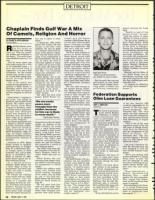
Rabbi Ben Romer:
"Death is one of the horrors of
war, whether it's yours or theirs:'
But the end of the war was
still painful, he says. Rabbi
Romer found himself recov-
ering pieces of bodies and
performing emergency
prayer services for Iraqi
dead.
"Death is one of the
horrors of war," he says.
"And the horror is there
whether it's yours or theirs.
The last army chaplain to
leave Saudi Arabia, Rabbi
Romer returned last month
to his base in Georgia.
Among his responsibilities
are counseling, and teaching
stress management and
marriage workshops. He
also works with commanders
on moral and ethical issues,
and in his rare free time
reads works of Abraham
Joshua Heschel, Mordechai
Kaplan and Hebrew Union
College Professor Lawrence
Hoffman.
Married and the father of
two, Rabbi Romer says he
anticipates working with
men returning from the Gulf
who face readjustment prob-
lems after war.
"A chaplain by definition
will always have business,"
he says.
❑
Federation Supports
Olim Loan Guarantees
AMY J. MEHLER
Staff Writer
T
he board of governors
of the Jewish Welfare
Federation of Detroit
voted unanimously last
week to participate in a
nationwide $900 million
loan guarantee program for
the resettlement of Soviet
Jews in Israel.
The loan guarantee plan,
which was adopted by more
than 100 communities at a
mini General Assembly of
the Council of Jewish Fed-
erations in Washington,
D.C, means that federations
around the country will use
their assets as collateral to
guarantee $1,000 loans —
plus accrued interest— by
Israeli banks to individual
Soviet Jews.
Immigrants will have 10
years to repay their loans
and are exempt from making
payments during the first
four years.
Detroit will back about
$40 million of the package
for Soviet immigrants in
Israel and would be liable for
that amount should every
Soviet Jew default on his or
her loan, according to Fed-
eration President Mark
Schlussel. But the risk, Mr.
Schlussel said, is minimal.
He's confident the loans will
be repaid and the JWF's re-
serve fund will remain sol-
vent.
"If one oleh defaults on his
or her loan, Detroit's JWF
would be responsible for 3.3
percent of the loan guar-
antee program," Mr.
Schlussel said. "But we're
really not that concerned.
This is more of a contingency
plan, and the event of every
oleh defaulting is highly
unlikely.
"This is one of the most
important events in the last
100 years of Jewish history
aside from the Holocaust
and the recognition of the
State of Israel," Mr.
Schlussel said. "The une-
quivocal support of Russian
olim is a risk Detroit can't
afford not to take."
Last year's Operation Ex-
odus, Mr. Schlussel said, was
only designed to fund the
first 185,000 Russian immi-
grants.
"We're now dealing with
another 800,000 to 1 million
Soviet Jews," he said. "It's
still not adequate to meet
the costs of resettling up to 1
million Soviet Jewish refu-
gees over the next three
years."
Three federations —
Boston, Cleveland and
Madison, Wisc. — voted
against the loan guarantee.
They argued that federa-
tions would be putting their
assets in jeopardy.
But according to the Coun-
cil of Jewish Federations,
more than 90 percent of past
loans to immigrants have
been repaid.
❑