

ISRAEL
High Noon
At The Israel Corral
There is a Wild West atmosphere in the
post-war Middle East, and Jerusalem's
gun shops are doing a brisk business.
INA FRIEDMAN
Special to The Jewish News
W
hatever optimism
may have wafted
through Israel at
the close of the Gulf war has
pretty much dissipated by
now and been replaced by a
sense of deja vu as the coun-
try was hit by a new wave of
Palestinian violence on both
sides of the Green Line.
In Israel proper the main
modus operandi has been
stabbings by individual Pa-
lestinians; in the West Bank
it has been firing at Israeli
settlers from ambushes laid
on deserted country roads.
The combination of the two
sent a ripple of near-hysteria
through Israel this week,
above all through the top
echelons of the government
and its security arms. As a
result, a Wild West at-
mosphere has invaded the
Middle East — with the
blessings of the government
and none other than Israel's
chief of police.
During the six weeks of
the Gulf war, the Palestin-
ians were closed up tight in
the territories and for the
most part inside their
homes. But almost as soon as
the curfew was lifted and
laborers began to trickle
back to work in Israel, the
violence resumed.
The first victim had his
throat cut in Jerusalem's
Old City before Israelis were
even allowed to dismantle
their sealed rooms. The
stabbing of four women in
Jerusalem a week later, one
day before the arrival of the
American secretary of state,
was dubbed "a message for
Baker."
Over this past week, hard-
ly a day has gone by without
a knifing somewhere in the
country, augmented by two
ambushes in the West Bank
(the first taking the life of a
30-year-old Jewish settler).
In the midst of the in-
tifada's fourth year, Israel's
police and army stand
relatively helpless against
Ina Friedman writes from
Jerusalem.
these acts of random and in-
dividual terror.
Blockades on the main
roads are meant to ensure
that only Palestinians with
permits to work in Israel
(granted after security
checks) can cross the Green
Line. But they have proven
highly ineffective — partly
because Israeli employers
prefer to flout the regula-
tions.
The resulting frustration
has spawned a list of sugges-
tions for tightening security
that range from increasing
the number of deportations
and sealing or destroying
houses (the army's prescrip-
tion throughout the intifada)
to closing Israel to all Pales-
tinians, regardless of the po-
litical and economic conse-
quences (the police).
The government has ac-
cepted neither approach as a
sure-fire solution. Instead, it
has sent defense minister
and minister of police back
"From now on
we're all sheriffs
with a license to kill
at our own
discretion. All this
stems from the fact
that the govern-
ment doesn't know
how to deal with the
Intifada."
— Yoel Marcus
to the drawing board to work
out a more promising pro-
gram over the Passover
holiday.
One sign of the general
chagrin is that on the polit-
ical level, the suggestions for
coping with the violence has
made for some strange
bedfellows.
Two prominent doves
(Labor's Chaim Ramon and
Shinui's Amnon Rubinstein)
have teamed up, so to speak,
with ultra-right-winger
Rehavam Ze'evi in ad-
vocating that the territories
be closed — though for very
different reasons.
The doves see it as the
start of a process that will
"gradually separate Israel
from the territories" — to
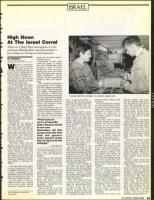
A young Israeli tries a handgun in a Jerusalem weapons store.
their mutual benefit —
whereas Mr. Ze'evi argued
before the Cabinet that "all
the workers from the ter-
ritories are potential
murderers."
The Right itself is simi-
larly divided between those
who back the army's pro-
posals, those who back the
police, and those who were
simply embarrassed by the
police minister's half-frantic
suggestion — which has
since been withdrawn —
that' all Palestinian bache-
lors up to the age of 30 be
summarily barred from
Israel. ("In the next stage
they'll bar the entry of red-
headed, bald, tall, short ;
lame and pot-bellied men,"
one columnist quipped.)
At the beginning of the
week, Geula Cohen of the
Tehiya Party (on the Likud's
right flank) complained that
punishments should be
meted out not only to Pales-
tinians who steal into. Israel
without work permits but to
their Israeli employers.
Indeed, in the middle of
the week the police began
arresting and interrogating
Israeli contractors whose Pa-
lestinian workers lacked
the proper papers, and some
were fined up to $900 for tri-
fling with the law.
But the biggest flap
resulted from statements
made by top-ranking police
officers. First the com-
mander of the Tel Aviv
district proposed that any
Arab spotted on a bus should
be marched straight to the
nearest police station and
turned in.
Since Palestinians belong
on work sites during the day,
and back in the territories at
night, any found on public
transport or simply on the
street, he implied, is
justifiably suspect of being
up to no good.
Then the chief of police
himself invited the 300,000
Israelis who hold weapons
licenses to tote their guns
and use them whenever they
deemed it necessary.
"Anyone who feels that his
life is in danger can and
must shoot to defend
himself' he said this week —
prompting a howl of dismay
from the press.
"From now on we're all
sheriffs with a license to kill
at our own discretion,"
wrote Ha'aretz columnist
Yoel Marcus, adding, "All
this blather (the variety of
measures broached for cop-
ing with the knifings) stems
from the regrettable fact
that the government doesn't
know how to deal with the
intifada."
The upsurge of sales in
Israel's weapons shops
seems to confirm that the
citizenry perceives the police
as being helpless, so that it's
every man for himself.
One store in Jerusalem is
doing a brisk business in
everything from handguns
(mostly for men) to mace
spray and "electric
shockers," the latest hit for
the ladies.
Thirty-four-year-old
Shlomo Gogek, who came
into the shop for target prac-
tice, has carried a gun for 10
years. But although he has
never yet drawn it, he be-
lieves that "every able-
bodied person should carry
one, too. If it will save one
person's life, it'll be worth
all the trouble."
Itzik Mizrachi, the shop's
owner, notes that sales first
._ at the start of the
picked up
Gulf crisis ("when the Pales-
tinians believed they were
going to take over the
place") and got their second
wind when it ended ("when
they realized they were
not").
"Everyone knows what
should be done," he snaps,
referring to the idea of
"transferring" the Arabs out
of Israel and the territories.
"But they hide behind all
kinds of qualms. There's no
prime minister in Israel.
There hasn't been one for
years now."
Others agree with that
assessment, but for the op-
posite reason.
"The undermining of do-
mestic security is the price
we have to pay for Yitzhak
Shamir's unwillingness to
negotiate concessions in the
territories," Mr. Marcus
wrote in his popular column
this week. "In the mean-
while, when every Yankel,
Itzik, and Yoske draws his
gun, we'd all better hit the
floor. They may be acting
with sanction," he con-
cludes, "but who knows
whether they can aim?" ❑
THE DETROIT JEWISH NEWS
33