

PASSOVER I
Handicapism.
It's Thinking
That People
With Disabilities
Are Different.
People with disa-
bilities are really like
the rest of us—diverse,
complex, each with
different strengths
and weaknesses,
likes and dislikes.
Sometimes they
may need more help
than you do. But they
always need a smile,
a hello, respect and
dignity. Just like you.
Treat every person
you meet like a
person. It's as simple
as that.
A Jewish Association for Residential Care
for persons with developmental disabilities
28366 Franklin Road Southfield, MI 48034 (313) 352-5272
COMPLIMENTS OF THE
Gees o .Maxwell House
Marvin Stoloff
And All The Gals At
KOSHER FOR PASSOVER
.."
hilsum
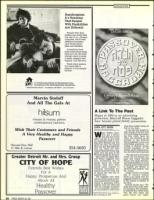
A Link To The Past
Begun in 1934 as an advertising
promotion, Maxwell House haggadot
have become prized family possessions.
misses & misses petites
contemporary fashions
CAROL COTT GROSS
Wish Their Customers and Friends
A Very Healthy and Happy
Passover
Harvard Row Mall
11 Mile & Lahser
354-4650
Greater Detroit Mr. and Mrs. Group
CITY OF HOPE
Extends Best Wishes
For A
Happy, Prosperous And
Above All
Healthy
Passover
36
FRIDAY, MARCH 29, 1991
113,M
CITY OF
H•O•P•E
Special to The Jewish News
W
hen Phyllis Horo-
witz got a divorce
last year, her in-laws
didn't ask her to give back
the Rosenthal china or ster-
ling silver flatware they had
given her when she married
their son. But they did insist
that she return the wine-
stained Maxwell House hag-
gadot that had been in the
Horowitz family for 40 years.
Since 1934, 33 million Max-
well House haggadot have
been distributed free of
charge across the United
States. They have been
mailed (upon request) to
American servicemen sta-
tioned around the world, and
to anyone else who has re-
quested them.
The haggadot have often
become prized family posses-
sions handed down from gen-
eration to generation. Early
editions, from the 1930s and
'40s are nostalgic reminders
of the immigrant experience,
Carol Cott Gross is a writer in
East Northport, N.Y.
when Jews couldn't always af-
ford to buy them.
It was the late Joseph Ja-
cobs, founder of the New York
City advertising and market-
ing firm which bears his
name, who dreamed up the
concept of the Maxwell
House haggadah to use as an
advertising promotion. Ac-
cording to Richard Jacobs,
current president of the
Joseph Jacobs Organization,
Inc., his father had a hard sell.
"The executives of General
Foods, the non-Jewish com-
pany that owned Maxwell
House, were quite reluctant,
and understandably so, to use
a Jewish prayer book written
in English and Hebrew to
advertise their product," says
Mr. Jacobs.
Joseph Jacobs was finally
able to convince General
Foods to go ahead with the
haggadah project by pointing
to the success of another of
his ideas.
Richard Jacobs says, "My
father knew that many East-
ern European Jews mistaken-
ly believed that coffee beans
were like lima beans and
green beans, not 'legal'