

CLASSIC
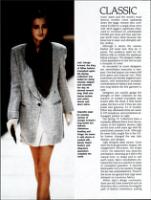
Left: Giorgio
Armani, the King
of Milan fashion,
triumphed again.
His Spring
Collection was
hailed for being
sensual, elegant
and wearable.
For day, he
showed several
long, fluid one-
button jackets
over pants,
shorts, and
short skirts.
Opposite page:
An evening
version of
Giorgio Armani's
long jacket has
delicate
rhinestone
beading and
fringe. He teams
it with shorts in
washed silk.
Barely tinted
hosiery and
sling-back
spectators
complete the
outfit.
music starts and the world's most
famous models come sashaying
down the stage, women who com-
mand $3,000 for a single show. Jerry
Hall, Mick Jagger's significant other,
used to command an unbelievable
$10,000 per show and they said she
was worth every dime because she
knew how to wear, and ultimately sell,
the clothes.
Although it seems the camera
flashes will never end, they do. A
pause. The audience waits for the
fashion elite to initiate the applause
before joining in. The designer makes
a final appearance to bow and accept
a bouquet of roses.
As successful as some designers
are, nevertheless insecurity is ram-
pant. One bad season can mean a fall
from grace and financial ruin. Their
businesses are literally wagered each
season, with tremendous monetary
commitments for fabrics and contrac-
tors long before the first garment is
sold.
Designers can quickly gauge the
strength of their collection by the
reaction of trusted journalists and
buyers after the show. If they lavish
praise, the line is a hit; if they are only
polite and gracious, it's in trouble.
Either way, afterwards there are usual-
ly VIP receptions, and sometimes ex-
travagant parties at night.
The Spring '91 Collections have a
markedly different flavor from the ex-
cesses of the Eighties. Romeo Gigli
set the tone a few years ago with his
pared-down peasant look. Although
he never fully caught fire in the U.S.,
he forever changed the way Italy
dresses, and designs.
Gigli stripped away excess. Gone
were the bold geometric shapes, the
exaggerated silhouettes, the bright
colors. His statement was distinctly
anti-fashion, returning as it did to the
natural form, to drape and to soft
earth tones. Italy's trendsetters em-
braced the look as a reaction to years
of overstated grandeur. It became
fashionable not to be opulent, though
the key was understatement. Those in
the know recognized that Gigli never
skimped on luxurious fabrics.
Within Italy's design community,
there are still a few mavericks such as
Moschino who continues his singular
path of fashion irreverency: poking