

EDUCATION
F GUS
she said, when often these
children simply require more
time to process information
and formulate an answer.
"They need special teachers
who understand that these
children have to be unlocked."
Another issue that many
feel has contributed to
P'tach's troubles is the confu-
sion over its identity. "By be-
ing where we are, we are
aligned with the right-wing
Orthodox community," said
Michael Hochheiser, one of
P'tach's founding parents and
former chairman. Because
many people think that
P'tach is actually part of
Yeshiva Beth Yehudah, they
presume their contributions
to the Yeshiva automatically
extend to P'tach, which is
untrue.
Although it is housed
within the Yeshiva, P'tach
operates independently, with
its own administration, ad-
mission process and tuition
structure.
Educationally, the two
schools function as a
"seamless web," with P'tach
students attending both
special education and regular
yeshiva classes. Teachers
from both schools work
together to coordinate each
student's curriculum and
educational goals. It is in the
area of finances that the web
begins to show its seams.
Quality special education
does not come cheaply, and
P'tach is no exception. Tui-
tion averages $1,000 for every
academic hour spent in the
P'tach program. Theoretical-
ly, one child's tuition could
run as much as $5,000 per
academic year, although most
children spend an average of
two or three hours a day in
P'tach classes.
P'tach tuition is paid in ad-
dition to the tuition for
Yeshiva Beth Yehudah, with
no deduction of Yeshiva fees
for the hours children spend
in P'tach classes.
"I think that's a flaw in our
system," said Dr. Rosenfeld,
explaining that this places in-
creased hardship on parents
who are already dealing with
46
FRIDAY, MARCH 22, 1991
the problems of having a lear-
ning disabled child. And,
since learning disabilities
often run in families, it is not
uncommon for a family to
have more than one child in
P'tach, adding even more
financial pressure.
Tuition subsidies are
available according to need.
Of the 25 students currently
enrolled in P'tach, only three
pay full tuition.
P'tach has a budget of just
over $100,000. Some $20,000
of this total comes from tui-
tion payments, $35,000 from
the annual fundraising din-
ner, approximately $5,000 is
raised by a yearly raffle, and
between $30,000 and $40,000
is privately donated. A few
small fundraising events com-
prise the rest of the budget.
Future plans include apply-
ing for funding from the
Jewish Welfare Federation.
When P'tach applied several
years ago, however, the re-
quest was turned down.
According to Mr. Hoch-
heiser, Federation funding
was denied because the
community base of P'tach
was not broad. Ironically, if
P'tach had received the re-
quested funding, he said, it
would have expanded to day
schools throughout the
Detroit Jewish community.
Larry Ziffer, director of
planning for the Federation,
says, "One of our dilemmas is
that a new beneficiary means
a smaller slice of the pie for
our existing family." He says
there could be heightened
receptivity to P'tach since the
Federation's Task Force on
Services for Persons with
Disabilities recently com-
pleted its three-year study.
The task force, however, em-
phasized reallocating existing
dollars rather than dis-
tributing new funds.
Some parents, like past
president Tzvi Burstyn,
believe P'tach is better off
without Federation funding.
"When you're independent,
you try harder," he says. "I
think P'tach can be successful
without Federation. I hope
I'm right."
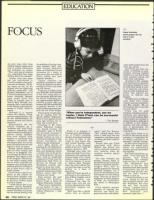
Yossie Hochheiser
studies prayers with the
help of a tape
recording.
"When you're independent, you try
harder. I think P'tach can be successful
without Federation:'
—
P'tach is no stranger to
financial woes. Ada Moseson,
one of P'tach's founding
parents, remembers knocking
on doors at night in the
winter to raise money. She
said several founders each
"threw in a few thousand
dollars of our own" to get the
program started in 1979.
Although more than 100
people attended P'tach's first
community-wide meeting, the
program began with a single
student in the basement of
one of its teachers. It moved
to Yeshiva Beth Yehudah
when the school offered free
rent and free reign to use the
facility as a base of
operations.
Much of P'tach's growth is
attributed to the untiring ef-
forts of Betty Josephs, one of
P'tach's founders, who
volunteered her time for
several years until she was
hired as administrator of the
educational program two
years ago.
"She's more like a Jewish
mother than an adminis-
Tzvi Burstyn
trator," said Tzvi Burstyn.
"She worked many more
hours a week than she was
supposed to, and when money
was short, she didn't cash her
paycheck."
Several years ago, P'tach
negotiated with Akiva
Hebrew Day School, but
Akiva eventually started its
own resource room for
students needing special
education.
The other Orthodox day
schools, Darchei Torah in
Southfield and the Lubavitch
Cheder in Oak Park and Far-
mington Hills, have no
specific programs for learning
disabled students, but a
future P'tach affiliation with
both schools is in the talking
stage. There are no plans to
implement a P'tach program
at Hillel, the Conservative
day school in Farmington
Hills.
P'tach regularly sponsors
seminars on learning dis-
abilities, and these pro-
grams have been well attend-
ed by staff members from the
other day schools.
And P'tach has been suc-
cessful in fulfilling its goal:
teaching learning disabled
children in a way that brings
them academic success and
raises their self-esteem.
According to Mrs. Josephs,
each child is given a specializ-
ed program designed to meet
his individual needs. A varie-
ty of materials and techni-
ques are used, including com-
puters with software pro-
grams in Hebrew and
English.
"Children learn in different
ways. Some learn better
visually and some auditorily,"
says Mrs. Josephs. "We use
the modality that works best
for each child."
P'tach has 12 staff
members, including teachers,
assistants and administra-
tors, for its 25 students. Most
of the teachers are certified in
special education, although it
is difficult to find Hebrew
teachers with this certifica-
tion. A psychologist, Dr.
Debora Rothbart, serves as a
consultant.
"Each child comes in (to
P'tach) for the amount of time
necessary to compensate for
his deficits and build on his
strengths," said Mrs. Josephs.
An after-school program for
children who attend public
school was implemented
recently, but only one student
has enrolled.
But P'tach has had its suc-
cesses. "I can only sing its
praises," said Bracha
Hochheiser. "It's certainly
made my life a lot easier."
Mrs. Hochheiser still
marvels at the way Yudi
learned to read. After months
of frustration, she and her
husband were at their wits'
end, but Yudi's teachers
refused to give up.
"I always had books in the
house, waiting for the day
when it finally clicked," said
Mrs. Hochheiser. But when
she saw Yudi actually
reading, "I stopped dead in
my tracks. All my prayers for
Rosh Hashanah were
answered right then." ❑