
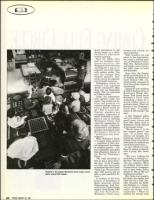

Students in the popular Workmen's Circle nursery school
gather around their teacher.
26
FRIDAY, MARCH 22, 1991
grant population to the
Jewish people as a whole.
Children's education
became a priority.
Since the 1960s, when
half its members were
American-born, the
Workmen's Circle has been
searching for a way to in-
corporate old world values
with modern reality. Not
only are younger Jews
English speakers, they
rarely turn to the organiza-
tion for health insurance.
Immigrants receive as-
sistance from organized
Jewish communities. Most
Jews now are financially
stable. Few are interested
in Yiddish culture.
Today, the organization
still operates under the
motto, "Let us help one an-
other and preserve our
cultural heritage while we
build a better world for
all." But it is not anti-
Zionist; members are
outspoken supporters of
Israel. Socialism no longer
plays a role in defining
Workmen's Circle. And
while the organization re-
mains secular, it has both
Conservative and Reform
members and leaders insist
Workmen's Circle is
"definitely not anti-
religious."
What Workmen's Circle
is is a place where all Jews
— regardless of their Jew-
ish background, knowledge
or religious practice — can
feel comfortable, says Ellen
Bates-Brackett, director of
the Detroit Workmen's
Circle.
"We want everybody to
feel he has a place here,"
she says. "A lot of people
out there may have given
up because they don't know
where to go. We may not be
their total answer, but we
offer a good possibility for
them."
A member of the Con-
ference of Presidents of
Major American Jewish
Organizations, with divi-
sions for the United Jewish
Appeal, Israel Bonds, ORT
and the Histadrut,
Workmen's Circle mem-
bership and schools are
open to gentiles.
Older members are still
active in the organization,
but youth is making head-
way at Workman's Circle.
Both Mrs. Bates-Brackett
and Sunday school director
Jan Adler came on board
last September.
Since then, the Sunday
school increased from 27 to
31 children and Workmen's
Circle Branch 1088, com-
prised mostly of parents in
their 30s and 40s, tripled in
membership.
Among the new members
of 1088 is Barbara Green of
Huntington Woods. Mrs.
Green first heard about
Workmen's Circle while
researching a paper for a
Jewish studies course in
graduate school. When she
learned of the Workmen's
Circle here, "I couldn't
believe it still existed," she
says.
A New England native
and the mother of two
small sons, Aaron and
Paul, Mrs. Green came to
Workmen's Circle because
of the nursery school.
"Hands down it is the
best nursery school," she
says. "It is better than
anyone can imagine. It's
nurturing, caring, the kind
of place many of us wish we
could send our children the
rest of their school days."
It also offered her chil-
dren the chance to identify
with a group, Mrs. Green
says.
"We were looking for
something to belong to,"
she says. "We have friends
who are religious. When
our children went to their
(Conservative) synagogue
and to their home, Aaron
seemed to like it. He was
seeking more of that."
Mrs. Green was raised by
her father; her mother died
when she was a child. Jew-
ishly educated, her father
sent Barbara to a Conser-
vative Sunday school,
which she found "very
unpleasant." When he
studied his Jewish texts